


Alkaline Diet Explained & Your Plan to Make It Easy
The alkaline diet in a nutshell: build about 80% of what you eat and drink around alkaline-forming foods – leafy greens, vegetables, healthy fats, nuts and seeds, and low-sugar fruits like lemons and avocado – and keep acid-forming foods like sugar, processed food, dairy, meat, alcohol and caffeine to about 20%. The goal is NOT to make your body more alkaline. It’s to give your body the tools it needs to effortlessly maintain its blood pH, instead of constantly buffering an acidic diet.
Hey, I’m Ross. I’ve been teaching and coaching the alkaline diet since 2004, I’ve written two bestselling books on it for Hay House (The Alkaline Reset Cleanse and The Alkaline Life), and I absolutely love helping people to get to the health of their dreams, the health they deserve AND make it as easy and enjoyable as possible.
Now, I don’t know you personally (yet), but if you’re anything like me when it comes to your health:
- You’re sick and tired of conflicting information
- Fed up with everything seeming so complex and impossible to stick to
- You don’t have hours and hours to spend crafting in the kitchen – you need things to be quick and easy
- You don’t want to keep having to wonder ‘what’s for dinner’ (or breakfast…lunch…or snacks)
- And you’re not prepared to give up everything and be ‘perfect’ or ‘on a diet’ for the rest of your life
I’m here to tell you now that isn’t how it needs to be! In the 22+ years I’ve been doing this, I’ve taught tens of thousands of people how to live the alkaline diet AND find it easy and fun, AND not have to give up everything, AND still have treats, nights out and an enjoyable social life, all while reaching their health goals.
My coaching is always founded on the principles already proven in the literature (the studies are all below), AND it’s super intuitive and common sense. I love it. So let’s get into it!

What is the alkaline diet?
It’s an approach to health that focuses the majority of your foods and drinks on those that have an alkaline-forming effect on your body (put simply, alkaline foods), while limiting those that have an acid-forming effect on the body (note the word forming – it’s important, and we’ll get onto why in a minute).
It is as simple as that – eat mostly alkaline-forming foods, and don’t eat too many acid-forming foods. Don’t get bogged down in the detail, don’t strive too much for perfection, go easy on yourself, and take it one step, and one day, at a time. It’s actually less of an alkaline diet and more of a lifestyle – the Alkaline Lifestyle, if you will.
Most people misunderstand the alkaline diet, so I made this video to clear it up properly – what it really is, what it really does, and why so many people feel better eating this way:
How the alkaline diet works: your blood pH and the “safe zone”
To keep this simple and not too science-y (the references are all below if you want to explore the science too): your body HAS to keep your blood at a slightly alkaline pH of 7.365, within a very tight range of about 7.35 to 7.45. Nobody disagrees with this – it’s an accepted truth in the scientific community.
If your blood pH drops below this level, your kidneys shut down and you die, pretty quickly. So your body will do whatever it takes to maintain this balance – even if, long term, the way it does it slowly damages your health.
And here’s where the problem of an acid-forming diet comes in. To neutralise all that acidity, your body calls in its lines of defence: its small built-in buffers first, then your lungs (breathing off more carbon dioxide) and your kidneys (working overtime to clear the acid), and finally the alkaline minerals, like calcium and magnesium, that it borrows from your bones and muscles. Do that every day, meal after meal, and it’s hugely stressful. It puts your body in a constant state of emergency.
The “safe zone”: diet-induced acidosis
Here’s the part most people never hear about. Raising your blood pH all the way back to the ideal 7.365 is so stressful that your body doesn’t quite get it there. It just gets you to a level that is “safe”, hovering a little below the optimal – safe from immediately dying, but you don’t want to live there.
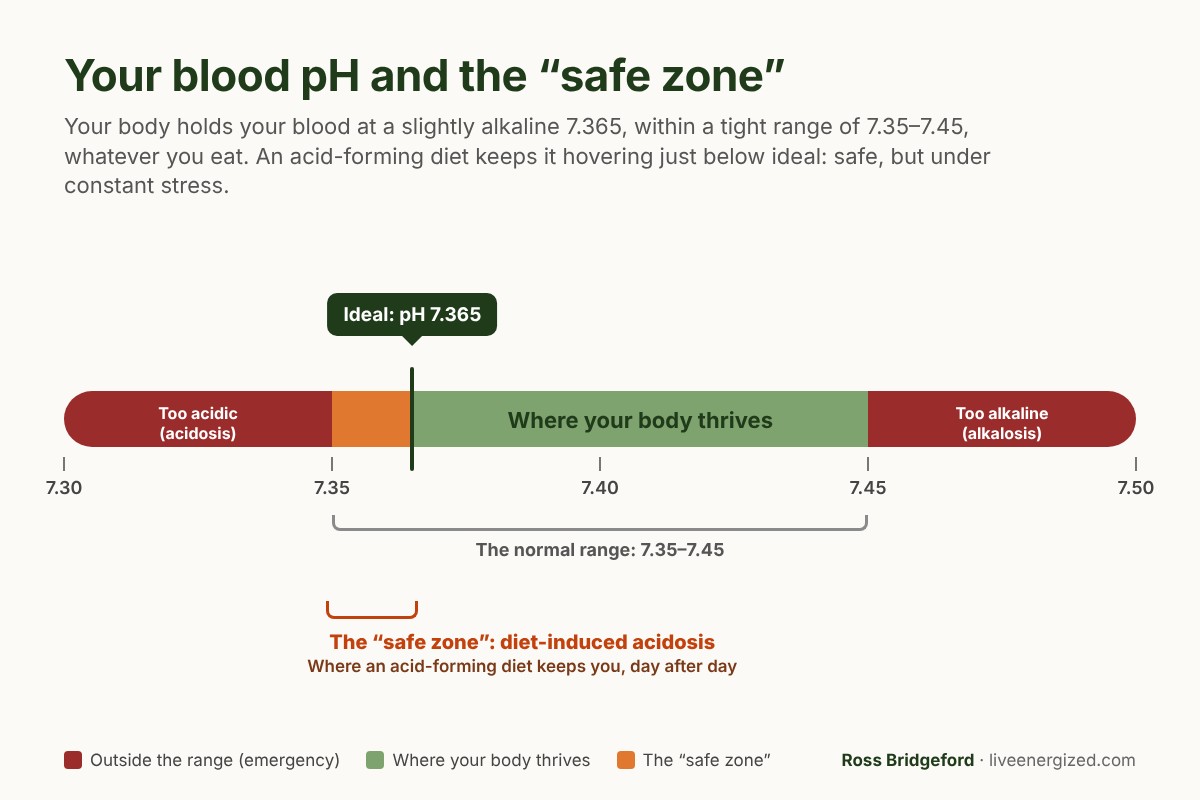
In the research this is called diet-induced acidosis, or low-grade metabolic acidosis: a slight drop in blood pH that stays inside the normal range, sitting close to its lower limit (Carnauba 2017). It isn’t the dramatic kind of acidosis you’d end up in hospital with, which is exactly why it gets overlooked. But one major review concluded there’s a compelling case that diet-induced acidosis is real and has a significant long-term effect on health (Pizzorno 2010), and another describes the Western diet as creating a lifelong, overlooked state of it (Adeva and Souto 2011).
And this is where most people are living, all day, every day. They wake up still processing the acidity from the night before, then their breakfast of toast, coffee, processed meats and juice drives it lower, and it keeps building through the day. There’s no respite.
The knock-on effects: cortisol, your adrenals and blood sugar
The damage of living in the safe zone doesn’t stop at your kidneys. For each imbalance there’s a flow-on effect, and a great example is cortisol, your main stress hormone.
When researchers took a typical Western diet and neutralised its acid load, cortisol came down. They concluded that an acid-forming Western diet goes hand in hand with mild metabolic acidosis and a state of cortisol excess (Maurer 2003). And even in 200 healthy children, eating perfectly normal diets, those with the higher acid loads were producing more cortisol (Esche 2016).
Chronically raised cortisol is like living in fight-or-flight mode around the clock. Your adrenals are constantly pumping it out, and over time it’s linked with holding on to fat (especially around the middle), poorer sleep, blood sugar problems and low mood, and it throws out other hormones too, including your thyroid. Then it feeds back into itself. It’s a vicious cycle.
And it isn’t just cortisol. Researchers have shown that even the slightest degree of metabolic acidosis causes insulin resistance in healthy people (Souto 2011), one of the first steps towards weight gain and type 2 diabetes.

The CORE TRUTH of the alkaline diet (that so many people misunderstand – see my rant on the five things the media needs to know about the alkaline diet):
The goal is NOT to make your body ‘more alkaline’. The goal of an alkaline diet plan is to give your body all of the tools it needs so it can effortlessly MAINTAIN your blood pH at 7.365.
Read that again – it’s essential you fully understand this. We’re not trying to change your pH. We’re eating more of the foods and drinks that let your body maintain it stress-free, and LESS of the foods that are acid-forming and cause it stress. Make sense? You with me so far?
I go through exactly why in this short video:
The Triple-A: alkaline, antioxidant-rich, anti-inflammatory
In study after study, three things come up over and over: acidity, inflammation and oxidative stress. They’re interlinked, they feed each other, and they sit behind so many of the health challenges people come to me with – from weight gain, fatigue and digestive issues to joint pain and the big chronic diseases.
That’s why the way I teach the alkaline diet is what I call the Triple-A, which I go deep on in The Alkaline Life:
Alkaline
Mineral-rich, alkaline-forming foods that lower the acid load your body has to buffer.
Antioxidant-rich
To counter oxidative stress, the “rusting” of the body that rises in diet-induced acidosis.
Anti-inflammatory
To calm the chronic, low-grade inflammation that an acid-forming diet throws fuel on.
The Triple-A foods
Leafy greens, vegetables, healthy fats, nuts and seeds, turmeric and ginger. They tick all three.
And here’s the beautiful thing: it’s the same foods that do all three. Leafy greens, vegetables, healthy fats, herbs and spices like turmeric and ginger are alkaline-forming, antioxidant-rich and anti-inflammatory all at once. So when you focus on them, you’re tackling all three together.
Alkaline diet foods: what to eat more of, and what to keep to your 20%
This is REALLY intuitive, all except for a few random foods (I’ll cover them below). In fact, if I asked you to sort a list of common foods into alkaline and acidic, I bet you’d get about 90% of them right.
We’re building 70–80% of your plate around fresh, natural, whole foods, and keeping the acid-forming foods to the other 20–30%:
| Eat plenty of these | Examples |
|---|---|
| Leafy greens | Spinach, kale, Swiss chard, rocket, watercress, beet greens, lettuce |
| Vegetables | Cucumber, celery, broccoli, bell peppers, beetroot, carrots, tomatoes, asparagus |
| Avocado, herbs and spices | Avocado, garlic, fresh turmeric, ginger, parsley, basil, coriander |
| Healthy fats | Olive oil, flaxseed oil, coconut oil, avocado oil, oily fish |
| Nuts and seeds | Almonds, macadamias, chia, flax, pumpkin seeds (alkaline nuts guide) |
| Legumes and grains | Lentils, chickpeas, quinoa, buckwheat |
| Low-sugar fruit | Lemons, limes, grapefruit, berries (alkaline fruits guide) |
| Drinks | Water, herbal teas, green juices and smoothies |
| Keep to your 20% | Examples |
|---|---|
| Sugar and sweets | All sugar (including syrups), sweets, chocolate, pastries, cakes, biscuits |
| Processed and fast food | Takeaways, chips, crisps, deep-fried food, microwave meals, processed meats (especially bacon) |
| Dairy | Some dairy is OK: kefir is the best choice, then butter. Keep milk and cheese occasional, and try to avoid ice cream |
| Meat and eggs | Fine in your 20%, alongside plenty of greens (alkaline protein sources) |
| Bread, pasta and gluten grains | Wheat, spelt, white bread, pasta, baked goods |
| Alcohol and caffeine | Coffee, black tea, energy drinks, alcohol |
| High-sugar and dried fruit | Bananas, mangoes, grapes, dried fruit, fruit juice (why bananas are acidic) |
| Peanuts and mushrooms | Peanuts and peanut butter (mould toxins), mushrooms (a fungus) |
For the ratings of every food, here’s my full alkaline foods list (195 foods rated), plus the 15 most alkaline foods and the most acidic foods to cut first.
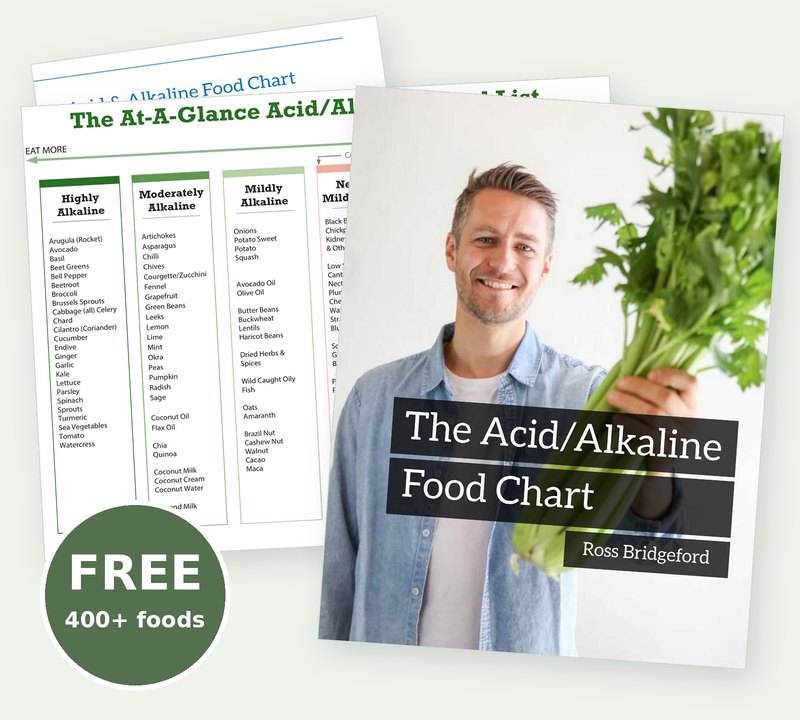
Free download
Your alkaline diet plan and chart, on one page
My free chart rates 400+ foods from Highly Alkaline to Highly Acidic, with a one-page version for your fridge, so you always know what to reach for.
It’s free. Just tell me where to send it.
Your alkaline diet plan: start with the 20/80 actions
So, if the alkaline diet is as simple as eat mostly alkaline-forming foods and avoid mostly acidic foods, we could stop the guide here, right? Well, almost. Not quite! The hard part isn’t knowing what to eat. It’s HOW to make it easy and delicious, so it sticks.
The concept of Pareto’s Principle, often known as the 80/20 rule, is absolutely core to the way I coach, and it gets amazing results over and over again. 80% of your desired health result will come from just 20% of the actions you take. So many people make the mistake of trying to be 100% perfect from day one – and it’s just too much. In my experience, those who try to be perfect from day one are usually back to square one within 48 hours.
For most people, that powerful 20% falls into four core actions:
The four core actions
- Get properly hydrated. Build up to around 3–4 litres a day of clean, filtered water and herbal teas, slowly, linking a glass to things you already do (how to get properly hydrated, and how to make alkaline water at home).
- Go green. Aim for 5–7 serves of leafy greens a day. The easiest wins: a side salad with every meal, and a green juice or smoothie in the morning.
- Get an abundance of healthy fats. Omega-3s from oily fish, flax, chia, walnuts and hemp, plus a good omega-3 supplement as your safety net. Dress that side salad with flax or olive oil and you’ve ticked two boxes.
- Add the anti-inflammatories. Fresh turmeric and ginger every day, about a centimetre of each – grated into salads and stir fries, or in a turmeric and ginger latte or tea first thing in the morning.
Pick ONE thing. Turn it into a habit, then add the next. You don’t have to do it all at once.
And notice there’s nothing on that list about cutting things out. That’s my “crowd out the bad” approach: focus only on adding the good stuff in. The more you do the good stuff, the more you naturally want to do more of it, and the less space there is for the bad stuff. No restricting, no willpower battles.
Remember (and people do tend to forget this) – you are on the same team as your body. All your body wants is for you to give it the tools to thrive, the tools to do its job. When you do this, you’re going to see a HUGE lift in your health and energy.
How to make it a habit
The trick to making these stick is to make each new habit: clear (build it into your day so you can’t miss it, like a glass of water every time you clean your teeth), enjoyable (if you don’t like it, you won’t keep doing it), simple (wash and prep your greens when you get home from the shops) and rewarded (tick it off on the fridge, and treat yourself when you hit the week). If you can tick two of those boxes, you’re SO much more likely to make it stick.
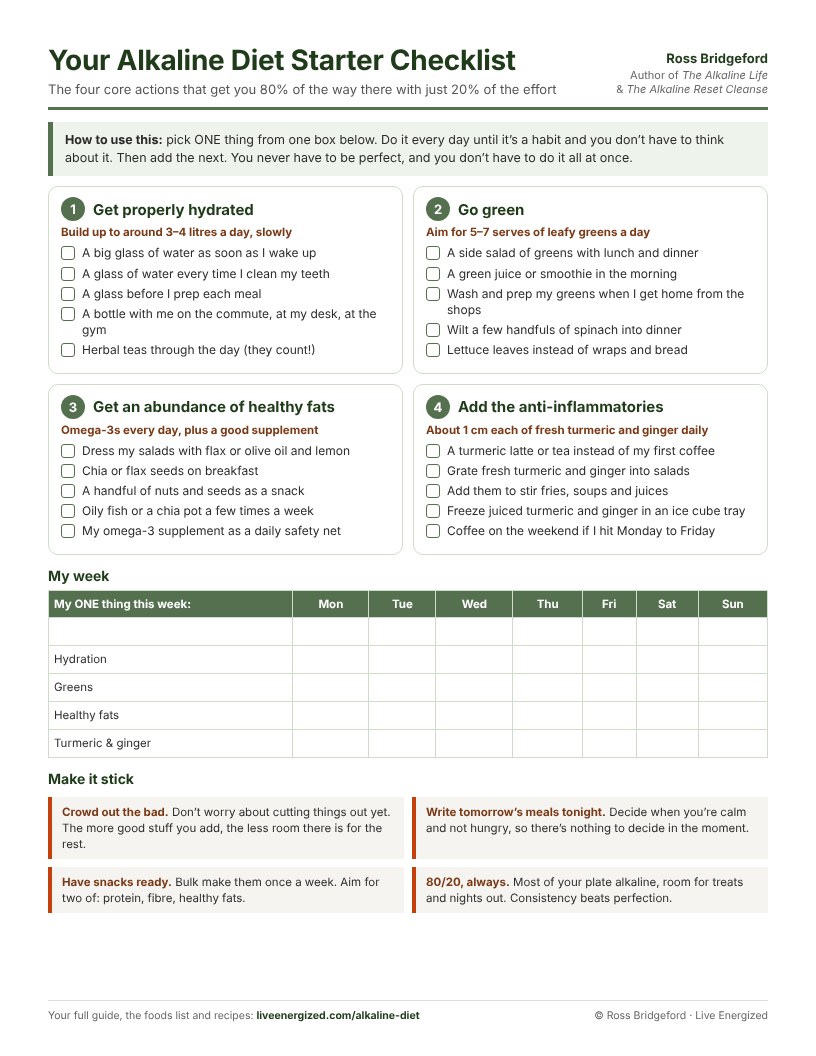
Free printable
Your Alkaline Diet Starter Checklist
The four core actions on one page, with simple ideas for each and a weekly tracker. Print it, pop it on the fridge and tick off your ONE thing every day.
Download the checklist (PDF) →
No sign-up needed.
A sample alkaline day
When people first grab my food chart, they get it. They understand the alkaline foods vs the acidic foods… BUT then they ask “but what am I going to eat?!”. At first glance it can look like a lot of salads and veggies. It really isn’t. Here’s what an easy alkaline day can look like:

Breakfast
A turmeric latte or lemon water, then a green smoothie or a quick quinoa, spinach and asparagus stir fry, or one of these 9 alkaline breakfasts

Lunch
My alkaline power bowl of greens, roast vegetables, avocado and quinoa, or lettuce-leaf wraps with hummus
Snack
Blueberries with chia seeds and walnuts, a chia pot, or one of these portable alkaline snacks

Dinner
My spiced lentil soup, or a family favourite made more alkaline (below), always with a side salad
The trick: make your family favourites more alkaline
When it comes to making alkaline-friendly meals, don’t try to start from scratch, staring blankly at your list of alkaline foods or a fridge full of raw ingredients. The trick is to take your existing family favourites and make tweaks to make THEM more alkaline! Yep, we’re sneakily putting the family on an alkaline diet too. A good example is spaghetti bolognese:
- Instead of regular pasta, use gluten-free pasta
- Instead of it being 80% meat, make it 25% meat and make the sauce the star of the show
- Instead of a store-bought, sugar-laden jar of sauce, make your own – just blend together tomatoes, onion, garlic, bell pepper, carrot, celery and basil and warm it through. It takes 5 minutes and is a huge hit of alkalinity
- Serve with way less pasta, and way more sauce
- Serve with a side salad of mixed greens, dressed with flax or olive oil and lemon, instead of garlic bread
Make sense? You’re still making a meal that’s quick and easy, that your whole family will love (nothing worse than cooking one meal for you and one for them), but it’s now alkaline, fresh, delicious and kid-friendly too.
One more tip that works like magic: write tomorrow’s meals down the night before. When you’re relaxed and not hungry, decide breakfast, lunch, dinner and snacks. Then when the moment comes, with the kids going crazy and the clock ticking, the decision has already been made.
My number one tip: be ready for the hunger pang
The moment most people slip up isn’t at a meal. It’s when the hunger pang hits, you’re out of the house and there’s nothing quick and easy to grab, and convenience food is almost always acidic, sugary and processed. The antidote is to have delicious, portable alkaline snacks ready to go. Bulk make a batch once a week, and aim for at least two of the satiation equation: protein, fibre and healthy fats. Here are my portable alkaline snacks, and I explain why it works (and why it’s not about willpower) in this quick video:
Alkaline diet myths vs facts
Most of the criticism you’ll read about the alkaline diet is aimed at a version of it that I don’t teach. Here’s what’s actually true:
| Myth | Fact |
|---|---|
| The alkaline diet is about making your blood more alkaline. | It’s about supporting your body to MAINTAIN its blood pH at 7.365, without the stress of constantly buffering an acid-forming diet. |
| Food can’t affect your acid–base balance, so it’s pointless. | Food changes your dietary acid load – how much acid your body has to buffer and your kidneys have to clear – and researchers measure it (it’s called PRAL). Here’s how it works. |
| Lemons and tomatoes are acidic, so they’re off the menu. | They’re acidic in your mouth, but alkaline-forming in your body, because their alkaline minerals far outweigh their acid. |
| Your stomach is acidic anyway, so it doesn’t matter what you eat. | Your stomach makes acid to digest your food, and every time it does, it also sends bicarbonate into your blood. Then, as your food leaves the stomach, your pancreas releases alkaline bicarbonate juice to neutralise it before it moves into your small intestine. So digestion is its own acid–alkaline balancing act, and your dietary acid load is what’s left for your body to buffer once it’s done. That’s what eating alkaline changes. |
| There’s no evidence it works. | Large studies of hundreds of thousands of people link the most acid-forming diets with type 2 diabetes, some cancers, heart disease, kidney failure and obesity (see the research below). |
| You have to go vegan and give up everything. | It’s 80/20. Fish, meat, eggs and your favourite treats all fit in your 20%. |
| Drinking alkaline water is all you need. | Water is the easy part. What you eat is where the biggest change happens (here’s how to make alkaline water at home). |
Does the alkaline diet work? What the research says
Now, this is the bit I get really excited about. Remember, eating alkaline is NOT about changing your blood pH. It’s about your dietary acid load – how much acid your diet leaves your body to buffer and clear every single day (I explain how it’s measured in why alkaline food lists are different).
There’s now a big body of research on it, and the message keeps coming back the same: the more acid-forming the diet, the higher the risk of the chronic diseases we’re all trying to avoid. Here are some of the strongest studies.
The most acid-forming diets, compared with the least
Tap a number to see the study. These are large population studies, so they show a strong link rather than proving cause.
The alkaline diet and weight loss
This is the one I get asked about most, so let’s start here. In a 2020 trial, 22 sedentary women did the same eight weeks of step aerobics on either an alkaline or an acidic diet – and it was the alkaline group that lost more weight and more body fat. A 2024 trial found the same pattern: eight weeks of an alkaline diet plan plus aerobic exercise cut BMI by 5.2%, with triglycerides down 37.6% and LDL cholesterol down 20.2%. They’re small trials, but they point exactly the right way.
The bigger population studies back this up. A 2019 review of 32 studies linked more acid-forming diets with higher rates of obesity and higher triglycerides. In 306 women in Tehran, those with the highest dietary acid load had more than twice the odds of obesity, and of carrying weight around the middle. And in 2,689 women in the TwinsUK study, the most alkaline diets went with more muscle mass – which is exactly what you want to hold on to while you lose fat, especially as we get older.
The alkaline diet and type 2 diabetes
In a Harvard-led analysis of three big US cohorts, covering more than 187,000 adults, people eating the most acid-forming diets had a 29% higher risk of type 2 diabetes. And in 66,485 French women followed for 14 years, those in the top quarter for acid load had a 56% higher risk. And in a randomised trial of 81 people with type 2 diabetes, drinking 2 litres a day of alkaline (ionized) water for 8 weeks lowered blood markers of oxidative stress and inflammation, and combined with a daily walk it worked even better (Rias 2020).
The alkaline diet and cancer
In the Sister Study of 43,570 women, the most acid-forming diets were linked with a 21% higher risk of invasive breast cancer, and more than double the risk of triple-negative breast cancer. In 95,708 US adults, the highest dietary acid load went with a 73% higher risk of pancreatic cancer.
Smaller case-control studies point the same way. People with the most acid-forming diets had 2.3 times the odds of colorectal cancer in a Korean study, and in studies from Uruguay, between 1.7 and 2.5 times the odds of oesophageal, bladder and breast cancer.
And pooling the studies together, a 2022 meta-analysis found the most acid-forming diets were linked with a 58% higher risk of cancer, and a 53% higher risk of a poorer outcome for people who already had cancer (Wang 2022).
The alkaline diet and heart health
In a Japanese study of more than 92,000 adults followed for almost 17 years, the most acid-forming diets were linked with 16% more deaths from cardiovascular disease (and 13% more deaths overall). In 6,788 German adults, those in the top third for acid load had 1.45 times the odds of high blood pressure, and a 2019 review of 14 studies and more than 306,000 people also linked a higher dietary acid load with high blood pressure.
The alkaline diet and kidney health
Among 1,486 US adults with kidney disease, followed for a median of 14 years, those eating the most acid-forming diets were about three times more likely to develop kidney failure. And in a trial of people with stage 4 kidney disease, adding fruit and vegetables corrected acid build-up and reduced markers of kidney injury about as well as bicarbonate tablets. (If you have kidney disease, check with your doctor before eating more potassium-rich foods.)
The alkaline diet and acid reflux
In a 2017 study of 184 people with throat reflux, 62.6% of those on alkaline water and a 90% plant-based, Mediterranean-style diet improved meaningfully, against 54.1% on reflux medication. In the lab, pH 8.8 alkaline water also switched off pepsin, the enzyme behind reflux damage (Koufman and Johnston, 2012). My alkaline diet for acid reflux puts it into practice.
What it all adds up to
These are mostly large population studies, so on their own they show a strong link rather than proving cause. But when study after study, across different countries and hundreds of thousands of people, points the same way – and the trials and the mechanisms (the safe zone, cortisol, insulin resistance) line up with it – I think that’s well worth acting on.
And here’s the best bit: an alkaline plate is mostly vegetables, with healthy fats, nuts, seeds and beans, which mainstream nutrition advice already backs. You’ve got nothing to lose and so much to gain.
Alkaline diet FAQ
What is the alkaline diet?
The alkaline diet is a way of eating where most of your food (about 80%) comes from alkaline-forming foods like leafy greens, vegetables, healthy fats, nuts and seeds, and only a little (about 20%) from acid-forming foods like sugar, processed food, dairy, meat, alcohol and caffeine. The goal isn’t to make your body more alkaline. It’s to give your body the tools to maintain its blood pH without the stress of buffering an acidic diet every day.
What is an example of an alkaline diet plan?
A green smoothie or a quick quinoa and greens stir fry for breakfast, a big salad or power bowl for lunch, a handful of almonds or a chia pot as a snack, and a lentil soup or a family favourite made more alkaline for dinner, always with a side salad. Plenty of water and herbal teas through the day, and a turmeric latte instead of a coffee.
What are the 10 most alkaline foods?
Beet greens, spinach, avocado, Swiss chard, kale, rocket, collard greens, watercress, carrots and beetroot. All ten are Highly Alkaline. Here’s my full list of 195 alkaline foods.
What is the easiest way to alkalize your body?
You don’t need to (and can’t) make your body more alkaline. The easiest way to support it is to get properly hydrated, add a side salad of leafy greens to every meal, get some healthy fats and fresh turmeric or ginger in each day, and crowd out the most acidic foods. Start with just one of those.
Does the alkaline diet work?
Yes. You can’t change your blood pH with food, and that’s not the point. What you can change is your dietary acid load, and large studies of hundreds of thousands of people link the most acid-forming diets with higher rates of type 2 diabetes, some cancers, heart disease, kidney failure and obesity. Small trials have also found more weight and fat loss on an alkaline diet with exercise.
Can you lose weight on the alkaline diet?
Yes. In two small eight-week trials, women eating an alkaline diet alongside regular exercise lost more weight and body fat, and larger studies link acid-forming diets with higher rates of obesity. It works best the 80/20 way, without giving up everything you love.
Do you have to be vegan or vegetarian to eat alkaline?
No. You can include good-quality fish, meat and eggs. They’re acid-forming, so they sit in your 20%, alongside plenty of greens and vegetables. Here’s my take on meat on the alkaline diet.
Can I still drink coffee on the alkaline diet?
Coffee is Moderately Acidic, mainly because of the caffeine, so it’s a 20% food. A trick that works for so many of my members: have a turmeric latte or tea Monday to Friday, and enjoy your coffee on the weekend.
Is the alkaline diet safe?
An alkaline plate is mostly vegetables, healthy fats, nuts, seeds and legumes, which mainstream nutrition advice already backs. If you have kidney disease or take regular medication, check with your doctor before making big changes, especially before eating a lot more potassium-rich foods.
Can you be too alkaline?
Not from food. Your body keeps your blood pH in its tight range whatever you eat, and you can’t eat your way into alkalosis (blood that’s too alkaline). That comes from acute medical problems, not from eating your greens. The one way people do overdo it is taking lots of baking soda, which is why I never recommend it for your daily water. I answer this one fully in a quick video below.
Can food change your blood pH?
No, and it shouldn’t. Your body holds your blood at a slightly alkaline 7.365 (within a tight range of about 7.35 to 7.45) whatever you eat. Food changes how hard your body has to work to keep it there, which is the whole point of eating alkaline.
Free download
Start your alkaline diet plan today
Grab my free alkaline food chart: 400+ foods rated from Highly Alkaline to Highly Acidic, with a one-page version for your fridge. It’s the easiest first step.
It’s free. Just tell me where to send it.
This guide pretty much epitomises everything I’m about – making the alkaline diet as easy, achievable, do-able, enjoyable and effortless as possible for you to reach your health goals. So let’s get started, let’s do this. If you have any questions, just ask away in the comments below.
Here’s to your health,
Ross

Ross has taught and coached realistic, sustainable alkaline eating since 2004, working with tens of thousands of people around the world. He’s the author of The Alkaline Reset Cleanse and The Alkaline Life (Hay House). Ross is a health educator, not a doctor or dietitian, so if you have a medical condition, talk to your own health professional before making big changes to your diet.
Sources
- Carnauba et al. (2017), Diet-induced low-grade metabolic acidosis and clinical outcomes: a review, Nutrients
- Pizzorno, Frassetto and Katzinger (2010), Diet-induced acidosis: is it real and clinically relevant?, British Journal of Nutrition
- Adeva and Souto (2011), Diet-induced metabolic acidosis, Clinical Nutrition
- Maurer et al. (2003), Neutralization of Western diet inhibits bone resorption independently of K intake and reduces cortisol secretion in humans, American Journal of Physiology – Renal Physiology
- Esche et al. (2016), Higher diet-dependent renal acid load associates with higher glucocorticoid secretion and potentially bioactive free glucocorticoids in healthy children, Kidney International
- Souto et al. (2011), Metabolic acidosis-induced insulin resistance and cardiovascular risk, Metabolic Syndrome and Related Disorders
- Rias et al. (2020), Synergistic effects of regular walking and alkaline electrolyzed water on decreasing inflammation and oxidative stress, and increasing quality of life in individuals with type 2 diabetes: a community based randomized controlled trial, Antioxidants
- Wang et al. (2022), Association between dietary acid load and cancer risk and prognosis: an updated systematic review and meta-analysis of observational studies, Frontiers in Nutrition
- Yalcinkaya et al. (2020), Effect of alkaline diet with 8-week step aerobic exercise on body composition and aerobic exercise performance of sedentary women, Progress in Nutrition
- Yalcinkaya et al. (2024), Effects of 8-week alkaline diet and aerobic exercise on body composition, aerobic performance, and lipid profiles in sedentary women, Frontiers in Nutrition
- Abbasalizad Farhangi et al. (2019), Higher dietary acid load potentially increases serum triglyceride and obesity prevalence in adults: an updated systematic review and meta-analysis, PLoS One
- Welch et al. (2013), A higher alkaline dietary load is associated with greater indexes of skeletal muscle mass in women, Osteoporosis International
- Kiefte-de Jong et al. (2017), Diet-dependent acid load and type 2 diabetes: pooled results from three prospective cohort studies, Diabetologia
- Fagherazzi et al. (2014), Dietary acid load and risk of type 2 diabetes: the E3N-EPIC cohort study, Diabetologia
- Park et al. (2019), Higher diet-dependent acid load is associated with risk of breast cancer: findings from the Sister Study, International Journal of Cancer
- Shi et al. (2021), Dietary acid load and the risk of pancreatic cancer: a prospective cohort study, Cancer Epidemiology, Biomarkers & Prevention
- Akter et al. (2017), Dietary acid load and mortality among Japanese men and women, American Journal of Clinical Nutrition
- Parohan et al. (2019), Dietary acid load and risk of hypertension: a systematic review and dose-response meta-analysis of observational studies, Nutrition, Metabolism and Cardiovascular Diseases
- Banerjee et al. (2015), High dietary acid load predicts ESRD among adults with CKD, Journal of the American Society of Nephrology
- Goraya et al. (2013), Treating metabolic acidosis in CKD stage 4 with fruits and vegetables or sodium bicarbonate, Clinical Journal of the American Society of Nephrology
- Zalvan et al. (2017), A comparison of alkaline water and Mediterranean diet vs proton pump inhibition for treatment of laryngopharyngeal reflux, JAMA Otolaryngology
- Koufman and Johnston (2012), Potential benefits of pH 8.8 alkaline drinking water as an adjunct in the treatment of reflux disease, Annals of Otology, Rhinology & Laryngology
- Fatahi et al. (2021), Associations between dietary acid load and obesity among Iranian women, Journal of Cardiovascular and Thoracic Research
- Tran et al. (2024), The association of diet-dependent acid load with colorectal cancer risk: a case-control study in Korea, British Journal of Nutrition
- Ronco et al. (2022), Dietary acid load and esophageal cancer risk: a case-control study, Thoracic Cancer
- Ronco et al. (2022), Dietary acid load and bladder cancer risk: an epidemiologic case-control study, Multidisciplinary Cancer Investigation
- Ronco et al. (2021), Epidemiologic evidence for association between a high dietary acid load and the breast cancer risk, SciMedicine Journal
- Krupp et al. (2018), Dietary acid load and potassium intake associate with blood pressure and hypertension prevalence in a representative sample of the German adult population, Nutrients

Thk you for sharing yr ‘wisdom’ across Alkaline life, can’t wait to receive yr book The Alkakine Life’ here in NZ…
So good! Hope it arrives soon!
Thank you Ross 🙏 since finding your amazing wealth of alkaline diet recipes and information, I’ve been able to put all the pieces together with my path to optimal health, yay! I really appreciate your contribution to my life and the health of the planet 🌍
My pleasure Liz!
Can’t click on the mini recipe book and I’m not ready to grab the full program
Hi. I am ready to begin and only have one question. How does coconut oil or flax oil make sense? Our ancestors would not have likely eaten any or much oil. I feel the rest makes sense. I hope to see and feel cleaner..how long does that take?
Thanks
Dear Ross,
I recently asked you about using sprouted oats in one of your no-bake cookie recipes. They were absolutely tasty. I left a party and two thirds of what I brought disappeared by the end of the gathering. Thank you so much for giving us that recipe!
My question concerns the Alkaline life combined with eating for your blood type. I am about a month in trying to combine both. I’ve read the eating for your blood type book. I’ve gone through your website and am also reading other material. Do you have any suggestions for combining the two life styles or a source to which I could turn?
I contacted the group supporting the Doctor who created eating for your blood type and was told that they haven’t explored combining the two. I’ve searched on Google using various search key words and am not finding anything. My biggest problem is when I find something that is great for me on the alkaline/acidic food chart, but I need to avoid it according to my blood type (Type O). A very dear friend who is in the health profession suggested following the alkaline lifestyle food guide over the eating for your blood type guide because simply put, cancer cannot live in an alkaline environment.
Thank you in advance for your input!
Hi Ross,
I purchased the Hurom Cold Press Juicer and love it! Can you recommend a juicer that is convenient for travel?
Hi Ross,
I´ve just bought your recent offer for making bread etc.
I´m not a fan of shredded coconut although I do like coconut milk/cream.
Do you have an alternative for shredded coconut in your bread or any other recipes?
Thanks!
Hi Ross,
I am trying to reduce my plasma uric acid levels, as I am prone to acute gout attacks and am aware of the other negative health associations of having high plasma uric acid. I have had moderate success previously with a plant based diet, but lost a fair amount of muscle and strength.
I have seen meta analyses that indicate low fat dairy aids in significant excretion of uric acid and lowering of SUA levels. I notice you place dairy in the highly acidic category, which would lower the ph of the urine. The study you cited above shows more effective UA excretion via alkaline urine.
I would like to use dairy as a protein source to aid my gym workouts, but now I’m not sure if it will help or hinder my SUA levels.
What are your thoughts?
Thanks for this wonderful free resource.
Hello Ross!
I am very excited to begin my alkaline journey. Much info I have been aware of through the years. I just love being part of the program now.
I am wondering what a “Usual lunch” and “Usual dinner” mean of the menu sheet I printed.
Also, there are so many places to retrieve info. I am wondreing if there is a trick or easier method to find what one desires.
Thank you in advance.
Margaret Keller
It means whatever you would ‘usually’ have 🙂
I’m trying to find your program. The one for 29.95 that includes the shopping list and simple follow along program. There is no link or call to action for this. I can’t even remember where I saw it. Does it exist? Please let me know where I fan find that program. Thank you.
Hi Beth – check out: https://learn.liveenergized.com/abc-ea1
Hi,
Thank you for all these wonderful I formations, I am one week deep I to the alkaline lifestyle change. I am only concerned with the Oxalate contant of certain greens. Spinach for example is high in Oxalate and almond also, almond has some cyanide as well. When we eat a small amount of these it won’t effect us but eating as much as five servings a day, I might build a nice big kidney stone in one year. So, how do I go about it? Use kel instead? I had a kidney stone four years ago, not sure what it was.. calcium o or Oxalate? But I am careful with high oxalate content vegetables and greens.
Thank you
Anicet
Hi Anicet – check out: https://liveenergized.com/live-energized-tv/truth-about-oxalate/
Hi Ross,
As I’m taking your advice and going gluten-free, it would be good to know just how alkaline-forming the various GF flours are – whether grain, nut, seed, or bean based. That’s something I’d love to see included in the next incarnation of the Acid / Alkaline Food Charts – that would be worth a section all to itself.
Thanks,
C h r i s s i e
Dear Ross
Thank you for the information you have provided. I came across your site accident. I was wondering if you would kindly advise me on a problem I have developed.
I have been a lacto vegetarian for over 40 years. I eat a lot of vegetables, fruits. and a very healthy diet . I have developed a large polyp in my colon and I have been advised by surgeon they have to cut it and it involves surgery. They have also told me it regrows back.
I have done some research on this matter and came across an Oncologist from Italy Dr. Simionici who believes Bicarbornate soda can eradicate this. As it is alkaline. All polyps and cancers thrive in acidic and glucose environment which is based from Candida.
I find this very interesting, as I have consumed a lot of fruit,fresh dates. pomegranates, at least I would say 4-5 different kinds of fruit plus a massive a mount of vegetables.
I find your diet sheet very interesting that you advocate no fruits.
So would you say no fruit all??? I only consume a small amount of feta cheese, and youghart.
I eat a lot of garlic ginger and turmeric in my food and drinks. I have always drank lemon water first thing in the morning, and take spirulina an green foods drink.
I would be grateful of your further advice.
cant download your 10 free recepies
I’ve been in the vegan path for the last 11 months and lost 60lbs. Although I’m vegan i stay away from a lot of acid foods, I see you mentioned that spelt is acidic , I know that it has fiber and contains minerals but where is it on the acid scale , I only use if I want to make pancakes every once in a while .Do you recommend another flour ?
Hi
i really enjoyed your post and plan on buying the book.
i just want to know – do you recommend dairy (i know grass fed is best)and if yes which? like guernsey milk? unpasturised unhomogonised….? raw butter? cheese?yogurt?
thanks very much
I generally don’t recommend dairy at all – it’s acidic for many reasons. If anything, a little grass-fed butter is acceptable from time to time.
U shd read Weston A price’s book
Juste one example to destroy all your theory.
Swiss eating milk cheese and bread at every meal with meat once a week.
That’s 4 “acidifying” foods. They live healthy all there life.
REALLY? There is NO metabolic disease in Switzerland?! Wow. I did not know this. Switzerland has a life expectancy almost identical to the UK and Australia, where diet is just as poor overall.
Listen, I am not saying everyone has to be perfect and eat only a salad. It’s not what I am saying at all. I am saying CUT OUT refined, processed, high sugar, gluten, preservative, chemical, flavouring, sweetener foods, and focus on eating close to nature.
If you ate bread, milk, cheese and some meat but NO sugar or processed food you would have less disease in a population, and my hunch is the Swiss *might* have less fast food and processed food.
But your generalisation is very, very sweeping. You are saying EVERY Swiss person eats break, milk and cheese at EVERY meal and they ALL are healthy. It’s total nonsense.
Hi Ross!
Dr. Theodore Labusa, Food Scientist Professor at the University of Minnesota told me years ago that one with osteoporosis or just wanting good bone health needs to be aware that the food they consume has to have a ratio of 2 Calcium to 1 Phosphorus. It isn’t easy. Spinach also absorbs the calcium. i am looking to share back and forth with you if that is OK? My husband is in miserable shape. Now that we are still in lock down we can’t go to clinic. We are going to have to use diet and exercise to work on this. I am the one that shared with you about our daughter’s lost battle with breast cancer. Her oncologist told her she could eat anything she wanted, while she poured a lot of chemo into her which didn’t work.
How do you make a living giving away so much. I do it for love for my fellow man and live on our savings. I am doing research in my kitchen to find natural ways to reduce antinutrients. I notice that almond are extraordinarily high in phosphorus with very little calcium. It is hard to get much done around here. It takes me the major part of the day to grocery shop. Once I bring the food home it all has to be sanitized because a lot of people don”t wear masks or gloves. They are young and clueless. I can see where the alkaline diet is a positive force, but what about the phosphorus? I will keep. We need the phosphorus, but has to balanced with the calcium. Got any ideas? 🙂 Blessings
I have a stomach that cramps every day all day. I have just retired from teaching- and I am looking for answers to correct this problem. Could my problem be related to extreme stress?
I can’t find the “seven days before” meal plan and shopping list described on page 114 in the book. 🙁
Hello,
I just started doing the alkaline diet about 4 days ago.
I’m not sure why but Ive noticed that im very bloated and have to drink ginger tea.
I believe I’m doing the right things staying away from wheat, dairy, gluten sugar etc..
I’m also taking seamoss and Bladderwrack, dandelion, nettle tea..
Might sea moss/Bladderwrack have those side effects?
Any helpful tips?
Ross would you share with me what. A week diet would look like for you. I am having trouble planning my meals.
Dear Ross, natto is a alkaline fermented foods derived from the action of bacillus subtilis on soybeans (or other beans)
See: https://www.ncbi.nlm.nih.gov/pubmed/8817079
What about alkaline or acidic load of natto on our bodies?
Thanks
Hi Ross!
I’m really looking forward to start. But I wanted to ask you which is the best green powder supplement for breastfeeding mums like me (I don’t want to affect the production or flavour) and also, do you have any special recommendations for women in my situation, diet Wise? Thank you!
The truth is, its only eating fruit above your energy requirements or metabolic capability that poses a problem, this is fact!
The majority of the fructose is converted into glucose, which can be either stored as glycogen or released as plasma glucose. Part of the fructose is oxidized or converted into lactate and fatty acids through the process of de novo lipogenesis
I have another question, I am concern about being hungry if i start this lifestyle .can you please give me some advices to solve this problem?
Hi dear ross ,thanks for your great article.I am from iran and I don’t know how can i be one of your alkaline base camp members and get the full pakage of your alkaline diet?
Thanks for the interesting article.
I have osteoporosis and have been off medication for close to 15 years now. I’ve checked my pH daily as you instructed for 30 days! But some days are better than others. Most of the time my first urine sample is below 7.0 and the second can either be lower or higher. When it is lower there isn’t much difference in food consumption from one day to the next. What am I doing wrong?
Here is my typical daily food and water intake: I’ll drink 20 oz of water with lemon after taking second urine sample over the course of an hour and a half. Breakfast is a green smoothie (avocado, kale, spinach, beet, almond milk, almonds, sesame seeds, pumpkin seeds, spirulina, Tumeric). Lunch is typically sprouted bread (Eziekiel) with homemade almond butter, half a cup of blueberries or grapes. Dinner is small portion of chicken or beef with either sweet potato or red potatoes, very large salad. I snack on nuts. I’ll drink 2-3 Lemongrass tea or roobias tea and another 20 – 40 ounces of water with lemon. I’m trying to drink more water.
Why is this not working?
What is the difference between the adrenal gland and the thyroid. I have been tested for the thyroid over the years and the doctor will give me pills to take. I have done a study and came to the conclusion that it is my adrenal gland, or endocrine. I started taking L-Tyro sine in the last week and I see things happening, but not sure what at this time. Am I on the right track?
Hi Esther
Without meaning to sound facetious – it’s like saying what is the difference between the liver and the lungs. They’re totally different glands with different roles. They do have some crossover, but you have to look at them completely differently. The ‘endocrine’ is the name given to the entire collection of all hormone regulating glands.
I definitely recommend you do some more research into the endocrine system and your hormones before you start to take products, as it sounds like you’re a bit confused at the moment.
In my Alkaline Base Camp membership I have lots of resources on this but sadly we’re totally full at the moment – you can, however go on the wait list here: https://energiseross.lpages.co/abc-closed-page/
Thanks
Ross
Hi Ross, I read in one of your emails that you recomend to take magnesium mixed wit other minerals. I work in retail and feel tired all the time! So I believe magnesium will help me to feel more relaxed and less tired. Could you please recommend a good magnesium supplement?
Thank you.
Sonia
Hey Sonia
You can buy a specific magnesium supplement (if so I recommend magnesium glycinate which is sometimes also called bisglycinate) – but my top recommendation would be a product thats a mix of all the most alkaline forming minerals (inc. sodium, calcium, potassium etc).
My fave is Alkamind’s Daily Minerals.
Ross