


Acidic Foods List: The Most Acidic Foods (and What to Swap Them For)

Acidic foods can be incredibly damaging to your health. They put your body into a state of high alert and stress, as your body has to work to buffer the acidity and neutralise it, maintaining the correct pH balance in your digestive system and blood. When we overload our system with acidic foods, something, eventually, will break.
Now, I’m pretty easy going compared to most. When it comes to helping, teaching and coaching people to get alkaline and break through their health goals, I have a very realistic, achievable, relaxed (but powerful) approach.
In the 22+ years I’ve been teaching and living the alkaline diet, I’ve learned over and over again that getting alkaline is easiest, most enjoyable and most likely to stick if you take it day-by-day, step-by-step, and don’t have perfection as the goal. You should always allow yourself treats, you never have to give up everything, and you can still live a normal life, go out with friends and have your favourite foods.
It’s all about my “Focus on the Good, Crowd Out the Bad” approach: getting the good stuff in, rather than going cold turkey and putting your brain into a state where you’re always restricting yourself and craving your favourite foods – even if they are acidic!
But…! There are certain acidic foods that you should try to let go of asap. The worst of the worst. And below I’ll show you exactly which ones they are, plus the full list of acidic foods so you know where everything sits.
The quick answer: the most acidic foods are sugar and sugary drinks (cola, fruit juice), alcohol, processed and cured meats like bacon, red meat and chicken, hard cheese and ice cream, white bread and pasta, artificial sweeteners and processed snacks. Below you’ll find 58 acidic foods rated, the seven I’d cut first, and easy swaps for each.
Acidic foods: the two kinds of “acidic”
This is where so much of the confusion comes from. When people talk about acidic foods, they mean one of two things:
- Acidic in your mouth: the pH of the food itself, before you eat it. Lemons, limes, vinegar, tomatoes, soda, coffee and wine are all acidic this way. This is what matters for your teeth, and for how a food feels going down if you have reflux.
- Acid-forming in your body: the acid load a food leaves behind once it’s digested. Sugar, meat, cheese, alcohol, refined grains and processed foods are acid-forming. This is what the alkaline diet is about, and it’s what this guide (and my food chart) is all about.
The two don’t always match. A lemon is acidic in your mouth but alkaline-forming in your body, because its alkaline minerals far outweigh its citric acid. Bacon is the opposite.
Lemon
In your mouth: Acidic
Moderately Alkaline Its alkaline minerals far outweigh its citric acid.
Tomato
In your mouth Acidic
Highly Alkaline Rich in potassium and low in sugar (2.6 g per 100 g).
Coffee
In your mouth Acidic
Moderately Acidic The caffeine is what tips it to the acidic side.
Cola
In your mouth Very acidic
Highly Acidic Acidic in your mouth AND in your body: sugar, caffeine and phosphoric acid.
Cheddar
In your mouth Mildly acidic
Moderately Acidic Dairy, with a high acid load (PRAL 16.5).
Bacon
In your mouth Close to neutral
Highly Acidic Not acidic to taste, but the highest acid load on this list (PRAL 24.0).
So how is “acid-forming” worked out? The starting point is PRAL (potential renal acid load), the research measure of the acid load a food leaves for your kidneys, calculated from its protein, phosphorus, potassium, magnesium and calcium (Remer and Manz, 1995). But PRAL counts sugar as zero and doesn’t look at what kind of food it is, so the ratings below also take in the sugar and whether a food is fresh and mineral-rich, or processed, refined, dairy, gluten, yeast, fermented, alcohol or caffeine. I explain all of this in why alkaline food charts are so different.
Acidic foods list: 58 foods rated
Here are the acidic foods from my full alkaline foods list, grouped so you can see where your everyday foods sit. Highly Acidic foods are the ones to keep for now and then; Moderately Acidic foods are fine in your 20%.
PRAL in mEq per 100 g (below zero means PRAL alone would call it alkaline). Sugar in g per 100 g. Figures from USDA FoodData Central.
Acidic drinks 10 foods
| Food | Rating | PRAL | Sugar (g) | What makes it acidic |
|---|---|---|---|---|
| Orange juice (fresh) | Highly Acidic | −3.7 | 8.4 | Sugar |
| Apple juice | Highly Acidic | −2.0 | 9.6 | Sugar |
| Cranberry juice (unsweetened) | Highly Acidic | −1.2 | 12.1 | Sugar |
| White wine | Highly Acidic | −1.2 | 1.0 | Alcohol |
| Beer | Highly Acidic | 0.0 | 0.0 | Alcohol |
| Cola | Highly Acidic | 0.2 | 9.9 | Sugar, caffeine |
| Red wine | Moderately Acidic | −2.2 | 0.6 | Alcohol |
| Coffee (brewed) | Moderately Acidic | −1.0 | 0.0 | Caffeine |
| Black tea (brewed) | Moderately Acidic | −0.8 | 0.0 | Caffeine |
| Green tea (brewed) | Moderately Acidic | −0.1 | 0.0 | Caffeine |
Drinks are the easiest place to start, because they’re the easiest to swap. Look at the fruit juices: all of the sugar, none of the fibre (more on that in my alkaline fruits guide). And coffee and tea are Moderately Acidic because of the caffeine, so they belong in your 20%, not your every-hour habit.
Sugar, sweeteners and processed snacks 7 foods
| Food | Rating | PRAL | Sugar (g) | What makes it acidic |
|---|---|---|---|---|
| Potato chips | Highly Acidic | −18.2 | 0.3 | Processed |
| Maple syrup | Highly Acidic | −6.2 | 60.5 | Sugar |
| Tomato ketchup | Highly Acidic | −5.0 | 21.3 | Processed, sugar |
| White sugar | Highly Acidic | −0.1 | 99.8 | Sugar |
| Apple cider vinegar | Moderately Acidic | −1.5 | 0.4 | Fermented |
| Honey | Moderately Acidic | −0.9 | 82.1 | Sugar |
| Soy sauce (tamari) | Moderately Acidic | 4.2 | 1.7 | Fermented, salt |
Sugar in all its forms is acid-forming, and yes, that includes honey and maple syrup. Potato chips and ketchup look alkaline on PRAL (it’s all the potassium), but chips are fried, salted and processed, and ketchup is around 21% sugar. Here’s my guide to sugars and the healthier alternatives.
Meat, eggs and seafood 10 foods
| Food | Rating | PRAL | Sugar (g) | What makes it acidic |
|---|---|---|---|---|
| Beef mince 85% lean (cooked) | Highly Acidic | 12.6 | 0.0 | Animal protein |
| Prawns (cooked) | Highly Acidic | 13.2 | – | Animal protein |
| Pork loin (cooked) | Highly Acidic | 13.3 | 0.0 | Animal protein |
| Lamb leg (lean, roasted) | Highly Acidic | 13.6 | 0.0 | Animal protein |
| Turkey breast (roasted) | Highly Acidic | 17.1 | 0.0 | Animal protein |
| Chicken breast (roasted) | Highly Acidic | 17.3 | 0.0 | Animal protein |
| Bacon (cooked) | Highly Acidic | 24.0 | 0.0 | Animal protein |
| Egg white | Moderately Acidic | 2.1 | 0.7 | Animal protein |
| Egg (whole) | Moderately Acidic | 9.5 | 0.4 | Animal protein |
| Egg yolk | Moderately Acidic | 18.1 | 0.6 | Animal protein |
Animal protein carries the heaviest acid load of anything on this list (PRAL counts the protein and phosphorus), and bacon tops the lot. You don’t have to cut these out. Keep them to your 20% and fill the rest of your plate with greens and veggies.
Dairy 9 foods
| Food | Rating | PRAL | Sugar (g) | What makes it acidic |
|---|---|---|---|---|
| Vanilla ice cream | Highly Acidic | −0.6 | 21.2 | Dairy, sugar |
| Whole milk | Moderately Acidic | 0.2 | 5.0 | Dairy |
| Skim milk | Moderately Acidic | 0.2 | 5.1 | Dairy |
| Cream cheese | Moderately Acidic | 2.7 | 3.8 | Dairy |
| Cottage cheese | Moderately Acidic | 6.4 | 4.0 | Dairy |
| Feta | Moderately Acidic | 11.2 | 0.0 | Dairy |
| Mozzarella | Moderately Acidic | 15.3 | 0.0 | Dairy |
| Cheddar | Moderately Acidic | 16.5 | 0.5 | Dairy |
| Parmesan | Moderately Acidic | 24.7 | 0.1 | Dairy |
We’ve been told for decades that milk builds strong bones, but the big long-term studies don’t back that up. A Harvard study of nearly 78,000 women found milk didn’t protect against fractures (Feskanich 1997), and in a Swedish study of 61,000 women, those drinking three or more glasses a day had 60% more hip fractures (Michaëlsson 2014). Interestingly, fermented dairy didn’t show the same pattern, which is one more reason kefir is my first choice if you’re having dairy.
You don’t have to be 100% – some dairy is OK. Kefir is the best choice, then butter, with milk and cheese kept occasional and ice cream best avoided.
Bread, pasta and grains 6 foods
| Food | Rating | PRAL | Sugar (g) | What makes it acidic |
|---|---|---|---|---|
| Barley (cooked) | Highly Acidic | 0.4 | 0.3 | Gluten |
| White bread | Highly Acidic | 2.8 | 5.7 | Refined wheat, gluten, yeast |
| Rye bread | Highly Acidic | 3.3 | 3.9 | Gluten, yeast |
| Pasta (cooked) | Highly Acidic | 3.5 | 0.6 | Refined wheat (gluten) |
| Wholemeal bread | Highly Acidic | 4.6 | 4.3 | Gluten, yeast |
| Couscous (cooked) | Moderately Acidic | 1.1 | 0.1 | Refined wheat (gluten) |
Refined wheat, gluten and yeast are the issue here, and white bread and pasta are the big two. Swap to quinoa (Moderately Alkaline), buckwheat or oats (Mildly Alkaline), or brown rice and millet (Neutral).
High-sugar and dried fruit 13 foods
| Food | Rating | PRAL | Sugar (g) | What makes it acidic |
|---|---|---|---|---|
| Dried apricots | Highly Acidic | −21.7 | 53.4 | Sugar |
| Dates (medjool) | Highly Acidic | −13.7 | 66.5 | Sugar |
| Raisins | Highly Acidic | −12.1 | 65.2 | Sugar |
| Banana | Moderately Acidic | −6.9 | 12.2 | Sugar |
| Apricot | Moderately Acidic | −4.3 | 9.2 | Sugar |
| Papaya | Moderately Acidic | −4.0 | 7.8 | Sugar |
| Orange | Moderately Acidic | −3.6 | 9.3 | Sugar |
| Grapes | Moderately Acidic | −3.2 | 15.5 | Sugar |
| Peach | Moderately Acidic | −3.1 | 8.4 | Sugar |
| Mango | Moderately Acidic | −3.0 | 13.7 | Sugar |
| Pineapple | Moderately Acidic | −2.2 | 9.8 | Sugar |
| Pear | Moderately Acidic | −2.1 | 9.8 | Sugar |
| Apple | Moderately Acidic | −1.9 | 10.4 | Sugar |
Fruit is fine in moderation, but the high-sugar fruits are acid-forming because of the sugar, and dried fruit is the most concentrated of all (dates are 66% sugar!). Here’s the full story on why bananas are acidic, and my alkaline fruits guide for the ones to choose instead.
Peanuts and mushrooms 3 foods
| Food | Rating | PRAL | Sugar (g) | What makes it acidic |
|---|---|---|---|---|
| Mushrooms (white) | Highly Acidic | −2.3 | 2.0 | Fungus |
| Peanuts | Highly Acidic | 6.2 | 4.7 | Mould toxins (aflatoxin) |
| Peanut butter | Highly Acidic | 6.6 | 10.5 | Mould toxins (aflatoxin) |
Peanuts are acidic because of the mould toxins they so readily store (aflatoxin) – see my alkaline nuts guide for the nuts to have instead. Mushrooms are a fungus, which is why they sit on the acidic side.
Free download
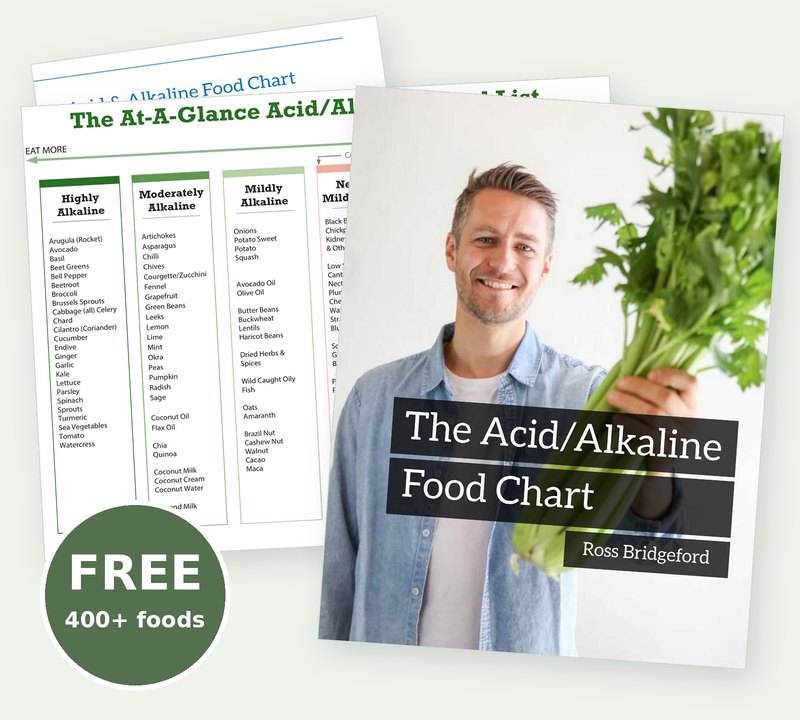
The full acid/alkaline chart, on one page
My free chart rates 400+ foods from Highly Alkaline to Highly Acidic, with a one-page version for your fridge, so you can check any food in seconds.
It’s free. Just tell me where to send it.
The seven most acidic foods (cut these first)
These are the worst of the worst. Certainly don’t let these exist in your everyday life. For each I’ve given some of the known negatives and some of the research, to help with your motivation the next time one of them is calling your name!
#1. Cola and soft drinks
Cola has to come in at number one, and I could write a whole thesis on why. Let’s just touch on the main points as to why I quite literally never touch colas, lemonades, sports drinks and other fizzy drinks:
- Sugar: about 9 teaspoons in a single can. This. Is. Crazy.
- Phosphoric acid: in a study of over 2,500 people, women who drank cola had lower bone density at the hip, and the more cola they drank, the lower it was. Other fizzy drinks didn’t show this (Tucker 2006).
- Caffeine: acid-forming, and around 30–50 mg a can. That’s a lot of caffeine from a drink that isn’t even coffee!
- High-fructose corn syrup: researchers have linked the rise of HFCS in drinks directly to the obesity epidemic (Bray 2004).
- Diet versions: swap the sugar for aspartame and you’re no better off (see #7).
And the simple fact is, sugar, caffeine, HFCS and sweeteners are all HIGHLY acid-forming, and sodas contain them in abundance. Let’s put it like this – you can’t be alkaline and consume cola on a daily basis.
Some other scary facts about regular soft drinks:
- In a study of 548 schoolchildren published in The Lancet, every extra sugary drink a day raised the odds of obesity by 60% (Ludwig 2001).
- Women drinking one or more sugary drinks a day had an 83% higher risk of type 2 diabetes than women who rarely drank them (Schulze 2004).
- Men drinking two or more sugary soft drinks a day had an 85% higher risk of gout (Choi 2008).
Linked to: obesity, type 2 diabetes, tooth decay, reflux, low bone density, gout and heart disease.
#2. Ice cream
All dairy is acid-forming, but ice cream is the worst of it, because it’s dairy AND sugar (over 21 g per 100 g), plus the additives, colourings, sweeteners and other acidic extras that go in to make it so addictive. That combination makes it one of the most acidic foods you can eat.
Personally, if I ever have even a little bit of ice cream, I feel tired instantly and get a headache. It’s instant. It literally couldn’t taste good enough for me to want that response in my body.
We’ve been told for decades that milk builds strong bones, but the big long-term studies don’t back that up. A Harvard study of nearly 78,000 women found milk didn’t protect against fractures (Feskanich 1997), and in a Swedish study of 61,000 women, those drinking three or more glasses a day had 60% more hip fractures (Michaëlsson 2014). Interestingly, fermented dairy didn’t show the same pattern, which is one more reason kefir is my first choice if you’re having dairy.
You don’t have to be 100% – some dairy is OK. Kefir is the best choice, then butter, with milk and cheese kept occasional and ice cream best avoided.
Ice cream is an easy one to get rid of. Do it! (Try blending frozen berries with coconut cream instead.)
Linked to: weight gain, acne, digestive issues and, for milk, no protection against fractures.
#3. Sugar
Sugar is sugar is sugar. It’s at the root of so much acidity! And this counts for all sugar: white, brown, raw, cane, corn syrup, malt, honey, molasses, sucrose, fructose (yes, fruit sugar), lactose, maltose, glucose and anything else ending in -ose.
I know this isn’t an easy one to give up entirely, but I want you to start to lower the amount of sugar in your life and move slowly away from it. Sugar drives a rapid rise in blood sugar, feeds yeast and candida in the gut, and the more you have, the more you crave. In one study, rats given the choice between sugar-sweetened water and cocaine chose the sweet water 94% of the time (Lenoir 2007).
Giving up sugar is normally really hard, but with the alkaline approach, the more alkaline you get, the less you’ll crave. It makes it so much easier and less stressful.
And it’s clear something needs to be done: the average American now eats around 17 teaspoons of added sugar a day, nearly three times the American Heart Association’s limit for women (6 teaspoons) and almost double the limit for men (9) (AHA). The food manufacturers KNOW it’s the way to keep us coming back to their products.
Here’s my complete guide to sugars and the healthier alternatives.
Linked to: inflammation, type 2 diabetes, weight gain, colon and pancreatic cancer, and cravings that keep you coming back for more.
#4. Trans fats (hydrogenated and partially hydrogenated fats)
As healthy as the healthy oils are to the body, the wrong fats are devastating. Trans fats are made when vegetable oils are hardened into margarine or shortening, and they turn up in the most acid-forming foods of all: takeaways, fried foods, cakes, biscuits, chocolate snacks, chips and pizza. You know the drill.
Trans fats raise your LDL (“bad”) cholesterol while lowering your HDL (“good”) cholesterol (Mensink and Katan 1990). The swines! And getting just 2% of your daily calories from trans fats is linked to a 23% higher risk of heart disease (Mozaffarian 2006).
Many countries have now restricted artificial trans fats, but they still sneak into fried and imported foods, so check labels for “partially hydrogenated” oils and steer clear of these fats!
Linked to: raised ‘bad’ cholesterol, lowered ‘good’ cholesterol, heart disease and type 2 diabetes.
#5. MSG (monosodium glutamate)
When we’re talking about acidic foods, we have to include this one, even though it’s more of an additive than a food. MSG is a very powerful flavour enhancer, and it’s used in crackers, chips, microwave meals, canned foods, stock cubes and fast food to make them taste fresher and more moreish. It’s not just in Chinese food – it’s everywhere, if you eat a lot of refined and fast foods.
The FDA classifies MSG as safe for most people, but acknowledges that some sensitive people report short-term reactions like headaches, numbness, flushing, tingling and palpitations after eating it (FDA). And in a study of over 750 Chinese adults, those eating the most MSG were more likely to be overweight (He 2008).
MSG also hides on labels, so look out for: yeast extract, autolyzed yeast, hydrolyzed protein, glutamate, glutamic acid, monopotassium glutamate, sodium caseinate and textured protein.
Linked to: headaches, numbness, flushing and palpitations in sensitive people, overeating and weight gain.
#6. Yeast
Yeast-based foods – bread, beer, baked goods and yeast extracts – are acid-forming, and they’re a vicious cycle when they come with lots of sugar: sugar feeds yeast, and an overgrowth of yeast (like candida) in the gut keeps the cravings for sugar going.
For so many people I’ve coached, cutting back on yeast and sugar together has made a huge difference to bloating, digestion and energy. You don’t have to be perfect, but the less of it in your everyday life, the better.
Linked to: bloating, digestive issues and candida overgrowth.
#7. Artificial sweeteners
As acidic foods go, this is a shocker. I’m talking about the super-commercial artificial ones here (aspartame, sucralose, saccharin, acesulfame, neotame, cyclamates), not the natural ones like stevia. If you use these sweeteners in your daily diet, please stop asap!
And this isn’t just me saying it. In 2023, the World Health Organization advised against using non-sugar sweeteners for weight control, because long-term use was linked to a higher risk of type 2 diabetes, heart disease and early death in adults (WHO 2023). The same year, the WHO’s cancer agency classified aspartame as “possibly carcinogenic to humans” (IARC 2023).
Sweeteners also keep your sweet tooth switched on, so you never get the chance to lose the cravings (Yang 2010).
Linked to: type 2 diabetes, heart disease, sugar cravings, and possible cancer risk (aspartame).
Easy swaps for acidic foods
Remember: focus on the good, crowd out the bad. Here are the simple swaps I recommend most:
| Instead of | Try |
|---|---|
| Cola, soft drinks | Sparkling water with fresh lime or lemon, or a green juice |
| Coffee (the second and third cup) | Herbal teas or a turmeric & ginger tea |
| Fruit juice | Whole fruit (lower-sugar berries are best), or vegetable juice |
| Ice cream | Frozen berries blended with coconut cream |
| Milk | Unsweetened almond milk (Moderately Alkaline) |
| Cheese on everything | Avocado, or a dollop of hummus |
| White bread, pasta | Quinoa, buckwheat, zucchini noodles, or my gluten-free bread |
| Sugary breakfast cereal | Oats or one of my 9 alkaline breakfasts |
| Peanut butter | Almond butter (Moderately Alkaline) |
| Sugar, artificial sweeteners | A little stevia, or cinnamon for sweetness |
| Chips, crackers | A handful of almonds or veggie sticks with guacamole |
Sauces and condiments are where acidic foods sneak in most. Here are the alkaline seasonings I use instead of soy sauce, ketchup and shop-bought dressings.
Acidic foods, reflux and your teeth
If you’re here because of reflux, the “acidic in your mouth” foods matter too: citrus, tomatoes, vinegar, coffee, wine and soda can all be triggers going down, along with fatty, fried and spicy meals. Everybody is different, so listen to your body. My 14-day alkaline diet for acid reflux walks you through what to eat instead (and no, bananas aren’t the answer).
And for your teeth, acidic drinks like soda, juice and wine soften the enamel. Sip water alongside them, and wait at least 30 minutes before brushing.
Where to start
I’m all about mastering the fundamentals: the handful of super-effective things that make the biggest difference (the 80/20 rule), rather than trying to do it all at once. Here they are:
The fundamentals
- Transition away from the seven most acidic foods above
- Eat the most alkaline foods daily, especially the greens
- Stay properly hydrated
- Move every day, even if it’s just a 15-minute walk
- Get your omega-3s daily
- Get plenty of alkaline minerals
- Get some sunshine, and smile!
You never have to be perfect. Consistency is FAR better than perfection.
For the full picture, here’s my alkaline diet guide and easy plan.
Acidic foods FAQ
What are the most acidic foods?
The most acidic foods are sugar and sugary drinks (cola, fruit juice), alcohol, processed and cured meats like bacon, red meat and chicken, hard cheese and ice cream, white bread and pasta, artificial sweeteners and processed snacks. The seven I’d cut first are cola and soft drinks, ice cream, sugar, trans fats, MSG, yeast and artificial sweeteners.
What acidic foods should you avoid?
Start with the worst of the worst: soft drinks, ice cream, added sugar, trans fats (anything ‘partially hydrogenated’), MSG, yeast-heavy foods and artificial sweeteners. Everything else, like coffee, meat, cheese and bread, you can keep in your 20% while you fill the other 80% with alkaline foods.
Which foods help reduce acidity?
Leafy greens, vegetables, avocado, lemons and limes, herbs and healthy fats. These are the most alkaline foods, and the more of your plate they fill, the less acid load your body has to deal with. Here are my 15 most alkaline foods.
How do I stop my body from being so acidic?
Your body works hard to keep your blood pH steady no matter what you eat. What you can change is how much acid load you’re asking it to deal with: crowd in greens and veggies at every meal, swap the most acidic foods on this list, stay hydrated and aim for about 80% alkaline foods. You never have to be perfect.
Is coffee acidic?
Yes. Coffee is Moderately Acidic, mainly because of the caffeine. It’s also acidic in your mouth (around pH 5), which matters for reflux and teeth. One a day is fine in your 20%; herbal teas make a great swap for the rest.
Are tomatoes acidic?
In your mouth, yes: tomatoes are naturally acidic. In your body, no: tomatoes are Highly Alkaline, because their alkaline minerals far outweigh their acid. If you have reflux, though, some people find tomatoes a trigger, so listen to your body.
Is milk acidic?
Yes, milk is Moderately Acidic, and ice cream is Highly Acidic. If you’re having dairy, kefir is the best choice, then butter, with milk and cheese kept occasional.
Are eggs acidic?
Yes, eggs are Moderately Acidic, as with all animal protein. They’re fine in your 20%, alongside plenty of greens.
Are bananas acidic?
Yes. Bananas are Moderately Acidic because of their sugar: 12.2 g per 100 g. Here’s the full answer.
Free download
See where every food sits
My free alkaline food chart rates 400+ foods from Highly Alkaline to Highly Acidic, with a one-page version for your fridge. Check any food in seconds while you shop or cook.
It’s free. Just tell me where to send it.
If you have any questions, just post them below in the comments and I’ll get back to you!
Ross

Ross has taught and coached realistic, sustainable alkaline eating since 2004, working with thousands of clients around the world. He’s the author of The Alkaline Reset Cleanse and The Alkaline Life (Hay House). Ross is a health educator, not a doctor or dietitian, so if you have a medical condition, talk to your own health professional before making big changes to your diet.
Sources
- USDA FoodData Central, SR Legacy: protein, minerals and sugar for every food in the tables
- My 195-food dataset (CSV spreadsheet), rating, PRAL and sugar for every food
- Remer and Manz (1995), Potential renal acid load of foods and its influence on urine pH, Journal of the American Dietetic Association
- Feskanich et al. (1997), Milk, dietary calcium, and bone fractures in women: a 12-year prospective study, American Journal of Public Health
- Michaëlsson et al. (2014), Milk intake and risk of mortality and fractures in women and men: cohort studies, BMJ
- Lanou, Berkow and Barnard (2005), Calcium, dairy products, and bone health in children and young adults: a reevaluation of the evidence, Pediatrics
- Tucker et al. (2006), Colas, but not other carbonated beverages, are associated with low bone mineral density in older women, American Journal of Clinical Nutrition
- Bray, Nielsen and Popkin (2004), Consumption of high-fructose corn syrup in beverages may play a role in the epidemic of obesity, American Journal of Clinical Nutrition
- Ludwig, Peterson and Gortmaker (2001), Relation between consumption of sugar-sweetened drinks and childhood obesity, The Lancet
- Schulze et al. (2004), Sugar-sweetened beverages, weight gain, and incidence of type 2 diabetes in young and middle-aged women, JAMA
- Choi and Curhan (2008), Soft drinks, fructose consumption, and the risk of gout in men, BMJ
- Lenoir et al. (2007), Intense sweetness surpasses cocaine reward, PLoS One
- American Heart Association, How much sugar is too much?
- Mensink and Katan (1990), Effect of dietary trans fatty acids on high-density and low-density lipoprotein cholesterol levels in healthy subjects, New England Journal of Medicine
- Mozaffarian et al. (2006), Trans fatty acids and cardiovascular disease, New England Journal of Medicine
- US FDA, Questions and answers on monosodium glutamate (MSG)
- He et al. (2008), Association of monosodium glutamate intake with overweight in Chinese adults: the INTERMAP Study, Obesity
- World Health Organization (2023), WHO advises not to use non-sugar sweeteners for weight control
- World Health Organization / IARC (2023), Aspartame hazard and risk assessment results released
- Yang (2010), Gain weight by “going diet?” Artificial sweeteners and the neurobiology of sugar cravings, Yale Journal of Biology and Medicine

Hi Ross, Thanks for all you do. There is no science research listed under the yeast section, and I’d like to read further. The yeast in nutritional yeast has been dried out and killed, so I’m not clear about how it relates to the diagram in which mold eats the good nutrients. Thanks in advance for your help!
I’m on a natural thyroid med and have actually gotten my thyroid to rejuvenate itself and start producing its own T4 which docs were surprised about; but, changing my diet, eliminating all gluten, removing all chemicals from my body, and eating a more balanced diet has helped tremendously. HOWEVER, I was diagnosed with a severe case of GERD. Docs just want me to start taking prescription meds, which I hate doing. Can you help?
Your list indicates yeast bacteria has an acidic affect. Does that apply to the live bacteria present in the whey from kefir and similarly in the live bacteria in Kambucha? These are both commonly consumed by people with cancer… yet people with cancer benefit from an alkaline diet.
Hi Carl,
No, the 2 questions I asked ONE YEAR AGO are only centered on MARMITE… MAR-MI-TE !
Is the yeast extract contained specifically in Marmite is acidic or alcalin ?
I am definitively not speaking about kambucha or kefir.
I just want to know if eating MARMITE is an acidic food !!!
Thank you to answer me
Best regards
Jean-Michel
Hey Jean Michel – Marmite/Vegemite is 100% very acidic. It’s pure yeast extract.
Could an acidic condition contrbute to my vertigo?
What could be making my dizziness worse 4months after my fall!
Hi Ross,
I asked you already twice these 2 following questions, but it seem that you never answer the questions we make. That’s a little bit discouraging !
FIRST QUESTION : are the British MARMITE black paste an acidic food ?
I am a Belgian “lover” of this paste for over 50 last years. I love it for the taste but also for its dietetic components (thiamin, niacin, riboflavine, vit B12) – I mix and eat 10 grs of Marmite per day with my high diet of various (alcalin) esevegetables.
Being made of yeast EXTRACT, is the yeast level problematic in Marmite and at the dose I mentioned ?
SECOND QUESTION : I drink 3 cups of expresso MAX / day. Could this rate really deplete my calcium levels ? – Furthermore, I read from the PRAL international index, that expresso coffee is quite an alcalin beverage ! OK, I know that the PRAL index is rather an “in vitro” value than an “in vivo” value. But, what’s the reality ?What is your personal opinion about my 3 cups per day of coffee ?
Thank you so much to give me an answer for each of these two questions here above.
Jean-Michel
Hi Ross, I’ve been reading a book by Robert Morse titled “The Detox Miracle Sourcebook”. I thought he advocated an alkaline approach to nutrition, however his principles deviate quite a bit from yours. He seems to be all about raw foods, with the emphasis on fruits and veggies. Some of his “acid forming foods” are at odds with yours, so I’m really confused here. For instance Lentils, Dried beans, Oatmeal, Soy, Garbanzos, processed oils, Nuts etc, which I’m sure are staples for pretty much all vegans, of which I have been one for over a year now. He says we should be Frugivores! Yet you suggest limiting fruit to 2 pieces a day?
I’d love to know your thoughts on this. He apparently treated all manner of diseases for 40 years prior to his death, including Cancer of all things, but he did die at 58 of a heart related condition. Of course this could have been a defect and we don’t know if he followed his own advice towards the end?
Research into fructose and inflammation has highlighted a LOT since Morse’s work. 2-3 pieces of fruit a day is great, but the focus has to be on veggies, pref leafy greens. PLUS, raw is important but not all has to be raw.
Is powdered goats milk alkaline or acidic?
Acidic
Where do you start if you are trying to help someone that is a stubborn alcoholic?
I see yeast included on the things that should be avoided. Does that include nutritional yeast?
Hi Ross,
I asked you allready this question but it has disapeared
The Ultimate Question spelled another way : are the British “love or hate” black paste that you spread on toasts an acidic food ?
I am a Belgian “lover” of this paste for over 50 last years. I love it for the taste BUT ALSO for its dietetic components (thiamin, niacin, riboflavine, vit B12) – I mix and eat 10 grs of Marmite per day with my vegetables.
What is your opinion about this well known product as an acidic food or not ?
Being made of yeast EXTRACT, is the yeast level problematic in this product ?
Thank you in advance for your opinion
Sincerely
Jean-Michel Balteau
Hi my name is angela, I’m 63 and have developed burning gmouth syndrome. I’m post menopausal and have had what I thought was a reasonable Mediterranean diet. I am at my lowest state now. I feel so I’ll . I was given vaclovir for zoster vitus and now my health has spiraled down. I really need help. I’ve lost faith in doctors.
Hi Ross,
The Ultimate Question : are MARMITE made of yeast extract, an acidic food ?
I am a Belgian “Marmite lover” for over 50 last years. I love it for the taste BUT ALSO for its dietetic components (thiamin, niacin, riboflavine, vit B12) – I mix and eat 10 grs of Marmite per day with my vegetables.
What is your opinion about Marmite as an acidic food or not ?
Being made of yeast EXTRACT, is the yeast level problematic in Marmite ?
Thank you in advance for your opinion
Sincerely
Jean-Michel Balteau
I have high blood pressure. Is it safe to ingest turmeric etc?
Turmeric – yes (unless you ate crazy amounts, like a LOT – which you wouldn’t, it would be a very very very very large amount every day for a long time)
But supplements – be a little more careful. Supplements are concentrations of the main anti-inflammatory compound called curcumin. This is what CAN be contra-indicated with some blood pressure medication.
If you’re not on medication, there isn’t an issue.
What can I eat if I have Barrett Disease?
Please help!!
Thank you so much Ross! This is amazing 7 alkaline food and 7 acid-forming food so easy to remember! Will just concentrate on the alkaline food. Appreciate your hard work in teaching us to live healthily!
My pleasure Nancee!
Ross
———————-
Get Ross’ New Book: The Alkaline Reset Cleanse
http://smarturl.it/amz-arc
Hello. I read everything you send. I am the world’s biggest skeptic, because I’ve tried everything under the sun to lose weight and get healthy, and nothing has worked For me. But your advice makes sense to me. I am obese, diabetic, and filled with health issues (arthritis, high blood pressure, high cholesterol, neuropathy, and more!). These articles about the best and worst alkaline foods just make sense to me. The depth of research you put into the articles you share with us is evident. It puts something on my mind to make me really think about what I’m doing to my body to promote the health issues I’m dealing with. I tried your alkaline reset cleanse and I really felt the difference. I didn’t stick to it past a week, but reading these two articles has motivated me to get back on the right track. Starting today I am striking those 7 worst acidic foods from my diet! And I’m going to the store today to stock up on the 7 most alkaline foods. I will vow to eat them every day for a week and see how I feel. Thanks for everything. And please keep doing what you do. Your honesty and sharing freely your knowledge and expertise is very encouraging and helpful.
Hey Jo
I have some questions for you – I’ll drop you an email 🙂
Ross
Hi Ross!
Im curious about a few things. Is nutritional yeast acidic then as well?
How about natural sweeteners such as sugar alcohols like xylitol and erythitol?
As to other sugars: are maple syrup and brown rice syrups acidic?
I love your blog! I have found a lot of great recipes as well as purchased your book. I have yet to do the cleanse though.
Hi Kate
Nutritional yeast is acid-forming yes, and the best place to learn about sugars is right here: http://liveenergized.com/quit-sugar/complete-guide-sugars-sweeteners-healthy-alternatives/
Glad you’re liking the site and got the book!
Ross
Hi Ross,
Many thanks for your educative write-up. Quite eye opening.
I was wondering, where would maize (corn), both white and yellow fall into. Not sweet corn. Are they acid forming or alkaline?
How would you compare red and green apples in terms of which is healthier?
Many thanks for your feedback.
Izu
How acidic are popcorn and oatmeal?
Hey Ross,
when you say : All dairy is acidic (yes, milk is not good for you and doesn’t lead to stronger bones, it actually leads to weaker bones)
you mean all dairy? even organic goat milk?
Thank you ^^
Dear Ros,
I just love your site, and the wisdom that you share through it.
I have been into the natural way of eating, (natural remedies, etc.) for decades, but for the last three weeks or so, I have been recovering from Cystitis. When I do eat bread it is organic, gluten-free, and I see you have a couple of amazing recipes for the best bread, which I have downloaded and printed out. My question is, would Amaranth flour be another good choice for making bread. And I love a good, healthy pancake occasionally, so would Amaranth be suitable for pancakes too?
We are all Blessed to have you guiding us towards the ultimate healthy food plan and lifestyle.
Thank you,
Annette Amor.
I’ve just read an article about Sucralose citing a study that says:
“increased fecal pH,
The presence of sucralose in the gut raised pH, the amount of alkaline material. That means that it REDUCES the amount of acid (HIGHER pH means LOWER acid). Acid is necessary for digestion and it seems that acid levels are “out-of-whack” in almost everyone…”
https://thecompounder.com/sucralose-a-bitter-reality/
It seems no matter what fancy nutrition trend you follow, you can’t win. 🙂
Hey Bruno
Understand your confusion and frustation over this – the bottom line is that the pH of the gut and other areas of digestion are not all intended to be alkaline, and eating strong acid-forming foods upsets the pH from where it needs to be. When we eat highly acidic foods the body will INSTANTLY release huge amounts of sodium bicarbonate and utilize it’s other acid-buffering mechanisms (the other main one is the kidneys upregulating the amount of glutaminase) – this is designed to INCREASE the pH of the gut area to ensure all digested food reaches a pH back to 7 by the time it passes onto the duodenum and then the small intestine (which have a pH of about 6.8-7.2).
Eating acidic food stresses this first phase of digestion in the stomach which is where the most damage can occur. Because the food HAS to have the correct pH after it leaves the stomach the body will go through huge stress to make this happen. When excessive hydrochloric acid is needed to digest the food AND the food has an acidic pH the volume of sodium bicarbonate needed is huge. This is why splenda is having the effect. The splenda digestion increased the production of sodium bicarbonate.
The article you’ve quoted is simplifying the extremely complex process of digestion so ridiculously. It’s fuzzy logic to the extreme.
I’m so glad you’re doing your research, but if you ever see a fuzzy logic statement like that, definitely keep questioning it.
Ross
Are white potatoes okay? What about fish? My sister and I are going to start the foods that are in the 7 group . I thought we ate healthy.
I am grateful for the free information given.GOD bless you as you continue educating the world.
My pleasure Protus and all the best to you too.
Ice cream is great. It tastes great, and is packed with ice, which is water, which is good for you.
Did you know that to this day, no double blind studies exist around ice cream consumption, and so, we really do not know anything about this mysterious super food. But what we do know, we often get wrong, and this wrong doesn’t make a right.
Ice cream is that hidden unicorn in the mystical forest, somewhere out there.
No one really knows this beast, they hear stories, sometimes they get a glimpse of it, they see a hoof, or a horn and say its THAT. But unicorns don’t exist.
No its best to leave Ice-cream and unicorns alone. Say no ill words about either.
Merry Christmas Llewellyn, that’s hands down the best comment I’ve ever had. I actually love this.
Is popcorn acid or. Alkaline
Hi,
You mentioned that when having sweeteners, that you’re potentially consuming aspartame and when this is ingested it breaks down into formaldehyde in the body. I’ve just done a Google search and some of the foods that are known to contain natural forming formaldehyde are apples and bananas which is also on Dr Sebi’s alkaline diet list. I’m confused here!
Hi Sable
I disagree with some of Dr Sebi’s teachings – apples and bananas are most definitely not alkaline forming due to their high fructose content. Fructose is an incredibly hard sugar for the body to metabolise, as *only* the liver can metabolise it. When a lot of fructose hits the liver the byproduct of this is the formation of visceral fat cells, a spike in inflammation, and disruption to the endocrine system – most notably to the adrenals (due to the regulation of blood sugar/insulin and the resulting cortisol spike) and the thyroid – alongside your ‘weight/hunger’ hormones: leptin and ghrelin.
The levels of naturally occuring formaldehyde in these fruits aren’t a concern, and I’m not saying avoid all fruit – 1-2 pieces a day is fine if your other sugar consumption is low – but they are most definitely not alkaline forming.
Ross
Is Frozen yogurt safe to eat?
Nope – yoghurt (dairy) is quite acid forming and 99% of frozen yoghurts are absolutely packed full of sugar.
thanks for the info
I have a fatty liver, but do not know why? As I don’t eat a lot of fat and never touch alcohol.
Recently I was told Thát an MRI scan had shown up a small tumour! I knew I had some scarring on my liver, but did not expect this.Do you think an alkaline diet will improve this condition, I have heard that cancer cannot live in an alkaline body!
Hi Ross, your content is wonderful and I have only begun to delve in. Questions: I thought I saw that you occasionally use wheat bread in your recipes. Do you feel it doesn’t contribute to inflammatory response? Also, would organic cane sugar sometimes found in boxes but milks be considered acidic and should be skipped? Lastly, can you point me to the EASIEST recipes on your site for a beginner? Thank you! And congratulations on your success!
Hey Lauren
I don’t recommend any regular wheat bread. You shouldn’t have seen this on my site anywhere?
Cane sugar should be skipped whenever possible, absolutely. Organic makes no real difference.
The easiest recipes are…well, most of them!
For breakfast look up the Chia Pots and Simple Alkaline Oats (just google liveenergized chia pots for example)
Soups: Tuscan Bean Soup, Gut Healing Soup
Smoothies: pH Boosting Protein Shake, Anti-Oxidant Super Smoothie
Juices: Big Bad Green Juice, Anti-InflammatioN Juice, Triple A Juice
Salads: Fill You Up Salad & Summer Salad
Lunches: Simple Alkaline Wraps and any other salad, soup etc.
This post might help too: http://liveenergized.com/alkaline-diet-resources/ross-top-21-popular-alkaline-recipes-free/
Hi Ross,
What about Stevia as a sweetener? It is plant based, so is it ok in very small amounts, as per 1 tab per cup of green tea?
Cheers
Wally
Is consuming olive oils are acidic or in alkaline in nature?
What diet to follow for shingles?
Do the positive alkaline effects of foods such as collard greens, broccoli, bell peppers, etc. break down or diminish if they’re cooked?
A little, but not so much that you’d worry about it. Eating *everything* raw is not that sustainable for 99% of people.
I want to transition go an alkaline diet but love that one cup of coffee in the morning. Is this horrible if I concentrate on keeping the rest of my diet alkaline? Also, I had but out artificial sweeteners and was using sugar to avoid the chemicals but I heard that Stevia was ok. Could you tell me if stevia/Trulia is as bad as all the others??