

Struggling With Sleep AND Your Weight? This New Alkaline Diet Research Is for You
Struggling With Sleep AND Your Weight?
If you’re struggling to sleep AND struggling to lose weight, this new alkaline diet study is going to be very interesting for you.
Researchers have found a significant link between the alkaline diet and sleep, with those eating the most acid-forming diets having more than DOUBLE the odds of sleeping fewer than six hours a night, compared with those eating the least acid-forming diets. [4]
And when you understand what a lack of sleep does to your ability to lose body fat, you’ll see why I’m so excited to share this with you.
Sleep is one of the first things I work on with people in my personal weight loss coaching. It’s hugely important, it gets overlooked all the time, and helping someone finally get a proper night’s sleep is one of my favourite parts of what I do.
Because when you’re exhausted, hungry and trying to get through the afternoon without reaching for something sweet, being told to eat less and exercise more is just frustrating. You want to know WHY it feels so hard, and what you can actually do to make it easier.
This is where the research gets really interesting.
In one controlled trial, restricting people’s sleep reduced the proportion of weight they lost as body fat by 55%, even though they were following a calorie-restricted diet. [1]
Think about that for a moment. They were putting in the effort to lose weight, but getting less sleep dramatically changed the result.
So I want to show you what this new study found, how it connects with your weight, and why the foods you eat deserve your attention if you’re fed up with lying awake at night.
Less Sleep, Less Fat Loss
Let’s start with that fat-loss study, because it should get considerably more attention than it does.
In a small, tightly controlled crossover trial published in Annals of Internal Medicine, ten adults followed a calorie-restricted diet during two separate two-week periods. In one, they had an 8.5-hour opportunity to sleep each night. In the other, they had just 5.5 hours.
Both conditions produced weight loss, but the composition of that weight loss was very different.
With the longer sleep opportunity, participants lost around 1.4 kg of body fat. With restricted sleep, they lost around 0.6 kg, alongside greater loss of fat-free mass.
Restricting sleep reduced the proportion of weight lost as fat by 55%.
They also experienced more hunger during the restricted-sleep condition. So they were doing the work of dieting, feeling hungrier, and getting a worse result in terms of the fat they actually wanted to lose. [1]
If you have ever felt as though you’re making an enormous effort for very little return, this is one reason I want you to look beyond what’s on your plate.
And the research works in the other direction too.
A 2022 randomised trial published in JAMA Internal Medicine involved 80 adults with overweight who habitually slept less than 6.5 hours a night. Those given personalised guidance to extend their sleep increased it by around 1.2 hours a night and reduced their calorie intake by approximately 270 calories a day compared with the control group.
They weren’t prescribed a weight loss diet or told to increase their exercise. The intervention was to help them sleep longer. [2]
That is a powerful finding, particularly if your experience of weight loss has always involved trying to fight your appetite.
This Goes Beyond Your Weight
Sleep also deserves serious attention if improving your blood sugar or reducing your risk of type 2 diabetes is one of your goals.
In a randomised crossover trial involving 38 women, researchers reduced sleep by approximately 90 minutes a night for six weeks, bringing average sleep duration to around 6.2 hours.
That was enough to impair insulin sensitivity, independently of changes in body fat. The effect on insulin resistance was more pronounced in the postmenopausal women. [3]
In everyday language, their bodies became less sensitive to insulin, the hormone that helps move glucose out of the blood and into cells.
And we’re talking about the sort of sleep restriction that can easily become normal when you’re working, looking after a family and finally getting a little time to yourself late in the evening.
In my personal weight loss coaching, I want to understand what your nights look like, alongside your food, energy, cravings and everything else going on in your life. We can often start making progress with sleep quickly, and it’s something I give a lot of attention to.
Through my books, The Alkaline Reset Cleanse and The Alkaline Life, and in that personal coaching work, my focus has always been on helping you understand how these pieces fit together so you can actually do something about them.
Which brings us to this new research.
Alkaline Diet and Sleep: What the New Study Found
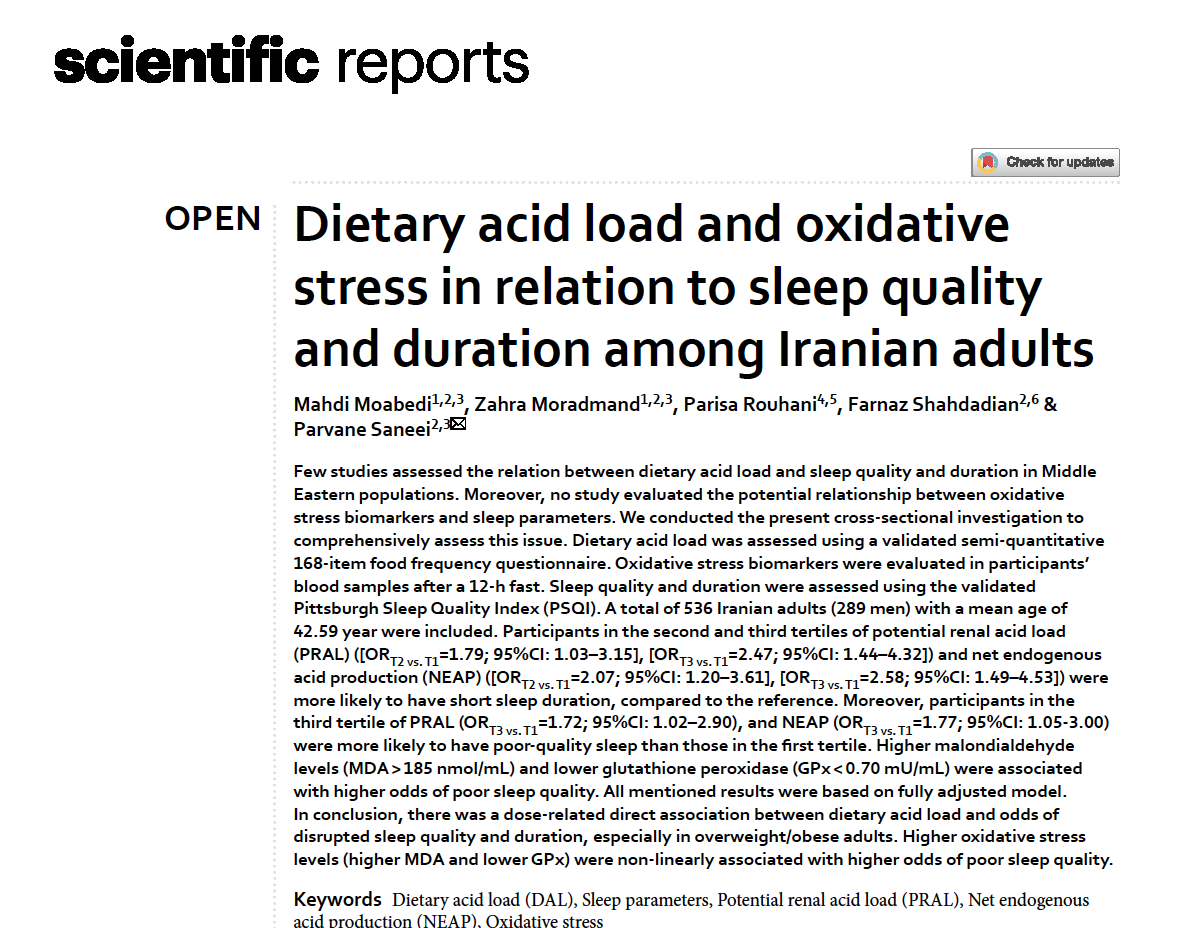
The study examined dietary acid load and sleep in 536 adults.
Researchers used established dietary acid-load measures, including PRAL and NEAP, alongside a validated sleep questionnaire.
Compared with the lowest acid-load group, those in the highest group had:
- 72% higher odds of poor sleep quality using PRAL, and 77% higher odds using NEAP.
- 2.47 to 2.58 times the odds of sleeping fewer than six hours a night.
These associations remained after adjustment for factors including age, calorie intake, physical activity, BMI, sleep apnoea and late tea or coffee consumption.
The lower acid-load groups ate more fruit and vegetables.
This was an observational study, so it establishes a link rather than proving that changing to an alkaline diet improves sleep. And these figures describe odds, rather than percentage increases in someone’s individual risk.
But the finding is clear: higher dietary acid load was associated with both poorer sleep quality and shorter sleep. [4]
For me, this adds another reason to pay attention to the acid-forming potential of what you eat.
There Is Serious Research Behind Reducing Dietary Acid Load
If you’ve been reading my work for a while, you’ll know that eating alkaline means building your meals around an abundance of nourishing foods, especially vegetables and leafy greens.
The research terminology you’ll often see is “dietary acid load” or “dietary acid reduction”. I’ve brought together more of this research in my guide to the scientific evidence behind eating alkaline.
And there are studies looking directly at this, beyond the sleep research.
In a large prospective study following 66,485 women for 14 years, those with the highest dietary acid load had a 56% higher relative risk of developing type 2 diabetes than those with the lowest. The association remained after adjustment for other known risk factors. [5]
We also have intervention research.
A five-year randomised trial involving 153 people with hypertension and elevated urine albumin tested dietary acid reduction using added fruit and vegetables, sodium bicarbonate, or usual care.
Both acid-reduction groups experienced slower kidney function decline than the usual-care group. The fruit-and-vegetable group also achieved better blood pressure and cardiovascular risk markers, despite receiving lower doses of protective medication. [6]
These are specific findings in specific populations, but they demonstrate why dietary acid load deserves to be taken seriously.
Your body tightly regulates blood pH. Eating alkaline is about the foods you give your body and the acid load they produce during metabolism, rather than trying to push your blood outside its healthy range.
And when we put this research alongside the sleep studies, you can see why I want you to think about your weight loss more broadly.
The connection between the alkaline diet and sleep is one more reason to work on your food and your sleep together, instead of spending another month trying to push harder through exhaustion.
Let’s Put This Into Practice
This is the approach I’m going to take you through in my upcoming Effortless Weight Loss Series, running 26–28 October.
I want to help you understand why losing weight can feel so difficult, particularly when you’re already trying to eat well, and show you where to focus your effort so the changes feel achievable in your actual life.
Sleep is one of those pieces. The food you eat is another, and understanding the connection gives you far more to work with than another instruction to eat less.
If you’re tired of feeling hungry, exhausted and frustrated with your progress, come and join me.
Register for the Effortless Weight Loss Series
I’ll help you make sense of what’s going on and show you how to get started.
Ross
Research References
- Nedeltcheva AV et al. (2010).
Insufficient sleep undermines dietary efforts to reduce adiposity.
Annals of Internal Medicine. - Tasali E et al. (2022).
Effect of sleep extension on objectively assessed energy intake among adults with overweight in real-life settings: a randomized clinical trial.
JAMA Internal Medicine. - Zuraikat FM et al. (2024).
Chronic insufficient sleep in women impairs insulin sensitivity independent of adiposity changes: results of a randomized trial.
Diabetes Care. - Moabedi M et al. (2026).
Dietary acid load and oxidative stress in relation to sleep quality and duration among Iranian adults.
Scientific Reports. - Fagherazzi G et al. (2014).
Dietary acid load and risk of type 2 diabetes: the E3N-EPIC cohort study.
Diabetologia. - Goraya N et al. (2024).
Kidney and cardiovascular protection using dietary acid reduction in primary hypertension: a five-year, interventional, randomized, controlled trial.
The American Journal of Medicine.