


The 4x Broccoli Trick: How One Simple Ingredient Makes a Huge Difference
Broccoli is already one of my absolute favourite alkaline foods. It’s packed with vitamins, minerals, fibre and some particularly interesting plant compounds.
But there’s a fascinating little trick that most people have never heard of, and it can make a surprisingly big difference to how much of one of broccoli’s most interesting compounds your body can access.
In fact, researchers at the University of Reading found that adding just ONE GRAM of a common kitchen ingredient to cooked broccoli increased the bioavailability of a compound called sulforaphane by more than FOUR TIMES.
And the ingredient? Ground brown mustard seed!
First, what makes sulforaphane so interesting?
Sulforaphane is a naturally occurring compound found in broccoli and other cruciferous vegetables. It’s attracted enormous scientific interest because of the way it interacts with our body’s natural cellular defence systems.
In particular, researchers have studied its ability to activate the NRF2 pathway, which helps regulate antioxidant defence and the body’s response to cellular stress.
There’s also ongoing research into its relationship with inflammation, metabolic health and other aspects of long-term health.
But here’s the interesting part…
Broccoli doesn’t contain large amounts of ready-made sulforaphane. Instead, it contains a precursor called glucoraphanin, which needs an enzyme called myrosinase to help convert it into sulforaphane.
When you chop or chew broccoli, these substances come into contact and the conversion can begin.
Unfortunately, cooking broccoli, particularly at higher temperatures or for longer periods, can deactivate much of that enzyme.
Which means less sulforaphane may become available, even though cooked broccoli is still an incredibly nutritious food.
Enter…mustard powder!
This is where the research gets really interesting.
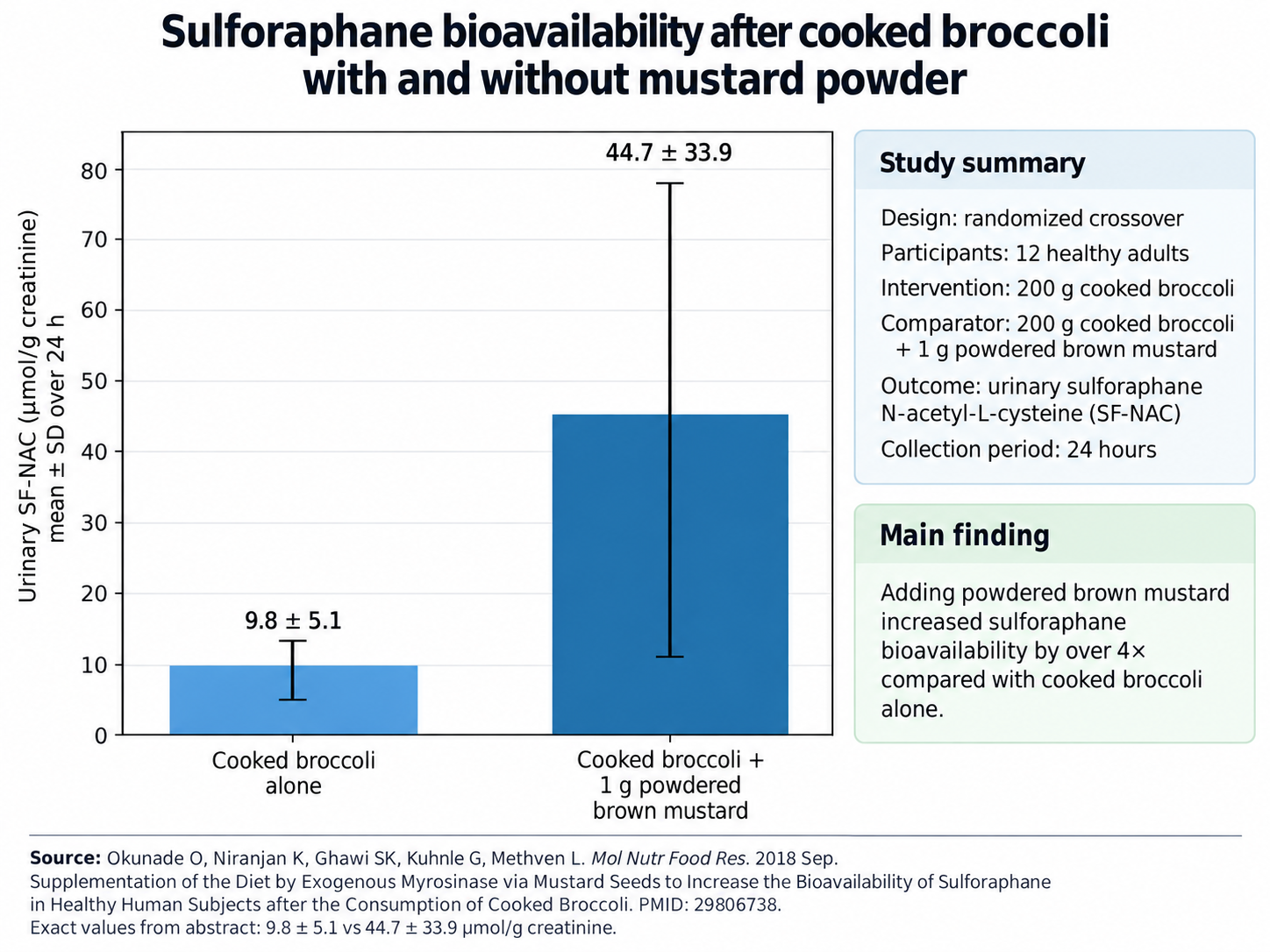
In a 2018 randomised crossover study, researchers gave 12 healthy adults 200g of cooked broccoli, either on its own or with just 1g of powdered brown mustard seed.
Why mustard?
Because mustard seeds contain myrosinase too! Adding the powder provides another source of the enzyme to help convert broccoli’s glucoraphanin into sulforaphane.
And the results were remarkable.
The researchers measured a sulforaphane metabolite in participants’ urine over the following 24 hours.
With cooked broccoli alone, the average measured level was 9.8 micromoles per gram of creatinine.
With the addition of mustard powder, that increased to 44.7.
That’s more than FOUR TIMES the measured sulforaphane bioavailability, simply by adding 1g of powdered brown mustard seed.
View the original study.
And this isn’t the only study to find this…
What makes this particularly interesting is that the mustard study isn’t an isolated finding. There are several other pieces of research that help explain what’s happening.
Study 1: Raw broccoli vs cooked broccoli (2008)
Researchers in the Netherlands gave eight men 200g of broccoli, either raw or cooked, and measured how much sulforaphane became available to their bodies.
The difference was enormous.
Sulforaphane bioavailability was 37% from raw broccoli, compared with just 3.4% from cooked broccoli.
That’s almost an elevenfold difference in this small human study, showing just how much food preparation can influence the availability of this compound.
Read the 2008 human study here.
Study 2: Mustard powder restores sulforaphane formation (2013)
In another study, published in Food Chemistry, researchers investigated what happened when powdered mustard seeds were added to heat-treated broccoli.
They found that cooking could deactivate broccoli’s own myrosinase, leaving less of the enzyme available to produce sulforaphane.
But when they added powdered mustard seeds, sulforaphane formation increased significantly.
This was a food laboratory study rather than a human clinical trial, but it demonstrates the mechanism behind the trick remarkably well.
The broccoli still contained glucoraphanin, and the mustard supplied additional myrosinase to help convert it.
Study 3: New human research confirms the principle (2026)
And here’s a particularly interesting recent addition to the research.
In a randomised, double-blind crossover study published in Scientific Reports in February 2026, researchers tested 16 adults using a glucoraphanin-rich broccoli seed extract.
They compared the extract on its own with the same extract combined with mustard seed powder containing myrosinase.
The mustard-containing preparation approximately doubled sulforaphane bioavailability, from 18.6% to 39.8%.
Now, this study used a broccoli seed extract rather than cooked broccoli, so it wasn’t a direct repeat of the original experiment.
But it provides further human evidence that supplying myrosinase from mustard seed can make a substantial difference to how efficiently glucoraphanin is converted into sulforaphane.
Read the 2026 human trial here.
Taken together, these studies make a compelling case for paying attention to how we prepare our cruciferous vegetables, particularly when we’re interested in sulforaphane.
Of course, the fourfold increase in the original experiment doesn’t mean broccoli becomes four times healthier in every respect, or that any particular disease risk falls by the same amount.
These studies primarily measured sulforaphane formation or bioavailability, rather than long-term health outcomes.
But they give us a fascinating insight into how we can get more from the foods we’re already eating.
How to put this into practice tonight
This couldn’t be much simpler. The next time you’re preparing broccoli:
- Lightly steam your broccoli until it’s cooked to your liking.
- Remove it from the heat and let it cool slightly.
- Add a little plain ground brown mustard seed and toss it through before serving.
The original researchers used just 1g of powdered brown mustard for 200g of cooked broccoli, so you really don’t need very much.
Look for plain powdered brown mustard seed rather than prepared mustard sauce. And of course, avoid this if you have a mustard allergy.
I love this kind of nutritional science because it demonstrates how we can take an already fantastic alkaline food and potentially get even more from it without making our diet any more complicated.
Want to go deeper into sulforaphane?
I’ve written about sulforaphane quite a few times over the years because it’s such an interesting area of nutritional research, and it fits beautifully with my alkaline approach to getting more nutrient-dense, antioxidant-rich foods into your diet.
If you’d like to explore the science further, I’ve got two guides for you:
Broccoli Sprouts and Inflammation: Three Human Trials
A closer look at research into broccoli sprouts, sulforaphane and inflammatory markers.
Immune-Boosting Nutrient to Protect You & Your Family
My earlier exploration of sulforaphane, its biological mechanisms and the foods that contain it.
And remember, you don’t need to overhaul your entire diet to start getting more of these incredible plant compounds. Simply eating more vegetables, greens and other alkaline-forming foods gives you a fantastic foundation to build upon.
Next time broccoli is on the menu, try adding that little sprinkle of brown mustard powder!
Let’s do this,
Ross
Scientific References
- Okunade O, et al. (2018).
Supplementation of the Diet by Exogenous Myrosinase via Mustard Seeds to Increase the Bioavailability of Sulforaphane in Healthy Human Subjects after the Consumption of Cooked Broccoli.
Molecular Nutrition & Food Research.
View research. - Vermeulen M, et al. (2008).
Bioavailability and Kinetics of Sulforaphane in Humans after Consumption of Cooked versus Raw Broccoli.
Journal of Agricultural and Food Chemistry.
View research. - Ghawi SK, Methven L, Niranjan K. (2013).
The Potential to Intensify Sulforaphane Formation in Cooked Broccoli Using Mustard Seeds.
Food Chemistry.
View research. - Mastaloudis A, et al. (2026).
Exogenous Myrosinase from Mustard Seed Increases Bioavailability of Sulforaphane from a Glucoraphanin-Rich Broccoli Seed Extract in a Randomized Clinical Study.
Scientific Reports.
View research.

Does the mustard powder need to be brown?
Could I use white mustard powder?
Does this apply to any cruciferous veg or just broccoli?
Broc is by far the highest in sulforaphane of all cruciferous.
Thank you ross, most interesting. I went to the hospital today and it seems doubtful if I have cancer. There is something on my lungs, not large and they wish to see iin 6 weeks, so shall have another scan. Then return to the City hospital in 7 weeks time. What a relief, thanks for taking an interest. Cheers Marion
The 7 day quit sugar is still saying starting on end of Sept. Can you update the dates please
Hey Gillian – it did and has wrapped up.