

The Starvation Signal: Why Your Body Fights Weight Loss
The Starvation Signal: Why Eating Less Can Make Weight Loss Harder
“I just cut a lot of calories, which is probably not the way to go, but it used to work.”
That came from one of the deep-dive onboarding interviews I do before I begin working with somebody in my weight-loss coaching, and it gets right to the heart of why your body fights weight loss in a way that can feel incredibly frustrating. I read it and thought, yep, there it is. That one sentence sums up a huge amount of the frustration I hear from people, particularly once they get into their 40s, 50s and beyond.
Ten or twenty years ago, they could clean things up for a few weeks, cut back on the food, start exercising again and the weight would move.
Now they try the same thing, often with considerably more effort, and either nothing happens or they lose a little bit before hitting a wall.
So what do they do next?
Usually, they decide they need to eat even less.
They make the portions smaller, cut out another food, skip breakfast, add in another workout, try intermittent fasting again, or go looking for a stricter plan that will finally force the weight to move.
And for a while, that may work.
I’m not going to pretend that eating less never causes weight loss, because of course it can. The problem is what often starts happening after those first few weeks, when you find yourself thinking about food more than you did at the beginning, the hunger starts getting stronger, the foods you were quite happily ignoring in week one suddenly become VERY difficult to ignore, your energy drops, exercise feels harder and the weight loss starts slowing down.
This is the point where most weight-loss advice becomes far too simplistic.
You are told that you have reached a plateau, which means you need to tighten things up, lower your calories again and be more disciplined.
But while you are sitting there thinking you need to try harder, your body is doing a whole lot more than simply counting the calories coming in.
It is responding to what is happening.
Why cutting back feels like the obvious place to start
Most of us have been taught some version of “eat less and move more” for practically our whole lives.
I grew up watching my mum doing Jane Fonda workouts in front of the television, going off to Weight Watchers meetings and meticulously counting calories. This idea that weight loss is basically a maths problem has been around for as long as most of us can remember.
Eat fewer calories than you burn and the missing energy has to come from your body fat.
Sounds pretty straightforward.
And when somebody first cuts back, the scale often rewards them. They lose a few pounds or kilos, their clothes loosen a little, they feel motivated and it seems to confirm that the plan is working exactly as promised.
But then the experience starts changing.
You are still eating less, but you are now hungrier than you were at the start. You are trying to exercise, but your energy is lower. You spend more time thinking about the foods you are avoiding, your cravings get louder, and you may start naturally moving less throughout the rest of the day without even realising it.
Perhaps you sit down more often, put off going for a walk, take the easiest route, leave a few jobs until tomorrow or simply feel less inclined to get up and do things.
None of that feels dramatic enough to count as part of the diet. You probably would not even notice most of it.
But it all counts.
And because the rate of weight loss has now slowed, the natural response is to cut back again, which can push the same hunger, fatigue and food preoccupation even further.
This is what I call the Starvation Signal.
Your body has no idea you have an event coming up
Your body is constantly receiving information about what is happening both around it and inside it.
It is responding to the amount of energy and nourishment available, but also to your blood sugar, appetite hormones, stress, sleep, digestion, inflammation, activity, muscle mass and all of the other inputs that help determine how much energy you use, how hungry you feel and how strongly you are driven to seek out food.
What your body does not know is WHY you have suddenly started eating less.
It has no idea that you have a wedding in six weeks.
It does not know that you want to fit into a particular dress, that you have downloaded a calorie-tracking app, or that you have decided this is the Monday when you are finally going to stick to it.
It only has the physiological information coming in.
So when the food drops, the nourishment drops with it, sleep is poor, stress is high and the body receives this repeated message that less energy is available, a collection of very real responses can start making the whole process considerably harder.
I should explain that the Starvation Signal is the name I use in my coaching to make this easier to understand. It is not a medical diagnosis, and I am definitely not suggesting that missing lunch once makes your body think you are living through a famine.
I am describing the combination of changes that can happen when the body is repeatedly asked to function on less energy while also dealing with stress, poor sleep, unstable blood sugar, hormonal changes, inflammation or a lack of proper nourishment.
Calories still tell us something useful about the amount of energy in a food. The bit I have never agreed with is treating the body like a basic calculator whose appetite, movement, hormones and energy use will remain exactly the same no matter how much food you remove.
The body is far more intelligent than that.
Starvation Mode and Abundance Mode
Inside my weight-loss coaching I use two broad terms to help explain this: Starvation Mode and Abundance Mode.
Again, these are coaching terms rather than medical diagnoses. They are simply a useful way of looking at the overall collection of information your body is receiving.
Starvation Mode describes the situation where enough signals around scarcity, undernourishment, stress and low energy availability are coming in that the body begins behaving more protectively. Hunger can increase, energy use can become more efficient, food can become more rewarding and you may move less without consciously deciding to do so.
Abundance Mode is the healthier environment we are trying to create, where the body is properly nourished, blood sugar is more stable, meals are genuinely satisfying, hydration is good, sleep and stress are being supported, and the systems involved in appetite, energy, hormones and metabolism have what they need to function properly.
I find this a much more useful way to approach weight loss because it gets you looking at what is happening inside the whole system.
If you are exhausted, sleeping badly, dealing with cravings, going through perimenopause, struggling with your digestion and already feeling stressed, cutting your food down further may be adding another problem to a body that is already having to cope with quite a lot.
This reminds me of Samantha
Samantha was 52 when she completed one of my coaching interviews.
She had already lost about 5kg, going from 64kg down to 59kg. She was eating mostly alkaline, exercising regularly, avoiding coffee and sweets, taking HRT and genuinely putting the work in.
But she had hit a wall.
She was dealing with perimenopause, and despite doing so many of the things she knew should be helping, she could not seem to get the weight moving again. She had tried alkaline, low carb and keto in the past, and what came through very clearly was this sense that her body no longer responded in the way it once had.
I hear versions of Samantha’s story all the time.
“Ross, ten years ago I could cut back for a few weeks and lose the weight.”
“I’m eating less than I used to, but I’m heavier.”
“I exercise more now than I did before, so why isn’t anything happening?”
“I know what to eat. I just can’t understand why my body won’t respond.”
And when somebody feels like this, what do they usually conclude?
They decide they must be doing something wrong, or that they need to find another thing to remove.
But Samantha was not lacking effort. She was already doing plenty.
What had changed was the situation she was asking that effort to work inside. She was now in perimenopause, her hormonal environment had changed and she was no longer working with exactly the same physiology or body composition she had twenty years earlier.
Continuing to tighten the screws without investigating any of that would have made very little sense.
Samantha’s experience is a good example of why your body fights weight loss differently at 52 than it may have at 32.
I explain this whole process, including the research behind it and what I want you to start doing differently, in the video below.
What can actually change when you diet?
One of the first things that can change is appetite.
When weight drops, the hormones involved in telling your brain whether food is needed and whether you have had enough can change too. Ghrelin, which is involved in hunger, can increase, while leptin and several of the signals associated with fullness can decrease.
That means somebody can be trying to eat less at the exact same time as their brain is becoming more interested in food.
That is going to make things a little tricky.
There is also the energy side of the equation.
A smaller body naturally needs less energy than a larger body, so some reduction in energy expenditure after weight loss is completely normal. But in some people, particularly after large or rapid losses, the reduction can go beyond what we would expect from the change in body size alone.
And then there is the movement you never deliberately planned in the first place.
Think about how differently you behave when you feel fantastic compared with when you are knackered.
When you have energy, you get up, walk around, tidy things, stand more often, fidget, take the stairs, go outside, potter around the garden and generally get more done.
When you are depleted, you sit down.
Your calorie app does not know that you stopped pacing around while talking on the phone, left the washing until tomorrow, drove somewhere you would normally walk, or spent the evening on the sofa because you simply did not have much left in the tank.
But your body knows, and all of those little reductions in movement add up.
The research backs this up
One of the best-known studies in this area followed 50 adults through a ten-week very-low-energy diet.
They lost an average of 13.5kg, and the researchers measured a wide range of hormones involved in appetite before the weight loss, at the end of the diet and again a year later.
After losing the weight, participants had higher ghrelin, lower leptin and changes in several other appetite hormones that would be expected to encourage eating and weight regain. Most importantly, many of those changes were still present one year later, and the participants continued to report greater hunger than they had before the diet.
So when somebody loses weight and then finds that maintaining it becomes a constant fight with hunger, it is a bit lazy to say they simply stopped trying.
The internal drive to eat may genuinely be stronger than it was before.
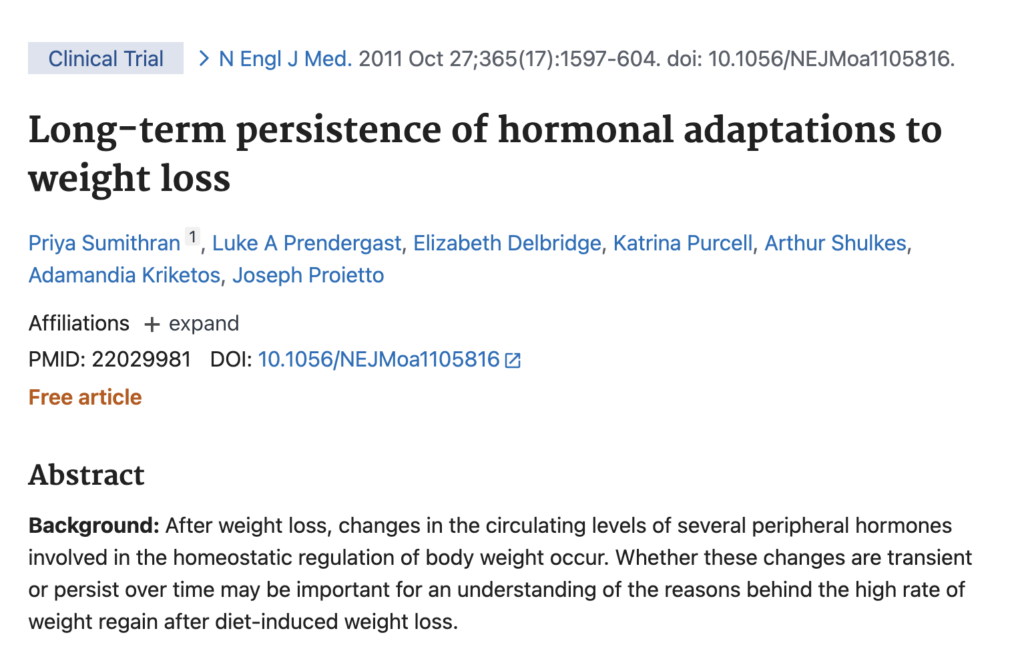
This research gives us a really useful insight into why your body fights weight loss after a period of significant restriction.
Another fascinating example came from the follow-up of contestants from The Biggest Loser.
Now, I want to put this in context because this was a tiny study of 14 people who had been through an extremely aggressive television weight-loss competition. It is about as far from a normal, sensible weight-loss plan as you could get, so we should not pretend the exact same result happens to everyone.
But the findings are still revealing.
At the end of the competition, the participants had lost an average of 58.3kg. Six years later they had regained an average of 41kg, yet their resting metabolic rate remained about 704 calories per day below where it had been before the competition, and roughly 500 calories per day below what the researchers predicted for their age and body composition at follow-up.
That does not mean dieting permanently “destroys” your metabolism. The size of this response varies enormously, and this was an extreme intervention in a very small group.
But it does show that the body is not sitting there passively while weight is forced down. It can make changes to both appetite and energy expenditure that continue long after the dramatic dieting phase is over.
This helps explain why so many people can lose weight successfully for a few months, yet find keeping it off considerably harder.
Why Your Body Fights Weight Loss More After 40
This brings us back to the frustration I opened with.
Why does the old approach so often seem to stop working in your 40s and 50s?
By this point, the circumstances inside the body may be very different.
You may have less muscle than you had twenty years ago, your activity may have gradually changed, your sleep may not be as good, stress may have accumulated and you may have a long history of dieting, losing weight, regaining it and starting again.
For women, perimenopause and menopause can also bring changes in body composition and the distribution of fat, particularly around the middle. Research consistently shows a shift towards greater central and visceral fat through the menopausal transition, alongside changes in lean mass.
On top of that, there may be blood-sugar problems, inflammation, digestive symptoms, cravings, fatigue and hormonal issues all sitting underneath the weight struggle.
This is what I see again and again in my coaching.
People rarely come to me saying that their energy is fantastic, they sleep brilliantly, their digestion is perfect, their hormones feel completely balanced and the only thing they would like to change is the number on the scale.
There is nearly always something else going on.
And that “something else” gives us useful information about why the body may be responding differently now.
Taking the same plan you used at 25 and simply making it more aggressive at 50 ignores all of that.
Has your body stopped responding the way it used to?
If you are in your 40s, 50s or beyond and feel as though you are eating less, trying harder and getting less back from your body, this is exactly what I am going to unpack in my new free weight-loss training series.
We will look at why restriction can make hunger, cravings and energy harder to manage, how hormones, inflammation, digestion and dietary acid load may all be contributing to the weight struggle, and the simple 20/80 actions I use with my coaching clients to start getting things moving in the right direction again.
So what should you do instead?
Please do not read this and decide I am telling you that weight loss requires eating unlimited amounts of food.
That is not the answer either.
You may well end up eating less energy overall than you did before, particularly if you are moving away from processed foods, sugar, refined carbohydrates, takeaway, alcohol and the foods that are incredibly easy to overeat.
But there is a world of difference between eating less because your meals are nourishing and satisfying, and spending the whole day deliberately trying to tolerate hunger.
My approach starts by looking at how we can nourish and rebalance the body while creating a way of eating that naturally makes it easier to consume the right amount.
Meals with plenty of vegetables and greens, enough protein, fibre, healthy fats, minerals, antioxidants and micronutrients give the body far more of the raw materials it needs, while also tending to be much more satisfying.
Then we look at everything else feeding into the situation.
How are you sleeping? What is happening with stress? Is your blood sugar stable? How is your digestion? Are you getting enough water? Are your hormones being properly supported? Are you having meals that actually fill you up, or are you trying to be “good” all day and then finding yourself fighting the cupboard every evening?
This is where weight loss becomes much more personal, because two people can be carrying the same amount of excess weight for very different reasons.
Start with your next meal
Here is what I want you to do for the next few days.
When you look at a meal, instead of immediately asking, “How can I make this smaller?”, ask:
Perhaps you add another couple of serves of vegetables or greens.
Maybe you make sure there is a useful source of protein and fibre, such as lentils, chickpeas, beans, quinoa, tofu, nuts or seeds, so you are not hunting for food again ninety minutes later.
Perhaps the meal needs healthy fats from avocado, extra virgin olive oil, flax, chia, hemp seeds or a small handful of nuts.
Maybe you simply need to swap something heavily processed for food that gives the body vitamins, minerals, antioxidants and other nutrients it can actually use.
And then pay attention to what happens.
Notice how hungry you are afterwards, what your energy is like, whether you are thinking about food all afternoon, how strong the evening cravings are and whether the meal comfortably carries you through to the next one.
A tiny lunch that looks wonderfully disciplined on paper but leaves you standing in front of the biscuit cupboard at 4pm has not done you many favours.
This is not about trying to make every meal enormous or perfect. It is about making sure the food you do eat is doing a proper job.
Which signals are affecting your body?
Once you understand the Starvation Signal, there is another useful question to ask:
What else is affecting the way MY body is responding?
This is where I begin looking at what I call the Four Weight Gain Paths: hormonal imbalance, inflammation, digestion and dietary acid load.
For one person, unstable blood sugar and powerful cravings may be the most obvious place to start. For somebody else, perimenopause, poor sleep and stress may be playing a much bigger role. Another person may be dealing with chronic inflammation, digestive problems, low energy and years of under-eating during the week before overeating at the weekend.
Very often, there is more than one thing involved.
This is also why I do not believe in handing everybody the same calorie target and telling them to come back when they have been more disciplined.
I want to understand what has changed, what appears most out of balance, and which small number of actions are most likely to create an early improvement for that particular person.
Because once hunger starts settling, energy improves, meals become more satisfying and the body begins responding again, it becomes considerably easier to keep going.
A much better question than “How little can I eat?”
If you have spent years believing that successful weight loss depends on becoming better at eating as little as possible, I hope this gives you a more useful way to look at it.
Your food choices obviously count. I will never pretend otherwise.
But those choices are being made inside a body affected by sleep, stress, blood sugar, hormones, inflammation, digestion, muscle mass, nourishment, habits and the results of everything you have tried before.
If you are exhausted, constantly hungry and thinking about food all day, simply removing another 200 calories is not much of a long-term plan.
Start with the next meal.
Make it nourishing, balanced and satisfying, then watch the feedback your body gives you through your hunger, cravings and energy.
That is where I would begin.
Let’s do this,
Ross