

Why Sugar Is So Dangerous: What the Research Actually Shows

This Is Why I Keep Going On About Sugar…
Over the last couple of days I’ve shown you how quickly sugar can creep into what looks like a pretty normal diet, and then we looked at the confusion around all of the supposedly healthier alternatives such as honey, maple syrup, coconut sugar and agave.
Today I want to come at this from a completely different direction, because there is a reason I have spent so much time talking about sugar over the years.
And it isn’t simply because sugar can make you gain weight.
It isn’t because I think you should never have a dessert again either. If you’ve followed me for any length of time you’ll know that’s not how I teach health, and it’s definitely not how I live my own life.
But when there is one food that is showing up every day in drinks, breakfast cereals, yoghurts, sauces, dressings, snack foods, desserts and packaged foods, and the research keeps linking higher consumption with metabolic disease, cardiovascular disease, liver fat, cancer risk and cognitive decline, I think we need to take it seriously.
I’ve always tried to make living alkaline realistic, achievable and enjoyable. I want you to get the biggest possible result from the smallest number of changes, rather than giving you another impossible health regime that takes over your life.
Sugar happens to be one of those changes that gives you a LOT back. And the more research we get, the stronger that case becomes.
The Research Is Getting Hard to Ignore
One of the most useful pieces of research I’ve seen on this was published in the BMJ in 2023.
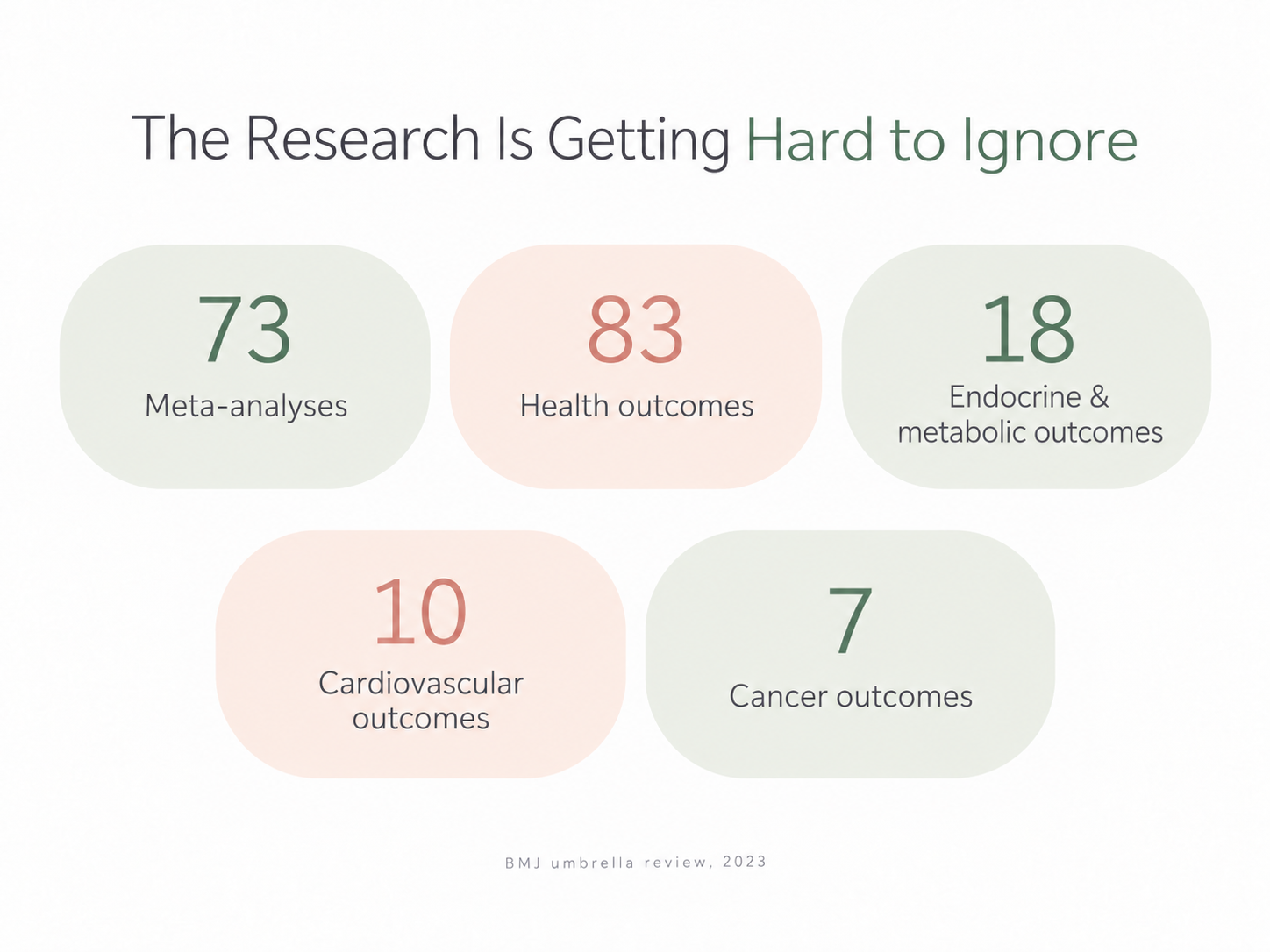
Rather than looking at one study, the researchers conducted what is called an umbrella review, which is effectively a review of existing systematic reviews and meta-analyses. They ended up looking across 73 meta-analyses and 83 different health outcomes.
They found significant harmful associations between higher sugar consumption and 18 endocrine and metabolic outcomes, 10 cardiovascular outcomes and seven cancer outcomes, plus another 10 outcomes covering neurological, liver, dental, bone and other areas of health. The researchers were very clear that the quality of evidence differed between outcomes, and much of the observational evidence can’t prove cause and effect, but the overall picture was certainly not reassuring. You can see the review here.
And when I read research like this, I immediately come back to the model I’ve used for years with you.
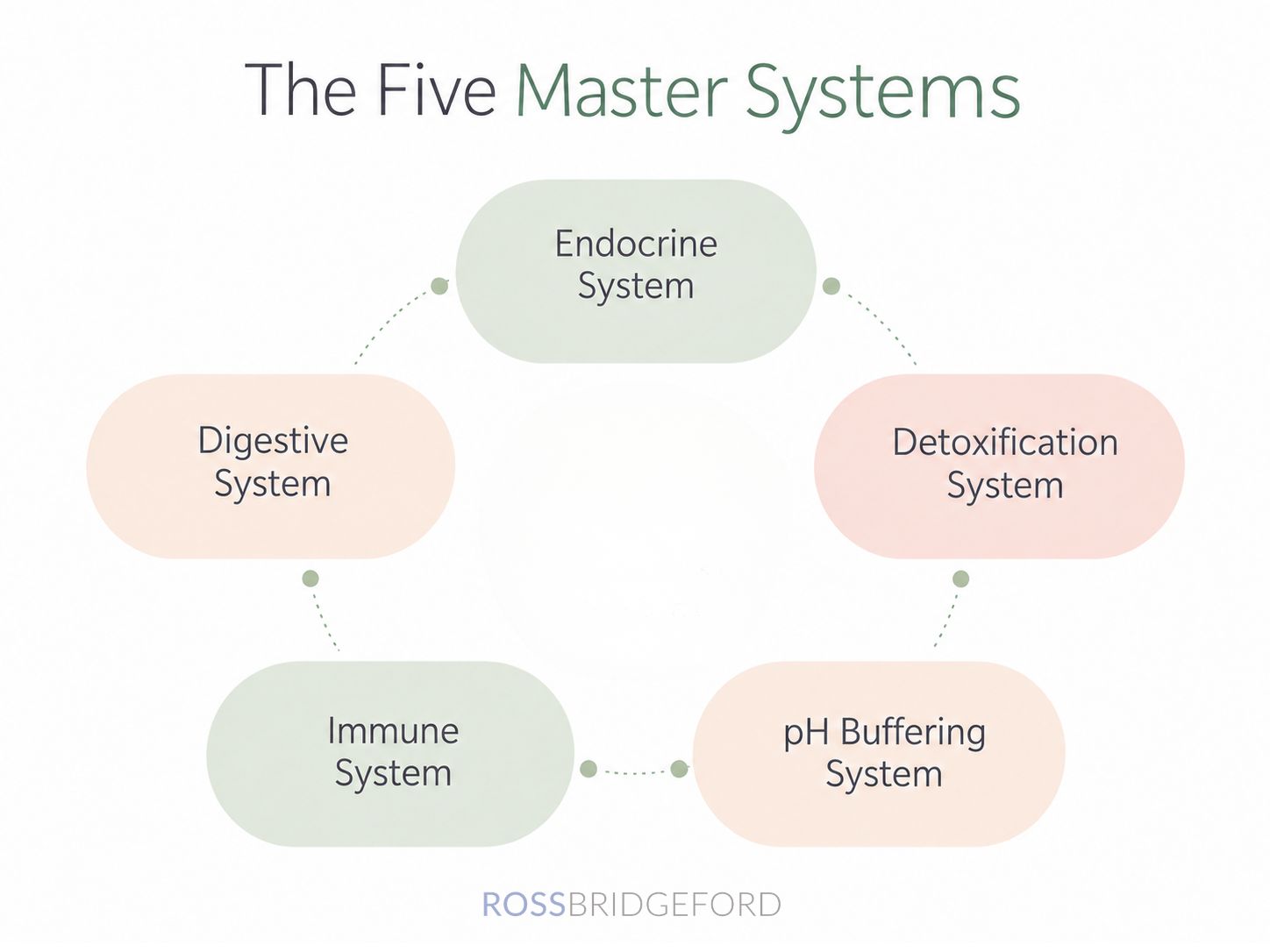
The Five Master Systems.
Because your health isn’t really divided into one box marked “blood sugar”, another marked “liver”, another marked “hormones” and another marked “brain”. These systems overlap constantly. Your endocrine system affects your liver, your liver affects your blood sugar, your digestive system affects your immune system, and your inflammation, oxidative stress and acid-base regulation influence all of them.
This is why I don’t see sugar as one isolated nutritional problem.
Your Endocrine System: Where the Trouble Often Starts
The most obvious place to start is your endocrine system because this is where glucose, insulin and your blood sugar regulation come into the picture.
When you eat carbohydrates and sugars, glucose enters your bloodstream and your pancreas releases insulin to help move that glucose where it needs to go.
That’s completely normal physiology. You need glucose and you need insulin.
The problem is the sheer volume and frequency of sugar in the modern diet.
If you saw the example I shared earlier this week, the apparently fairly normal day of eating contained 295 grams of sugar. And that wasn’t somebody sitting down eating sugar from a bag. It was cereal, juice, yoghurt, a sandwich, a smoothie, pizza, dressing and soda.
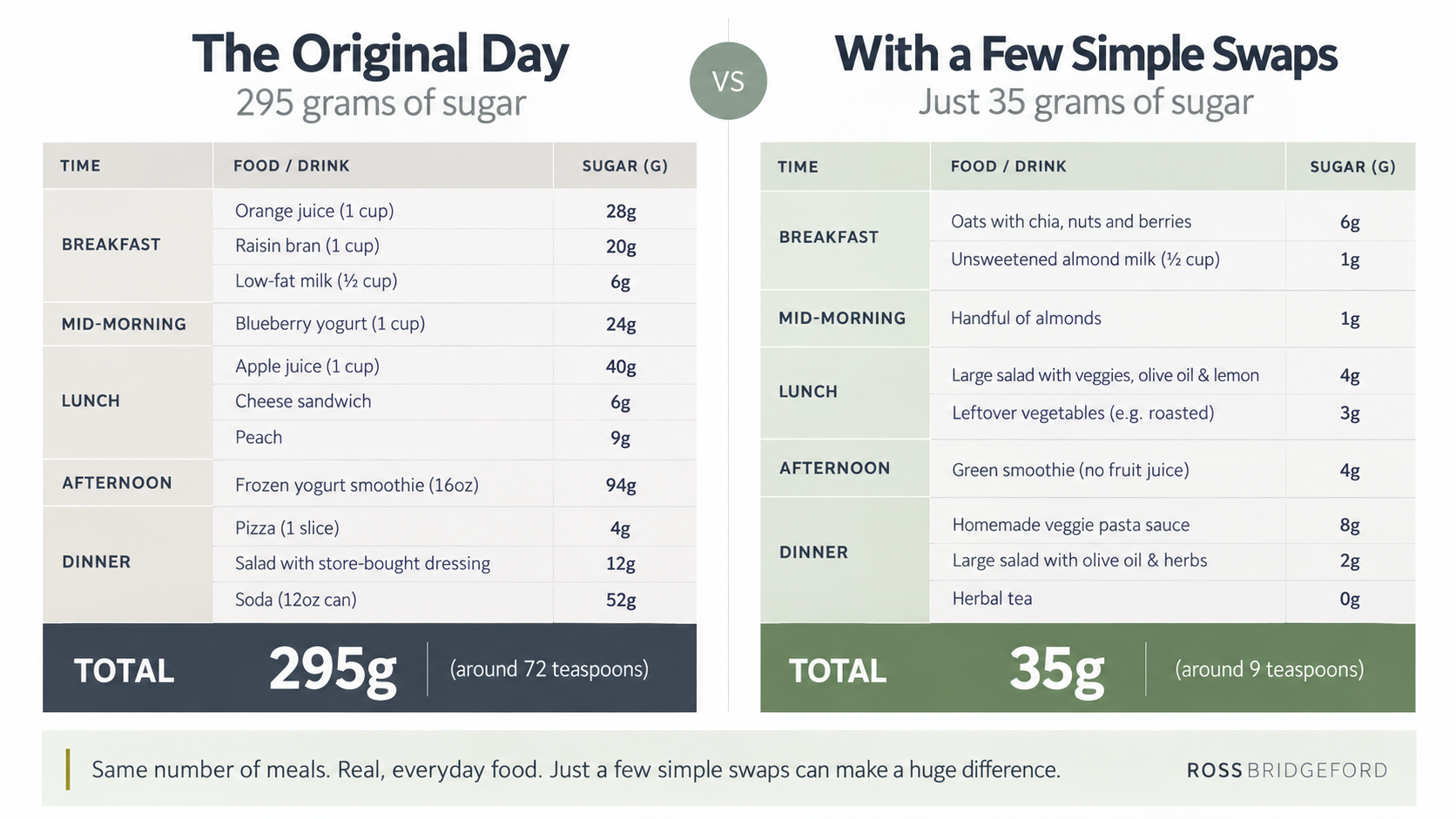
You can see the full 295g breakdown here, and this is why the volume becomes such a problem. Your pancreas is involved, insulin sensitivity is involved, your liver is involved, your appetite regulation is involved, and eventually, for some people, that repeated exposure becomes insulin resistance and type 2 diabetes.
A major BMJ meta-analysis found that every additional daily serving of sugar-sweetened beverages was associated with an approximately 18% higher incidence of type 2 diabetes, which was still around 13% higher after the researchers adjusted for adiposity. You can read that research here.
This isn’t simply about “too much sugar in your blood”. Your pancreas is involved, insulin sensitivity is involved, your liver is involved, your appetite regulation is involved, and as those systems become less effective at regulating glucose you can start to see the knock-on effects in energy, hunger, cravings, weight regulation and eventually metabolic disease.
Your Detoxification System: Sugar and the Liver
Then we have your detoxification system, and particularly your liver.
I think the liver gets forgotten far too often in the sugar conversation. Most people understand that alcohol can put pressure on the liver, but very few think about the metabolic work the liver is doing every time we consume large amounts of certain sugars, particularly fructose.
Again, I am NOT talking about becoming frightened of eating an apple.
Whole fruit comes with fibre, water, vitamins, minerals and a completely different food matrix from a bottle of soft drink or a food sweetened with large amounts of syrup. I’m talking about the concentrated sugar load that has become normal through sweetened drinks, packaged foods, syrups, juices, desserts and processed foods.
Your liver plays a huge role in fructose metabolism, and when we repeatedly supply more energy than the body needs, this is one of the routes through which liver fat can accumulate.
The BMJ umbrella review found evidence from randomised controlled trials linking added sugar consumption with increased liver fat accumulation. This is useful because in this case we aren’t relying only on people filling out questionnaires about what they ate years ago. Controlled research has also seen the effect.
And this is how I always want you to think about your Detoxification Master System. Your liver is involved in blood sugar regulation, metabolism, fat processing, cholesterol regulation and an enormous range of other jobs every minute of every day. When we reduce one of the metabolic loads we’re continually putting through it, while at the same time increasing vegetables, leafy greens, cruciferous vegetables, fibre, healthy fats and antioxidant-rich whole foods, we’re helping from both directions.
Your Immune and Inflammatory Environment
The same overlap appears when we look at inflammation and oxidative stress.
I’ve talked about this for years through the Triple A because I don’t want you thinking about alkalinity, inflammation and oxidative stress as three unrelated health ideas.
Alkaline. Anti-inflammatory. Antioxidant-rich.
They are incredibly interconnected.
A diet dominated by refined, highly processed, sugar-rich foods tends to be nutrient-poor at exactly the same time as it is pushing blood glucose and metabolic demand higher.
Repeated post-meal hyperglycaemia has been linked mechanistically with oxidative stress and vascular dysfunction, and long-term metabolic dysfunction such as insulin resistance and type 2 diabetes is closely intertwined with chronic inflammation.
This is where simply saying “sugar has calories” completely misses the point. When you swap the sugar-rich processed food for vegetables, greens, nuts, seeds, herbs, spices, healthy fats and other whole foods, you’re not just removing sugar. You’re changing the nutritional environment your immune system and every other system in the body is operating within.
And Then There Is Your pH Buffering System
This is obviously the part that brings us directly back to the alkaline approach.
And I want to be precise here because there has been so much confusion around this subject for years.
The goal of an alkaline diet is not to somehow make your blood dramatically more alkaline. Your blood pH is tightly controlled. If it moved significantly outside its normal physiological range, you would have a medical emergency.
The point is the dietary and metabolic load your body is dealing with while maintaining that balance.
This is something I’ve written about for years, including in my guide to the most acid-forming foods, and you can also dig much deeper into the research behind the alkaline approach in my alkaline diet evidence guide and collection of alkaline diet studies here.
Researchers now use established measures such as PRAL, Potential Renal Acid Load, and NEAP, Net Endogenous Acid Production, to estimate the acid-forming load of a person’s overall diet.
And the research here has become VERY interesting.
118 studies. More than one million people.
A 2025 systematic review found higher dietary acid load was associated with higher risk of type 2 diabetes and overall cancer.
The researchers classified the evidence linking NEAP with overall cancer as convincing, while the PRAL evidence was rated highly suggestive. They also quite correctly cautioned that these were observational studies, so we shouldn’t pretend this proves dietary acid load directly causes cancer. You can see the study here.
An earlier meta-analysis involving more than 227,000 participants came to a very similar conclusion. When the researchers compared the highest dietary acid load with the lowest, the pooled cancer risk was 58% higher in the high-acid-load group. Again, this was observational research and therefore shows an association, not proof of causation, but it is a significant association and one I don’t think we should ignore. Here’s the research.
Now bring sugar back into this.
I’m not going to tell you that white sugar sits at the top of some PRAL table as the single most acid-forming food, because that’s not what the science says.
But think about what a high-sugar modern diet actually looks like. It is generally a diet containing more soft drinks, sweetened breakfast products, packaged snacks, processed foods, sauces, desserts and refined foods, with less room left for the potassium-, magnesium- and mineral-rich vegetables, greens, herbs, nuts and seeds that are associated with a lower dietary acid load.
We’re talking about the overall environment created by the diet. And when you put this alongside the separate evidence linking high sugar intake with metabolic dysfunction, obesity, liver fat, cardiovascular disease and some cancers, the picture gets increasingly difficult to dismiss.
Cancer: Let’s Be Accurate About What the Research Says
This is one area where I really don’t want to make some giant headline claim simply because it sounds dramatic.
You’ve probably seen people say that “cancer can’t survive in an alkaline body”.
That isn’t what the alkaline diet does, and it isn’t what the evidence shows. You cannot eat alkaline foods and move your blood pH to some completely different level where cancer cells suddenly disappear.
But we can look at the actual evidence we do have.
As we’ve just seen, higher dietary acid load is associated with higher overall cancer risk across large observational datasets.
Separately, the 2023 BMJ umbrella review found harmful associations between dietary sugar consumption and several cancer outcomes, although the authors specifically noted that the cancer evidence was generally weaker than the evidence for cardiometabolic outcomes.
And in 2026, the World Cancer Research Fund’s Global Cancer Update programme reported on 158 publications from 51 cohort studies. Its expert panel judged the evidence consistent with a probable causal positive association between sugar-sweetened beverages and both pancreatic and colorectal cancer.
Each additional 355ml daily serving of sugar-sweetened beverages was associated with approximately a 9% higher incidence of pancreatic cancer and a 7% higher incidence of colorectal cancer.
I don’t need to tell you “sugar feeds cancer” or make some dramatic claim that the research doesn’t support.
The actual evidence is concerning enough. We know that high dietary acid load is associated with cancer risk. We know higher sugar consumption is linked with obesity, insulin resistance, liver fat and other metabolic abnormalities, several of which themselves influence cancer risk. And we now have prospective data linking sugar-sweetened drinks with specific cancers.
Cardiovascular Disease: This Isn’t Only About Weight
The cardiovascular data is another area where people often don’t realise just how strong the association has become.
In the BMJ umbrella review, every additional 250ml per day of sugar-sweetened beverage intake was associated with a 17% higher risk of coronary heart disease.
Two hundred and fifty millilitres. That’s less than one standard 330ml can.
The same review also found that people with the highest intake of sugar-sweetened beverages had a higher risk of myocardial infarction compared with those with the lowest intake.
Again, this does not mean drinking one can of soft drink gives you heart disease. That’s not how population risk works. But when repeated exposure to something as ordinary as a sugary drink keeps showing up alongside coronary disease, diabetes, obesity and liver dysfunction, it becomes very hard for me to understand why sugar still isn’t given more attention in the everyday health conversation.
And Your Brain Isn’t Separate From Any of This
This one is particularly interesting because most people still associate excessive sugar mainly with weight gain and diabetes.
Your brain doesn’t exist separately from your metabolic health.
A 2025 systematic review and dose-response meta-analysis of prospective cohort studies found that people with higher sugar-sweetened beverage intake had a 49% higher relative risk of Alzheimer’s disease.
There was substantial variation between the studies, so this isn’t proof that sugary drinks directly cause Alzheimer’s, but the researchers rated the certainty of the evidence as moderate and concluded that higher consumption may increase Alzheimer’s risk. You can see the research here.
This is another good example of why I want you thinking in systems rather than isolated symptoms. Blood sugar regulation, cardiovascular health, inflammation, liver health and brain health overlap. The healthier those core systems are, the better the environment you are creating for everything else.
This Is Exactly What I Mean by the Triple A
If you’ve read The Alkaline Life, followed my work for any length of time, or been through one of my programs, you’ll know that I keep bringing you back to the same foundation: Alkaline, Anti-inflammatory and Antioxidant-rich.
The reason I love this framework is that one good food choice normally gives you all three at once.
When you replace processed sugar-rich foods with leafy greens, vegetables, herbs, nuts, seeds, healthy oils and other whole foods, you naturally start shifting the acid-forming load of the diet, dramatically increase your intake of anti-inflammatory nutrients and fats, and flood the diet with antioxidants and the micronutrients your Five Master Systems use every single day.
That is why this doesn’t need to become complicated.
You’re not trying to separately run an alkaline diet, an anti-inflammatory diet, an antioxidant diet, a liver diet, a hormone diet and a heart diet. It’s the same handful of foundational foods and habits doing an enormous amount of the work, and getting excessive sugar out makes room for all of them.
Put the Last Few Days Together
This is why I’ve wanted to take you through this in the order we have this week.
First we looked at how a normal-looking day can reach 295 grams of sugar without somebody consciously spending the day eating sweets, and how just a few sensible swaps can dramatically reduce that number.
Then we looked at the supposedly healthy sugar alternatives, because replacing white sugar with unlimited honey, maple syrup or agave isn’t really solving the problem. If you missed that one, my complete guide to sugars, sweeteners and healthier alternatives is here.
Today I wanted you to see why reducing the overall load is worth doing in the first place.
I’m not particularly concerned about somebody having a dessert when they go out for dinner once in a while. What concerns me far more is when sugar has become woven through an otherwise ordinary day, appearing in breakfast, drinks, snacks, sauces, yoghurt, dressings and packaged foods without the person even seeing themselves as somebody who eats much sugar.
That’s the pattern I want to change.
And the brilliant thing is that we already know from the earlier breakdown that changing it doesn’t require you to rebuild your entire diet.
That 295g example came down to around 35g through a handful of fairly simple swaps. Nobody stopped eating breakfast, lunch or dinner, nobody was surviving on salad leaves, and there was no requirement to spend all day trying to resist food through willpower.
The problem is serious.
But fixing your own diet does not have to be difficult.
If You’re Ready to Actually Do This…
I’ve spent a lot of time this week giving you the information because I want you to understand what we’re changing and why.
But ultimately, knowing all of this only helps if you can put it into practice.
The 7-Day Quit Sugar Challenge
Come and do this with me.
I’ve created a brand new 7-Day Quit Sugar Challenge where I’m going to take you through the whole process with me, day by day.
We’ll have three days to get properly prepared first, then for seven days I’ll show you exactly what to eat, what to swap, how to deal with cravings when they hit, how to keep your blood sugar more stable and what to do when work, family, eating out or normal life gets in the way.
You don’t need to become perfect, and you certainly don’t have to promise yourself you’re never touching sugar again.
We just need to get it back under control.
Ross