


The TRUTH About Oxalate (Is Kale Bad After All?)

The short answer: for most people, oxalates are nothing to worry about, and you certainly don’t need to stop eating your greens. And no, kale isn’t high in oxalate – it’s spinach, Swiss chard, beet greens and rhubarb that are. Oxalate only becomes a real concern if you form calcium oxalate kidney stones, have kidney disease, or have a gut condition that makes you absorb more of it. Even then, the research says to go easy on a handful of very high foods, not to cut out vegetables.
Spinach is going to kill you, man! Your vegetables are TOXIC! Broccoli is gonna hunt you down! Or something like that…
Over the past few years oxalates have been getting a LOT of attention. We are being told that they are responsible for everything bad going on in our body. We’re being told that fresh, green vegetables are TOXIC.
Strong words. Toxic.
Look, there is a LOT of nuance here, and a ton of detail that is so important. Sadly, in nutrition these days there is a lot of financial gain to be had by being shocking and contrarian. People skip the detail, skip the nuance and jump to the big conclusion that suits their narrative. Saying something everyone THINKS is healthy is suddenly KILLING YOU gets attention and clicks, and rarely comes with any substance.
And it makes me kinda mad. And negative emotions are acid-forming, so I don’t get mad…I get into the studies. The studies soothe me!
As with everything in health, it’s rarely black and white. For a small number of people, being aware of oxalates is a worthy consideration. But even for those at-risk groups, it has a lot LESS to do with the oxalate we EAT than we’re being led to believe.
So today we’re going to dig into what oxalates are, where they come from, how the body deals with them, which foods are actually high in them, who is at risk (and who isn’t), what the studies tell us, and what your next steps are.
But right up front, I want to let you know: the vast majority of people reading this will NOT need to worry about oxalate.
Prefer to watch? Here’s my full video on oxalates:
Is kale high in oxalates? (Is kale bad after all?)
Let’s start with the question I get asked most: no, kale is NOT high in oxalates. A cup of raw kale has about 3 mg. Half a cup of cooked spinach has around 490 mg. That’s well over a hundred times more (Oxalosis & Hyperoxaluria Foundation).
I’ll be honest: when I first wrote about this back in 2017, I lumped kale in with the high-oxalate greens, because that’s how so many of the lists online presented it. The better data says otherwise. Kale, broccoli, bok choy, rocket, lettuce, cabbage and cauliflower are all LOW in oxalate.
And here’s a nice bonus: the calcium in kale is absorbed about as well as the calcium in milk (Heaney and Weaver, 1990), which is not the case with spinach (more on that below).
So if you love your kale juices, kale salads and kale chips – carry on!
What are oxalates?
Oxalates (the salts of oxalic acid) are small compounds found widely in nature – in plants, in animals, and in us. They’re made of just two carbon atoms and four oxygen atoms, and they carry a charge that makes them bind readily to minerals like calcium.
In plants, oxalates have various roles, like helping to regulate calcium and acting as a defence against animals that want to eat them. In our diet, they’re found in foods and drinks including spinach, rhubarb, nuts, cocoa and tea.
Now, they have no actual role in the human body. They’re simply a waste product. And this is the interesting bit that’s so often missed: oxalate doesn’t only come from food. Your body makes it 24/7 as a normal by-product of metabolism.
Which means that even if you cut out every oxalate-containing food on Earth, your body would still have oxalate to deal with. Your body HAS to be able to manage it. Remember that part, because it’s the key to this whole debate.
Where do oxalates come from?
The oxalate your body has to get rid of comes in roughly equal parts from your diet and from your own metabolism (Knight et al., 2006). So diet is only half the story. Let’s look at both halves.
From your food
The food side is where all the fear-mongering is focused – from certain books, websites and diet movements (hello, carnivore crowd). The argument is that eating spinach, nuts, seeds, berries and so on floods your body with oxalate and causes all sorts of disease.
And this is where it gets confusing, because the oxalate lists out there are ALL over the place. When I went looking, I found well-known sites contradicting each other on whether broccoli and cauliflower are high or low, and big health sites lumping all leafy greens together, when some of the most nutrient-dense greens have barely any oxalate at all. With acid/alkaline food charts there are small differences between lists; with oxalate charts, some of the differences are huge.
That matters, because the foods people are being told to avoid are REALLY nutrient dense. So I’ve put together the best list I could find below, using one consistent source.
From inside your body
The other half of your oxalate is made inside your body, when you break down nutrients that are precursors to oxalate. This is where the ‘evil toxic vegetables’ argument comes a little undone. Three of the big ones:
1. Collagen and gelatine. The amino acid hydroxyproline, found in collagen, gelatine and bone broth (in other words, meat, skin and connective tissue), is broken down into oxalate. When researchers gave people 30 g of gelatine instead of whey protein, their urinary oxalate went up by 43% (Knight et al., 2006), and in healthy people hydroxyproline accounts for around 15% of the oxalate in their urine (Fargue et al., 2018). Interesting how the carnivore folks are screaming that veggies are killing us with oxalate, while bone broth and collagen powders are some of the biggest sources of oxalate made inside the body!
2. Fructose. We know the impact fructose has on the liver and on inflammation. It also feeds oxalate production, and in a study of over 3,000 people, higher fructose intake and a higher BMI were both linked with more oxalate in the urine (Taylor and Curhan, 2008). We’re not talking about whole fruit here. We’re talking about fruit juices, soft drinks, dried fruit, syrups and processed foods sweetened with high-fructose corn syrup. Basically, processed rubbish (here’s how I’d tackle the sugar cravings).
3. Vitamin C. This one confuses people. We NEED vitamin C, and yet the body turns some of it into oxalate. So should we avoid vitamin C? Of course not – the vitamin C in your fruit and vegetables is not the problem. But high-dose supplements are a different story: Swedish men taking 1,000 mg vitamin C tablets had twice the risk of kidney stones of men taking no supplements (Thomas et al., 2013). Food, yes. Mega-doses, think twice.
High-oxalate foods list (and the low-oxalate swaps)
Here’s where the common foods sit, per normal serving, from the Oxalosis & Hyperoxaluria Foundation’s 2024 list (OHF). I’ve added my alkaline rating next to each so you can see how they fit with the way you’re already eating. Their bands are: very high 300 mg+, high 100–299 mg, moderate 25–99 mg and low under 25 mg per serving.
Very high oxalate (300 mg+ per serving)
| Food | Serving | Oxalate (mg) | My alkaline rating |
|---|---|---|---|
| Rhubarb, raw | 1 cup, diced | 1293 | – |
| Swiss chard, cooked | ½ cup | 293–594 | Highly Alkaline |
| Beet greens (mangold) | ½ cup | 590 | Highly Alkaline |
| Spinach, cooked | ½ cup | 493 | Highly Alkaline |
High oxalate (100–299 mg)
| Food | Serving | Oxalate (mg) | My alkaline rating |
|---|---|---|---|
| Sweet potato, with skin | ½ cup | 158 | Mildly Alkaline |
| Almonds | ¼ cup | 107 | Moderately Alkaline |
| Buckwheat | ½ cup | 105 | Mildly Alkaline |
Moderate oxalate (25–99 mg)
| Food | Serving | Oxalate (mg) | My alkaline rating |
|---|---|---|---|
| Cocoa powder | 2 tbsp | 79 | Mildly Alkaline |
| Cashews | ¼ cup | 72 | Mildly Alkaline |
| Dark chocolate | 1 oz (28 g) | 65 | Neutral / Mildly Acidic |
| Chia seeds | 1 tbsp | 61 | Moderately Alkaline |
| Quinoa, cooked | ½ cup | 55 | Moderately Alkaline |
| Black beans, cooked | ½ cup | 51 | Mildly Alkaline |
| Beetroot, cooked | ½ cup | 48 | Highly Alkaline |
| Tahini | 1 tbsp | 41 | Mildly Alkaline |
| Celery, raw | 1 cup | 30 | Highly Alkaline |
| Carrots, raw, grated | 1 cup | 30 | Highly Alkaline |
| Black tea | 1 cup | 27 | Moderately Acidic |
| Blueberries | 1 cup | 27 | Neutral / Mildly Acidic |
Low oxalate (under 25 mg)
| Food | Serving | Oxalate (mg) | My alkaline rating |
|---|---|---|---|
| Kale, raw | 1 cup | 3 | Highly Alkaline |
| Rocket (arugula) | 1 cup | 1 | Highly Alkaline |
| Bok choy | 1 cup | 3 | Highly Alkaline |
| Lettuce | 1 cup | 3 | Highly Alkaline |
| Broccoli, raw | 1 cup | 9 | Highly Alkaline |
| Cauliflower | ½ cup | 2 | Highly Alkaline |
| Cabbage, raw | 1 cup | 4 | Highly Alkaline |
| Cucumber | 1 cup | 5 | Highly Alkaline |
| Bell pepper (capsicum) | ½ cup | 11 | Highly Alkaline |
| Avocado | ½ cup | 7 | Highly Alkaline |
| Lemon | 1 slice | 1 | Moderately Alkaline |
| Lentils, cooked | ½ cup | 8 | Mildly Alkaline |
| Chickpeas, cooked | ½ cup | 9 | Neutral / Mildly Acidic |
| Tofu | ½ cup | 10 | Neutral / Mildly Acidic |
| Flaxseed | 2 tbsp | 2 | Moderately Alkaline |
| Pumpkin seeds | 2 tbsp | 2 | Moderately Alkaline |
| Walnuts | ¼ cup | 18 | Mildly Alkaline |
| Macadamias | ¼ cup | 13 | Mildly Alkaline |
| Strawberries | 1 cup | 6 | Neutral / Mildly Acidic |
| Brown rice, cooked | ½ cup | 5 | Neutral / Mildly Acidic |
Oxalate values from the OHF Oxalate List (Feb 2024); other lists give different numbers for some foods, and content varies with growing conditions and preparation. Alkaline ratings from my Acid/Alkaline Food Chart (see the full alkaline foods list).
What jumps out? A huge number of my favourite alkaline foods – kale, rocket, broccoli, bok choy, cucumber, avocado, lemon, lentils, flaxseed, pumpkin seeds – are LOW in oxalate. The really high ones are a short list: spinach, Swiss chard, beet greens and rhubarb, with almonds, sweet potato and buckwheat behind them. And some of the others on the ‘avoid’ lists, like chocolate and black tea, aren’t foods we’d be eating much of on the alkaline diet anyway.
Free download
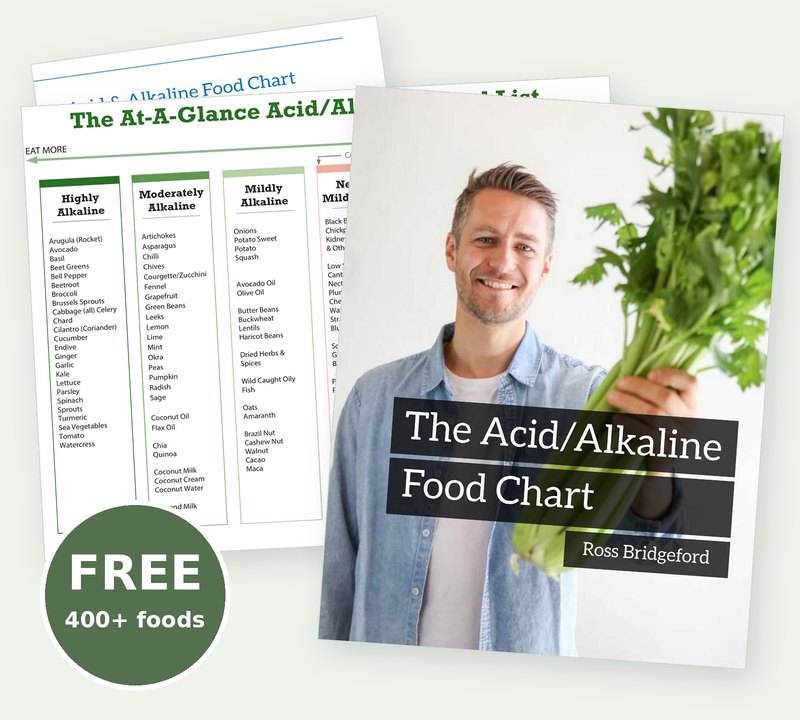
Every green, rated
My free Acid/Alkaline Food Chart rates 400+ foods from Highly Alkaline to Highly Acidic, with a one-page version for your fridge, so you can mix up your greens with confidence.
It’s free. Just tell me where to send it.
How your body deals with oxalate
To understand where the real concerns are, we need to look at how your body handles oxalate – both the oxalate you eat and the oxalate you make. Three places matter.
1. Your gut
Oxalate from food is absorbed along the intestinal tract, and digestive health matters a LOT here. Conditions like Crohn’s disease, ulcerative colitis and coeliac disease, and surgery such as gastric bypass or bowel resection, can mess with fat absorption. Unabsorbed fat grabs the calcium that would normally bind oxalate in the gut, so far more oxalate gets absorbed. This is called enteric hyperoxaluria, and it’s where oxalate becomes a genuine risk. In practically every case where one of my Alkaline Life Club members has told me they’ve been flagged for high oxalate, they have a digestive condition like Crohn’s or ulcerative colitis.
Your gut bacteria matter too. A bacterium called Oxalobacter formigenes uses oxalate as its main food, breaking it down before you absorb it. People colonised with it had about a 70% lower risk of being a recurrent calcium oxalate stone former (Kaufman et al., 2008). Antibiotics can wipe it out, and in a study of nearly 26,000 people with kidney stones, recent courses of several common antibiotics were linked with higher stone risk, up to more than double for sulfa drugs (Tasian et al., 2018).
Again, it’s not eating the foods that contain oxalate that’s the issue. It’s the body’s ability to process and remove it. Look after your gut, and your body deals with oxalate easily.
2. Your liver
The liver makes much of the oxalate produced inside the body. The main problems here are in people with primary hyperoxaluria, a rare genetic condition (affecting around 1 to 3 people in a million) where faulty liver enzymes produce far too much oxalate. If you don’t have this genetic condition, this isn’t something you need to worry about.
3. Your kidneys
Your kidneys filter oxalate out of your blood and send it out in your urine, and in healthy people they clear it quickly and efficiently (Osswald and Hautmann, 1979). When researchers gave people a measured dose of oxalate, urinary oxalate rose much faster in people with certain conditions (such as idiopathic hypercalciuria or a past gastric bypass) than in healthy people (Holmes et al., 2005).
Where it does matter is if your kidneys are already struggling: in people with chronic kidney disease, higher urinary oxalate has been linked with faster decline in kidney function (Waikar et al., 2019). So if you have kidney disease, oxalate is worth talking through with your kidney specialist.
Do oxalates cause kidney stones?
This is the big claim, so let’s take it seriously. First, there are four main types of kidney stone:
- Calcium stones (mostly calcium oxalate) – the most common type, and the one the anti-oxalate crowd talks about
- Uric acid stones – linked with an acidic urine, a high-protein diet and excess fructose from processed foods
- Struvite stones – caused by urinary tract infections
- Cystine stones – caused by a rare inherited condition
So here’s what the studies actually show about oxalate in food and calcium oxalate stones.
The link is small. In the biggest study, following more than 240,000 men and women for years, the people eating the most oxalate had only a modestly higher risk of stones than those eating the least (about 20% higher in men and older women), and there was no link at all in younger women. The researchers concluded their data did not support dietary oxalate as a major risk factor (Taylor and Curhan, 2007). The one food that stood out was spinach: people eating it eight or more times a month had around a 30% higher risk, which is why if you’re a stone former, spinach is the one to moderate.
Your diet’s oxalate barely moves your urine’s oxalate. In over 3,000 people, those eating the most oxalate passed only about 1.7 mg a day more oxalate in their urine than those eating the least, and the researchers concluded the impact of dietary oxalate on urinary oxalate appears to be small. Eating more calcium was linked with LESS oxalate in the urine (Taylor and Curhan, 2008).
Vegetable-rich diets LOWER stone risk. In the same Harvard groups, people whose diets were closest to the DASH diet (high in fruit, vegetables, nuts and legumes) had 40–45% lower risk of kidney stones, even though that way of eating contains MORE oxalate. The authors specifically warned against oxalate restriction if it means eating less fruit, vegetables and whole grains (Taylor et al., 2009). And in a trial of 57 recurrent stone formers with high urinary oxalate, a DASH-style diet tended to lower the overall risk measure (calcium oxalate supersaturation) more than a low-oxalate diet did, thanks to more magnesium, more citrate and a higher urine pH (Noori et al., 2014).
Alkaline minerals protect you. Higher potassium intake was linked with a substantially lower risk of stones in all three Harvard groups, while a high ratio of animal protein to potassium – a measure of dietary acid load – was linked with higher risk (Ferraro et al., 2016). An Italian study of stone formers found the same: dietary acid load was a significant risk factor (Vezzoli et al., 2015).
So while some are saying ‘don’t eat leafy greens, veggies, nuts and seeds because of the oxalate’, you’d be removing the exact foods – packed with potassium, magnesium, calcium and citrate – that protect your kidneys and help prevent stones. And not just calcium stones, but uric acid stones too.
Are oxalates an ‘anti-nutrient’?
The second claim is that oxalate-containing foods are ‘anti-nutrients’. Oh, what’s in a name. These compounds were given that name in a context completely separate from human health, because they can lower the absorption of certain nutrients in the same plant. Call them phytonutrients and suddenly they don’t sound so scary.
Here’s the honest version for oxalate. Oxalate does bind the calcium in the same food: in a classic study, people absorbed only about 5% of the calcium from spinach, compared with about 28% from milk (Heaney, Weaver and Recker, 1988). So don’t count spinach as a calcium source. But kale’s calcium is well absorbed, and the effect is about that meal’s calcium, not your whole day. It doesn’t drain the minerals from the rest of your diet.
The foods we’re being told to avoid are so abundant in minerals and antioxidants that you’d miss out on FAR more by avoiding them than you’d lose to a little binding. I’ve covered this in more depth in The Truth About Anti-Nutrients.
What about the green smoothie case?
You might have seen a scary screenshot of a medical paper titled ‘Green Smoothie Cleanse’ Causing Acute Oxalate Nephropathy being shared as proof that vegetables are dangerous. It’s not a study. It’s a teaching case about ONE woman, aged 65, who did a 10-day juice cleanse made from oxalate-rich greens. She also had a history of gastric bypass surgery and had recently been on a long course of antibiotics – two of the biggest risk factors there are – and sadly she developed kidney failure (Makkapati et al., 2018).
It’s a genuinely sad case, and it does carry a real lesson: if you have risk factors, don’t juice large amounts of the very high-oxalate greens (spinach, chard, beet greens) every day. Mix up your greens. But one person with several serious risk factors tells us nothing about the rest of us eating our vegetables, and the large studies above show the opposite.
Who should be careful with oxalates?
So should anyone be concerned? Yes, a small group of people should be a little more careful:
- People who have had calcium oxalate kidney stones, especially if a 24-hour urine test shows high oxalate
- People with chronic kidney disease
- People with Crohn’s disease, ulcerative colitis, coeliac disease or other causes of fat malabsorption
- People who have had gastric bypass or bowel surgery
- People with the rare genetic condition primary hyperoxaluria
- People on repeated or long courses of antibiotics, or taking high-dose vitamin C supplements
Even for these groups, the answer isn’t to cut out vegetables. The Harvard researchers put it well: it’s reasonable for stone formers with high urinary oxalate to go easy on a few very high-oxalate foods like spinach and almonds, but not to restrict oxalate in a way that means eating less fruit, vegetables and whole grains (Taylor et al., 2009). Keep your diet alkaline-rich, anti-inflammatory and full of those supportive minerals, work with your doctor or dietitian, and if you have a gut condition, put your energy into healing it.
How to enjoy your greens and not worry
- Mix up your greens. Rotate kale, rocket, cos, bok choy, broccoli and cucumber, especially in your daily juices and smoothies, rather than using spinach every single day.
- Boil the big ones. Boiling spinach, chard or beet greens cuts their soluble oxalate by roughly 30–87%, much more than steaming. Throw the water away (Chai and Liebman, 2005).
- Pair them with calcium. Calcium in the same meal binds oxalate in the gut so less is absorbed. Think tahini, kale, almond milk or a little kefir alongside your spinach.
- Drink plenty of water. Dehydration is one of the biggest stone risks of all. I aim for 3–4 litres a day.
- Cut the fructose and the processed rubbish – soft drinks, juices, syrups and processed foods.
- Skip the mega-dose vitamin C unless your doctor has prescribed it. Get your vitamin C from food.
- Look after your gut, especially after antibiotics, with plenty of fibre-rich plant foods.
The bottom line: don’t stress about oxalate
With so many of these shocking, contrarian ‘a food you thought was healthy is suddenly killing you’ stories, the theory is what I call a ‘dotted line’ theory. There’s a logical-sounding idea behind it, but as soon as you look at the research, it falls apart.
We’ve been here before with nightshades, goitrogens, lectins and anti-nutrients, and it’s always the same story. For most people, there’s no evidence these foods do harm, and plenty of evidence they do a lot of good.
So in short: don’t stress about oxalate. Eat your greens (and mix them up), drink your water, cut the processed sugar, and if you’re in one of the at-risk groups, work with your doctor rather than cutting out the foods that protect you.
And as ever, if you like what I’m teaching, grab a copy of my book The Alkaline Life, which is PACKED with studies and scientific references.
Oxalate FAQ
Are oxalates bad for you?
Not for most people. Oxalate from food is only a real concern if you form calcium oxalate kidney stones, have chronic kidney disease, or have a gut condition that makes you absorb more of it (such as Crohn’s disease or a gastric bypass). Even then, the advice is to go easy on a few very high-oxalate foods, not to cut out your vegetables.
Is kale high in oxalates?
No. Kale is a low-oxalate green, with about 3 mg in a cup of raw kale. It’s spinach, Swiss chard, beet greens and rhubarb that are very high (spinach has around 490 mg in half a cup cooked). And the calcium in kale is well absorbed, unlike the calcium in spinach.
Is spinach high in oxalates?
Yes, spinach is one of the highest-oxalate foods there is, at around 490 mg per half cup cooked. For most people that’s not a problem, but if you’ve had kidney stones, don’t make spinach your only green, and boil it (and drain the water) rather than juicing big amounts of it raw.
What foods are highest in oxalates?
Rhubarb, spinach, Swiss chard and beet greens are in a league of their own. After those come sweet potato with the skin, almonds and buckwheat, then cocoa and dark chocolate, cashews, chia seeds, quinoa and black beans. Most other vegetables, including kale, broccoli, bok choy, rocket, lettuce, cucumber and cauliflower, are low.
Do oxalates cause kidney stones?
Most kidney stones are calcium oxalate stones, but the oxalate in your food is only a small part of the story. In a study of over 240,000 people, the highest oxalate eaters had only a modestly higher risk, and none at all in younger women. Low calcium intake, not drinking enough, high fructose, high-dose vitamin C supplements, gut problems and antibiotics matter as much or more, and diets rich in vegetables actually lower stone risk.
Should I follow a low-oxalate diet?
Only if your doctor or dietitian has recommended it, usually because you form calcium oxalate stones and a 24-hour urine test shows high oxalate. Even then, the research supports moderating a few very high foods like spinach and almonds while keeping plenty of fruit and vegetables, rather than cutting them out.
Does cooking reduce oxalates?
Yes. Boiling cuts the soluble oxalate in vegetables by roughly 30 to 87%, much more than steaming. Throw the water away afterwards, because that’s where the oxalate goes.
What is oxalate dumping?
It’s a term from online low-oxalate communities for symptoms some people say they get when they cut oxalates quickly. There’s no published research describing it, so if you feel unwell after a diet change, talk to your doctor rather than assuming it’s oxalate.
Free download
Get my free Acid/Alkaline Food Chart
400+ foods rated from Highly Alkaline to Highly Acidic, with a one-page version for your fridge.
It’s free. Just tell me where to send it.
Ross

Ross has taught and coached realistic, sustainable alkaline eating since 2004, working with tens of thousands of people around the world. He’s the author of The Alkaline Reset Cleanse and The Alkaline Life (Hay House). Ross is a health educator, not a doctor or dietitian, so if you have kidney stones, kidney disease or a gut condition, talk to your own health professional before making big changes to your diet.
References
- Oxalate List (February 2024), Oxalosis & Hyperoxaluria Foundation
- Heaney and Weaver (1990), Calcium absorption from kale, American Journal of Clinical Nutrition
- Heaney, Weaver and Recker (1988), Calcium absorbability from spinach, American Journal of Clinical Nutrition
- Knight et al. (2006), Hydroxyproline ingestion and urinary oxalate and glycolate excretion, Kidney International
- Fargue et al. (2018), Hydroxyproline metabolism and oxalate synthesis in primary hyperoxaluria, Journal of the American Society of Nephrology
- Taylor and Curhan (2008), Determinants of 24-hour urinary oxalate excretion, Clinical Journal of the American Society of Nephrology
- Thomas et al. (2013), Ascorbic acid supplements and kidney stone incidence among men: a prospective study, JAMA Internal Medicine
- Kaufman et al. (2008), Oxalobacter formigenes may reduce the risk of calcium oxalate kidney stones, Journal of the American Society of Nephrology
- Tasian et al. (2018), Oral antibiotic exposure and kidney stone disease, Journal of the American Society of Nephrology
- Osswald and Hautmann (1979), Renal elimination kinetics and plasma half-life of oxalate in man, Urologia Internationalis
- Holmes, Ambrosius and Assimos (2005), Dietary oxalate loads and renal oxalate handling, Journal of Urology
- Waikar et al. (2019), Association of urinary oxalate excretion with the risk of chronic kidney disease progression, JAMA Internal Medicine
- Taylor and Curhan (2007), Oxalate intake and the risk for nephrolithiasis, Journal of the American Society of Nephrology
- Taylor, Fung and Curhan (2009), DASH-style diet associates with reduced risk for kidney stones, Journal of the American Society of Nephrology
- Noori et al. (2014), Urinary lithogenic risk profile in recurrent stone formers with hyperoxaluria: a randomized controlled trial comparing DASH-style and low-oxalate diets, American Journal of Kidney Diseases
- Ferraro et al. (2016), Dietary protein and potassium, diet-dependent net acid load, and risk of incident kidney stones, Clinical Journal of the American Society of Nephrology
- Vezzoli et al. (2015), Dietary style and acid load in an Italian population of calcium kidney stone formers, Nutrition, Metabolism and Cardiovascular Diseases
- Makkapati, D’Agati and Balsam (2018), ‘Green smoothie cleanse’ causing acute oxalate nephropathy, American Journal of Kidney Diseases
- Chai and Liebman (2005), Effect of different cooking methods on vegetable oxalate content, Journal of Agricultural and Food Chemistry

What if I don’t have a juicer? Can I use my blender?
Thanks for the great articles and information.
Lisa Campbell
Hi Ross, when are you going to teach the 3 part cleanse? Would love to take it. I’ve taken the 7 day juice challenge and just finished the Alkaline Diet. Such wonderful information. I’m 71 and beginning to feel better, not so bloated and wake up with more energy. Thank you!
Hello Ross
I’m so pleased I’ve found your website! I’ve been diagnosed with breast cancer and, after much research, want to follow an alkaline diet.
My question is this…..in relation to the juice/smoothie debate, what balance would you recommend i.e 80/20 % of time juicing to smoothies intake, 50/50 or what percentage would you think?
Many thanks Ross
Please don’t publish my full name or e-mail addres Thank you
I have lupus. Can the 7 day cleanse help.
Hi Aban – this is one of the students from my Alkaline Reset Cleanse – Juanita: https://www.youtube.com/watch?v=nJ2fVmmTMec
Please let me know if you will be repeating the Wednesday training. I will be on the road and really want to hear this. I am a big fsn!! HELP.
Hi Bernice
If you register for it, you’ll be sent all info regarding repeats or replays.
R
Just registered…thank you! “BC” Bernice
SUPERB! Can’t wait to teach it 🙂
Where can I get Alkaline Cleanse Workshop?
If I’m worried about my osteoporosis do I need to worry about cutting down on these oxalates?
Thank you so much Ross for that informative session! I had been told not to eat spinach because of osteoporosis.
I have recently joined your Alkaline Base Camp and within 3 days of cutting out gluten and fructose the pain and inflammation from my joints disappeared! Thank you, and also for all your videos and book which are so inspiring.
I am really excited about your juice cleanse and your 3 part series on preparing for the alkaline cleanse. Put my name down.
Thank you so much.
Wonderful thank you for clearing up all the confusion for me I thought I was going to go crazy
What about pomegranate juice
I think that you are unfairly demonizing gluten and sugar. Sure sugar is bad for you, but it is no worse than an equivalent amount of chicken breast (or other meat), and it is probably considerably better given the salt.
There are a lot of details behind this, but one example – Chicken breast raises blood sugar as much as pure sugar in pre-diabetics.
And regarding gluten – see this video from Mic the Vegan. https://www.youtube.com/watch?v=n-x0Vbbjdo0
Hi Jeff
By this logic I would not say sugar is OK and shouldn’t be demonized, I would say chicken is just as bad.
Big picture though, I disagree with you. I also disagree with your assertion that salt is bad (there is good and bad salt – see my article here: http://liveenergized.com/live-energized-tv/heart-disease-cover-up/
Sugar and gluten are hugely damaging to the body. Other foods are too of course, and I accept your thoughts on chicken breast or other meat (I haven’t eaten meat in 21 years btw – I’m not trying to support that), but sugar and gluten deserve to be revealed for what they are.
Ross
I have very active Rheumatoid Arthritis. Horrible decease. Looking forward to your cleanse workshop.
It is truly horrible – nobody deserves to be in pain like RA brings so often. I truly hope I can help for you.
Thank you Ross. I am one of those with thyroid issues. (Hypo). Had this problem for over 25 years and weight gain, hair loss, leg cramping etc. Although many have told me to stay away from Kale, (by the way broccoli too) as this worsens my symptoms, I do believe what you said in your video, that its the acidic foods that are causing these symptoms.
I haven’t been juicing, as folks tell me that I am losing the benefits of the roughage and I don’t have the correct juicer. I have a filter system at home that is attached to my kitchen pipes. Even though I have only just started, some of the benefits I am seeing already, such as some weight loss, more energy, feel lighter, is due to reducing and stopping, milk, cheese, bread, rice and other foods mentioned in your videos.
I look forward to the Alkaline Cleanse workshop.
I have poly myalgia rheumatica, I have always. raten lots of fruit and vegetables all kinds, I wish I could get rid of it I have had this for 10 years, having to have wretched steroids. Can Ido anything elseformybody and health.
Thanks Ross,
This was a great explanation. Love that you back everything up with research (and common sense).
Bev. Aus.
Thanks Ross.
Looking forward to the Alkaline Cleanse Workshop and to getting back on track.
Recently became sluggish and put on weight to find out the thyroid was the problem.
Couldnt hear your video
Can pregnant women follow any of your programs without putting a toxic burden on the fetus?
Hi Ross
I was diagnosed with raynauds and scleraderma. I got a kidney stone a few years back which I passed. Omg the pain. Apparently, I have another one sitting in my kidney. I was juicing every day kale, spinach beets etc. I was told that this had caused the stone. The urologist told me to add a pinch of magnesium to my juice which j do. I struggle with maintaining my weight too skinny. I have also been told that I have some crackling in my lung. I have controlled my condition with diet, exercise I,e. Yoga, dance and gym. I find that juices make me very cold. I was told by my naturopath to cut out oats, eggs and lots of other stuff. I just don’t know what to eat anymore
What foods contain calcium and magnesium?
Hi Ross,
thanks for the video and putting me straight about Kale not being bad for me !! I have signed up to your cleanse workshop, and am looking forward to that!
I live in the UK, and it seems as though your alkaline books are not available here. Strange as it seems to me as I thought that you would have been a best seller over here. Maybe you need to have a word with your publishers.
Keep up the great work
Hi ross
Im planning on getting a distiller or a bigger filter for water.
Does the distiller negatively effect minerals? Surely minerals come from plants anyway. I did hear a about that at one point but could do with your input.
I cant afford anything expensive so maybe even one step up from a britta filter would do.
Thanks for any help
Dan
Hi Ross. Do you have a book that I can buy with meal plans/menu plans and recipes. I am 95% vegan and gluten and sugar free but I am never sure if I am getting enough food or enough of what I need. I would prefer an actual book to downloads ? Please contact me at [email protected]. I am also interested in your training sessions but because of time difference, they are when I am sleeping
Warm regards
Marianne
Hi Ross,
Thank you for the video explaining everything.
I have arthritis in my fingers and digestive problems. I have been a vegetarian for 43 years. I always thought I ate well but I did have digestive problems my whole life. I loved ice cream, cheese, and breads along with fruit, vegetables and nuts.
I am ready to do things right.
Thank you for being here for us.
Sincerely, Niki
Hello Ross,
Is the sugar in water kefir bad for breast cancer patient who finished with chemo and radiation .
Thank you .
Hi and thank you for educating us
But what about lectins ?! I must find the video a send to you
I eat lots of cheese. I am new to oculars but have burning issues after urunation
Should I cut the cheese ?
My brother has chones and believes he can’t eat any healthy foods and on top of that we are twins and both are mild hemophiliacs so surgery for anything is a big risk. Can a hi oscolate diet reverse chrones. Thanks.
Thanks Ross for clearing up some confusing things for my Hashimotos healthy diet. I’ve been gluten free for a few years and the results have been astounding….now all this stuff about the greens I shouldn’t be eating threw me for a real loop. Also, I’ve watched and participated in your videos 1 2 &3 and . I AM READY TO JOIN YOUR ALKALINE DETOX CLEANS 2017…so excited….but I’m unable to find where I can pay to join. Help please.
Hey Lisa – I’ll be explaining everything in my next, and last, video in this workshop – which is coming out on Wednesday. Can’t wait to have you in the group!
I have had kidney stones and some was removed. Still have a piece left.
what would be the effect of using food with more oxalate in my body
You are spot on Ross as usual. Love your teachings❣
Thank you … great video. Very informative. Super excited to participate in the alkaline cleanse !!!
Hey Ross,
Thanks for your wonderful service in researching health and sharing your expertise. God bless you for teaching everyone to be healthy. My question is, can alkalizing help with treating SIBO? What are the specifics and how to do it to ensure that the SIBO does not recur (as tends to happen if one takes the regular pharmaceutical antibiotics – 50% recurrence rate)
Thanks!
Thanks for this valuable information Ross – really love that you have both the video and the written info for a kinesthetic person such as myself. Is chlorophyl purchased from health shops a good addition/supplement for green leafy vegetables that are commercially grown (non organic greens, that is) which I believe lack good nutritional value?
Thank you Ross for once again bringing such amazing facts and debunking all these crazy headlines that are designed to keep us ignorant and sick. So excited about the upcoming cleanse workshop. I am working on getting the Hashimoto’s in remission as well as digestive issues resolved once and for all and I too have done my research and know that everything you have said is accurate and I hope the word continues to spread rapidly so others too can benefit and pass it on! Blessings to you Ross for all the amazing things you do to help us regain our health. I am so inspired by you today that I am about the make myself a beautiful leafy green smoothly to celebrate! Cheers to good health!
Hi Ross,
Just watched the video, thank you, it makes perfect sense! Thank you for doing what you do ????
I am very interested in the Alkaline Cleanse Workshop that you will be doing.
Have a great day!
Hey Ross,
This is a brilliant article. I am so glad someone as smart as you have finally cleared the fluff about Oxalate. I really appreciate the depth of this article and I will be sharing it with all my readers and followers!
Thanks so much!
I have no gallbladder and you say that fat malabsorption is a risk factor. what ways can I combat this problem. it is having a huge impact on my diet as I am trying the alkaline with lots of healthy fats but still not able to tolerate them. I know digestive enzymes exist but its not low stomach acid but lack of extra bile excreted at the time it is needed that is the problem and I fear if I take them then it will inhibit my own production of stomach acid.
My study of food brought me to soaking, sprouting, or souring grains, nuts, legumes before consumption to eliminate phytates (anti nutrients). I’d also read that cooking greens removes oxalates. I still eat more fresh than cooked, but a person with above mentioned issues might steam greens until they can handle more raw. What do you think?
I appreciate your CAN DO positive approach to helping us listeners improve our diets. I spend a lot of time in my kitchen because we don’t do processed food and listening to you while I wash greens, prepare veggies etc. is fun and inspiring. Thank you! Sally
Note to Lisa: I have read that coconut oil (NEVER hydrogenated coconut oil) is the only fat that someone without a gall bladder can handle.
Hi Rick, thanks for that info about oxalates. Kale im my juices help keep me going…so i figured the other info was incorrect and just hype…im interesting in doing a cleanse via your program…let me know how…
Great video!
I can say that through personal experience and testing that I feel fantastic after having a vegetable smoothie in the morning containing kale, spinach, and others… way better than let’s say eggs with bacon, or a grain based breakfast.
Green vegetables make me feel healthy for sure!
Thank you so much for teaching and wisdom that you are sharing.
Hello Ross, thank you so much for clearing up that controversial bit of information about oxalates.
It was a bit of a concern to me.
I have been following Yuri Elkaim’s Program for the last 2 years fairly well, with some occasional relapses. His program is very close to your program and I am doing well on it if followed. I do not have a juicer mainly because of the work of cleaning it daily. I am using a Vitamix for my smoothies and I think the fiber is anyway good for me.
I am certainly interested in taking your Alkaline workshop when you are giving it. I trust you as much as Yuri Elkaim, I have a good feeling about both of you. Thank you for all your good information.
Thank you for answering this question. I have wondered about this for some time and am so happy to have some clear guidance on it. Also excited to do the cleanse.
Thank you for what you do 🙂
Jenny
Oxalates? Understanding the copious sides of (for / against) is a blessing…. Mahalo
Hi Ross,
i enjoyed your video on Oxalate in veges , I’m quite keen to do the Alkaline cleanse Work shop.
cheers Dej
Can diabetes be reversed? And if so, can it be done without prescription mess?
Can diabetes be reversed,? And if so, can it be done without prescription meds.
Hi Ross,
I actually emailed this exact question to you a couple of years ago, after advice given to me by a friend and I appreciated hearing your response again here in this post. Great work, so appreciate your efforts. I would like to be kept informed about the upcoming cleanse please. I am due for a reset!
Many thanks
Anna
Once again you come to our rescue with your knowledge and research. Thank you so much for clarifying this topic.
Hi Ross
Yes, I’m very keen for the Cleanse workshop. I bought the Reset cleanse a year ago and still haven’t tried it, a bit of nerves and a bit of feeling overwhelmed with the planning and prep (I work full days and commute, so my time at home is limited). I think the video workshop will help me with approaching it with the right frame of mind.
Awesome Ross ! Once again you’ve shared valuable life changing information! Thank you so much! I can’t wait for the Alkaline cleanse workshop. I Love the sense of community and knowing there are others in this journey of life and vitality healthy lifestyle so we can be the best “me” we can be.
Thank You Ros !!!
JoAnne
Hi Ross,
I’ve been following you for a while now and have been enjoying the juices /recipes. Bit of info: I am a (usually) fit, healthy 60 yr old female (I’m a runner).
However, I had surgery for colon cancer in June and am now undertaking chemo.
This has really knocked me for 12 let alone 6!
It’s making me too nauseous to even think about food let alone good healthy juices. I’ve lost weight too.
Can you suggest anything for me to do to counter this and get me back on my road to recovery and wellbeing?
Thanks
Alex