

Magnesium Deficiency: Why It’s So Common, What It Can Cause & How to Get Enough

Magnesium is one of my all-time favourite minerals, and I’ve been banging on about it for years. It’s one of the key alkaline minerals, it does hundreds of jobs in your body, and (this is the bit that gets me) a huge number of us simply aren’t getting enough of it.
But there’s a LOT of hype out there too. You’ve probably seen claims that literally everyone is deficient, or long lists of magnesium deficiency symptoms that could describe almost anyone on a busy week. So in this guide I want to give you the real picture, using the best and most recent research I could find, on three simple questions: is magnesium deficiency real, what can it actually cause, and how do you get enough? (Mostly from food, which is how I’d always rather you did it.)
The quick answer: yes, magnesium deficiency is real. Nearly half of Americans (48%) and almost a third of Australians (31%) get less magnesium from their food than they need. Being a little low is usually silent, which is why it’s so easy to miss, and over time low intake is linked to a higher risk of type 2 diabetes, heart failure, stroke and higher blood pressure. When symptoms do show up, they include tiredness, weakness, loss of appetite and nausea, and, as it gets worse, numbness, tingling, muscle cramps and an irregular heartbeat. The fix is mostly on your plate: pumpkin seeds, chia, almonds, leafy greens and beans. Most adults need 310 to 420 mg a day.
What magnesium does (and why it’s an alkaline mineral)
Magnesium is a helper (a “cofactor”) for more than 300 enzyme systems in your body, including the ones that run your muscles and nerves, control your blood sugar and regulate your blood pressure. You also need it to make energy, to build bone, and to make DNA and glutathione, one of your body’s own antioxidants (NIH).
You carry about 25 g of it in total. Between half and 60% sits in your bones, most of the rest is in soft tissues like your muscles, and less than 1% is in your blood. Keep that last number in mind, because it explains why a “normal” blood test doesn’t always tell the whole story (more on that below).

Why I call it an alkaline mineral
Magnesium is one of the alkaline minerals, alongside potassium and calcium. In PRAL, the formula researchers use to estimate how acid-forming or alkaline-forming a food is, magnesium is one of the minerals that pulls a food’s score towards alkaline (Remer and Manz, 1995). And that’s no coincidence: the foods richest in magnesium (leafy greens, seeds, nuts and beans) are exactly the foods at the heart of eating alkaline.
When your diet leans heavily on acid-forming foods, your body has to work harder to keep your blood in its tight, safe range, and alkaline minerals are part of how it does that. I explain the whole “safe zone” idea in my alkaline diet guide, but the short version is simple: the more of these mineral-rich foods you eat, the easier you make that job.
Is magnesium deficiency real?
Yes. But it’s worth being clear about what we mean, because there are really two kinds.
Severe deficiency (doctors call it hypomagnesaemia: low magnesium in your blood) is less common in otherwise healthy people. When your intake drops, your kidneys hold on to more magnesium to protect your blood levels, so in the short term you won’t notice much (NIH). It shows up more in people with certain health conditions, heavy drinkers and people on some long-term medications.
Not getting enough, day after day is a different story, and it’s very common:
- In the United States: national survey data (NHANES 2013–2016) show that 48% of Americans of all ages get less magnesium from food and drinks than their average requirement (NIH).
- In Australia: 31% of Australians didn’t meet their magnesium requirements in the 2023 national nutrition survey, released by the Australian Bureau of Statistics in March 2026. That counts food only, not supplements.
So no, not literally everyone is deficient. But somewhere between a third and a half of us aren’t getting enough, and because it’s so quiet at first, most of those people have no idea. That’s exactly why I think it deserves your attention.
Why so many of us fall short
Researchers at the NIH point to food processing, and to most of us eating fewer whole grains, fruits and vegetables than recommended (Costello and colleagues, 2016). Then there are the things that make you absorb less, or lose more:
- Processed foodRefining grains strips out much of their magnesium, so a diet built on packaged food starts low.
- Too few greens, seeds and beansThese are the richest sources of all, and most people simply don’t eat enough of them.
- Gut conditionsCrohn’s disease, coeliac disease and other gut problems can cut how much you absorb.
- Type 2 diabetesInsulin resistance and high blood sugar make your kidneys lose more magnesium in your urine.
- AlcoholLow magnesium is common in people who drink heavily.
- Getting olderAs we age we tend to eat less magnesium, absorb less of it and lose more of it through our kidneys.
- Some medicationsLong-term reflux medication (PPIs) and some diuretics (water pills) can lower your magnesium.
If you take reflux medication, please read this
This one matters a lot to me, because so many of you come to me for help with reflux. In 2011 the US Food and Drug Administration warned that taking a proton pump inhibitor (PPI), such as omeprazole, esomeprazole or pantoprazole, for a long time (in most cases more than a year) can lead to low magnesium. And in about a quarter of the cases they reviewed, magnesium supplements alone didn’t fix it and the medication had to be stopped (FDA, 2011).
Please don’t stop any medication on your own. Instead, ask your doctor whether your magnesium has been checked, especially if you’ve been on a PPI for a year or more. And if you’d like to work on the reflux itself, my 14-day alkaline plan for acid reflux is the place to start.
Magnesium deficiency symptoms
Here’s the honest truth: when you’re only a little low, you may not notice anything at all, which is exactly why it slips under the radar. When symptoms do show up, these are the ones the NIH lists:
| Stage | Signs |
|---|---|
| Early signs | Loss of appetite, nausea, vomiting, tiredness and weakness |
| As it gets worse | Numbness, tingling, muscle cramps and spasms, seizures, personality changes and an abnormal heart rhythm |
When to see your doctor
Book in with your GP if you have numbness or tingling, muscle spasms, or palpitations or an irregular heartbeat, particularly if you take reflux medication or diuretics, have diabetes, or have a gut condition. A seizure is an emergency, so call for help straight away.
So what about all those long lists online: anxiety, poor sleep, brain fog, the lot? Some of those are genuinely linked to magnesium in the research (I’ll show you the studies next), but on their own they could be caused by a hundred other things. Rather than diagnosing yourself from a list, look at what you eat and your risk factors above, and talk to your doctor.
What low magnesium is linked to: the research
Now for the part I find most exciting. I’ve stuck to large reviews, independent trials and official bodies here, and I’ve told you where a study is small:
- Type 2 diabetes: a 2016 analysis of 40 studies following more than 1 million people found that every extra 100 mg of magnesium a day was linked to a 19% lower risk of type 2 diabetes (Fang and colleagues, 2016).
- Heart failure, stroke and living longer: the same analysis found each extra 100 mg a day was linked to a 22% lower risk of heart failure, a 7% lower risk of stroke and a 10% lower risk of dying from any cause. (It didn’t find a link with heart disease overall, which is worth knowing.)
- Blood pressure: a 2016 analysis of 34 double-blind, placebo-controlled trials (2,028 people) found that about 368 mg of magnesium a day for three months lowered blood pressure by around 2 points on the top number and 1.8 on the bottom (Zhang and colleagues, 2016). Small, but real.
- Migraines: the American Academy of Neurology and the American Headache Society rate magnesium as “probably effective” for preventing migraines (Holland and colleagues, 2012). The doses used are often above the supplement upper limit, so do this one with your doctor.
- Mood: in a 2017 University of Vermont trial, 126 adults with mild to moderate depression took 248 mg of magnesium a day for six weeks. Their depression scores improved by 6 points, their anxiety improved too, and the benefits showed up within two weeks (Tarleton and colleagues, 2017). There was no placebo group, so it needs repeating, but it’s very promising. I dig into this one in magnesium and depression.
- Sleep: in a small trial of 46 older adults with insomnia, 500 mg of magnesium a day for eight weeks improved insomnia scores and helped people fall asleep faster, with higher melatonin and lower cortisol (your main stress hormone) than placebo (Abbasi and colleagues, 2012).
- Bones: people who eat more magnesium tend to have higher bone mineral density, and getting more might help older women improve theirs (NIH).
A quick word on what these studies can and can’t tell us. The diabetes, heart failure and stroke findings come from population studies, which show a strong link rather than proving cause. The blood pressure, mood and sleep findings come from trials, which are stronger, though some were small. Put together, it’s a very compelling case for making sure you get enough.
And one thing it probably won’t do
Magnesium is often sold as THE answer to muscle cramps. But a 2020 Cochrane review of 11 trials (735 people) concluded it’s unlikely to give older adults meaningful protection from ordinary muscle cramps, and for cramps in pregnancy the evidence is mixed (Garrison and colleagues, 2020). So if cramps are your main reason for taking magnesium, keep your expectations realistic, and get regular cramps checked by your doctor.
Can a blood test tell you if you’re low?
Partly. The standard test measures the magnesium in your blood (serum), where normal is about 0.75 to 0.95 mmol/L. It’s good at picking up a big drop. But with less than 1% of your magnesium in your blood, and your body working hard to keep that level steady, the NIH notes that serum levels don’t accurately reflect how much magnesium you have overall (NIH).
Even researchers at the NIH have called for a better, evidence-based “normal” range, because the one still in use was based on a population survey from the early 1970s rather than on health outcomes (Costello and colleagues, 2016).
So a normal result is reassuring, but it doesn’t rule out low stores. If you have symptoms or risk factors, ask your GP to check your magnesium, and take a good honest look at what you eat. Your diet is often the best clue you have.
How much magnesium do you need?
These are the recommended daily amounts, and they’re the same in Australia (NHMRC) and the US (NIH):
| Who | Age | Per day |
|---|---|---|
| Women | 19 to 30 | 310 mg |
| Women | 31 and over | 320 mg |
| Men | 19 to 30 | 400 mg |
| Men | 31 and over | 420 mg |
You need a little more in pregnancy, so check with your midwife or GP.
The best magnesium-rich foods
This is my favourite part, because the foods richest in magnesium are also some of the most alkaline foods you can eat. Here are the top sources from the NIH’s list, with how each one rates for alkalinity:
| Food, serving and rating | Magnesium |
|---|---|
| Pumpkin seeds, roasted 28 g (1 oz) Moderately Alkaline | 156 mg 37% DV |
| Chia seeds 28 g (1 oz) Moderately Alkaline | 111 mg 26% DV |
| Almonds, dry roasted 28 g (about 23) Moderately Alkaline | 80 mg 19% DV |
| Spinach, cooked ½ cup Highly Alkaline | 78 mg 19% DV |
| Cashews, dry roasted 28 g (1 oz) Mildly Alkaline | 74 mg 18% DV |
| Black beans, cooked ½ cup Mildly Alkaline | 60 mg 14% DV |
| Edamame, shelled, cooked ½ cup Mildly Alkaline | 50 mg 12% DV |
| Potato, baked with skin 100 g (3.5 oz) Mildly Alkaline | 43 mg 10% DV |
| Kidney beans, canned ½ cup Mildly Alkaline | 35 mg 8% DV |
| Salmon, cooked 85 g (3 oz), farmed Atlantic Neutral / Mildly Acidic | 26 mg 6% DV |
| Avocado, cubed ½ cup Highly Alkaline | 22 mg 5% DV |
| Broccoli, cooked ½ cup Highly Alkaline | 12 mg 3% DV |
Daily Value (DV) = 420 mg. Magnesium figures from the NIH, using USDA data.
A few easy wins: keep a jar of pumpkin seeds on the bench and throw a handful on everything, add spinach to every smoothie, swap crisps for a small handful of almonds or cashews, and get beans or lentils into at least one meal a day. For the bigger picture, my alkaline foods list rates 195 foods, my 15 most alkaline foods covers spinach, avocado and friends, and my alkaline nuts guide covers almonds, cashews and the rest.
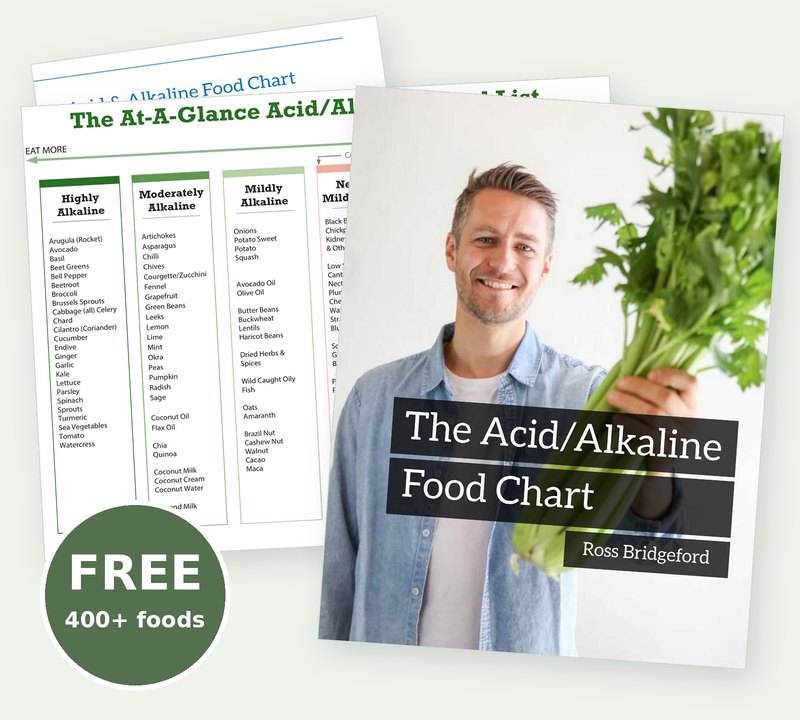
Want every food on one page? My free printable chart rates 400+ foods from Highly Alkaline to Highly Acidic, so it’s easy to load up on the mineral-rich ones. Get the free chart →
An easy magnesium-rich day
You don’t need to count every milligram. But I want to show you how easy it is to get there with real, alkaline food:
| When | What | Magnesium |
|---|---|---|
| Breakfast | 28 g (about 2½ tablespoons) chia seeds, in a chia pot or a smoothie | 111 mg |
| Lunch | A big green salad with ½ cup black beans, ½ cup avocado and a 28 g handful of pumpkin seeds | 238 mg |
| Snack | 28 g almonds (about 23) | 80 mg |
| Dinner | A stir-fry with ½ cup edamame and ½ cup cooked spinach | 128 mg |
| Total | Before you count the rest of the veg, herbs and water on your plate | 557 mg |
That’s well over what most adults need, without a single supplement. Here are some of my magnesium-rich recipes to make it delicious:


Breakfast
My Super-Magnesium Smoothie Bowl: pumpkin seeds, cashews, cacao and almond butter in one bowl

Lunch
My Magnesium-Boosting Super Salad: spinach, chard, quinoa, pumpkin seeds, almonds, black beans and avocado

Dinner
My Magnesium-Rich Sesame & Ginger Stir Fry: tofu, bok choy, spinach, edamame, and sesame and pumpkin seeds

Bedtime
My Alkaline Sleep Elixir: my warm, calming bedtime drink, made with magnesium glycinate
My Broccoli & Almond Bites (a great snack) and my Mineral-Rich Lentil & Greens Soup are two more easy ways to top up.
Should you take a magnesium supplement?
Food first, always. But there are times a supplement makes sense: if your diet is low while you work on it, if you’re on a long-term PPI or diuretic (with your doctor’s OK), or if your doctor suggests it for migraines.
Which kind?
According to the NIH, magnesium aspartate, citrate, lactate and chloride tend to be absorbed better than magnesium oxide and magnesium sulfate (NIH). Glycinate is another popular, gentle form, and it’s the one I use in my Sleep Elixir. Oxide is cheap and very common, but it’s poorly absorbed and more likely to upset your tummy.
How much is safe?
For adults, the upper limit from supplements is 350 mg a day. Above that, magnesium can cause diarrhoea, nausea and stomach cramps (NIH). The magnesium in food doesn’t count towards this, because healthy kidneys clear any extra. If you have kidney disease, though, don’t take magnesium without talking to your doctor first.
Check with your pharmacist if you take
- Osteoporosis medication (bisphosphonates): take it at least 2 hours apart from magnesium.
- Some antibiotics (tetracyclines and quinolones): take the antibiotic at least 2 hours before, or 4 to 6 hours after, magnesium.
- Diuretics (water pills): some lower magnesium and some raise it, so ask before you add a supplement.
- Reflux medication (PPIs): long-term use can lower magnesium (see above).
What about Epsom salt baths and magnesium oil?
You’ll see magnesium sprays and Epsom salt baths recommended everywhere, including on an older version of this page. But I have to be honest with you: there’s very little good evidence that much magnesium gets in through your skin. Enjoy the bath as a wind-down ritual (it’s great for that!), but don’t rely on it to top up your levels. Food, plus a well-absorbed oral supplement if you need one, is the way to go.
The bottom line
Magnesium deficiency is real, it’s common, and it’s quiet, which is the very reason to take it seriously. The good news is that the answer is one of my favourite things in the world: more greens, seeds, nuts and beans. Eat that way most of the time (my 80/20 approach makes it realistic) and you’ll be getting plenty of magnesium, along with all the other alkaline minerals that come with it.
Free download
The full acid/alkaline chart, on one page
My free chart rates 400+ foods from Highly Alkaline to Highly Acidic, with a one-page version for your fridge. It makes eating more of the mineral-rich foods (greens, seeds, nuts and beans) so much easier.
Magnesium FAQ
What are the first signs of magnesium deficiency?
Often there are none: when you’re only a little low, you may not notice anything, which is why it’s so easy to miss. When signs do appear, the earliest are loss of appetite, nausea, vomiting, tiredness and weakness. As it gets worse, numbness, tingling, muscle cramps and spasms, and an irregular heartbeat can follow. See your doctor if you notice these, especially if you take reflux medication or diuretics, have diabetes or a gut condition.
What causes low magnesium?
The most common reason is simply not eating enough magnesium-rich food: a diet built on processed food, with few greens, seeds, nuts and beans. Gut conditions such as Crohn’s and coeliac disease, type 2 diabetes, heavy drinking, getting older, and some medications (long-term reflux medication and some diuretics) can all lower it too.
Can a blood test show magnesium deficiency?
It can pick up a severe drop, but it can miss low stores. Less than 1% of your body’s magnesium is in your blood, and your body works hard to keep that level steady, so a normal result doesn’t rule out being low overall. If you have symptoms or risk factors, ask your GP to check, and look at your diet too.
What foods are highest in magnesium?
Pumpkin seeds top the list with 156 mg in a 28 g handful, followed by chia seeds (111 mg), almonds (80 mg), cooked spinach (78 mg per half cup), cashews (74 mg), black beans (60 mg per half cup) and edamame (50 mg per half cup). They’re also some of the best alkaline foods you can eat.
How much magnesium do I need a day?
Most adult women need 310 to 320 mg a day and most adult men 400 to 420 mg, depending on age. The figures are the same in Australia and the US, and a little higher in pregnancy.
Which magnesium supplement is best?
The NIH says magnesium aspartate, citrate, lactate and chloride tend to be absorbed better than magnesium oxide and sulfate. Glycinate is another popular, gentle form, and it’s the one I use in my Sleep Elixir. Oxide is cheap but poorly absorbed.
Can you take too much magnesium?
From supplements, yes. The upper limit for adults is 350 mg a day from supplements (food doesn’t count). More than that can cause diarrhoea, nausea and stomach cramps. If you have kidney disease, talk to your doctor before taking any magnesium.
Does magnesium help you sleep?
It might. In a small trial of 46 older adults with insomnia, 500 mg of magnesium a day for eight weeks improved insomnia scores, helped people fall asleep faster, and raised melatonin while lowering cortisol, compared with a placebo. Bigger trials are still needed.
Do Epsom salt baths raise your magnesium?
There’s very little good evidence that much magnesium gets in through your skin. An Epsom salt bath is a lovely way to wind down, but don’t rely on it to top up your levels. Food comes first, plus a well-absorbed oral supplement if you need one.
Should I take magnesium if I’m on a PPI for reflux?
Talk to your doctor first. The US FDA warns that taking a proton pump inhibitor for a long time (usually more than a year) can lower magnesium, and sometimes supplements alone don’t fix it. Ask whether your magnesium has been checked, and don’t stop any medication on your own.
Is magnesium alkaline?
Yes. Magnesium is one of the alkaline minerals, along with potassium and calcium, and it’s one of the minerals that pulls a food towards alkaline in PRAL, the formula researchers use to estimate a food’s acid load. That’s why magnesium-rich foods like leafy greens, seeds and beans sit at the heart of eating alkaline.

Ross has taught and coached realistic, sustainable alkaline eating since 2004, working with thousands of clients around the world. He’s the author of The Alkaline Reset Cleanse and The Alkaline Life (Hay House). Ross is a health educator, not a doctor or dietitian, so if you have a medical condition, talk to your own health professional before making big changes to your diet or taking supplements.
Sources
- NIH Office of Dietary Supplements: Magnesium fact sheet for health professionals (updated January 2026)
- NIH Office of Dietary Supplements: Magnesium fact sheet for consumers
- Australian Bureau of Statistics (2026), Australians continue to need more calcium, Usual nutrient intakes, 2023
- NHMRC: Nutrient Reference Values for Australia and New Zealand, Magnesium
- Costello and colleagues (2016), Perspective: The case for an evidence-based reference interval for serum magnesium, Advances in Nutrition
- Fang and colleagues (2016), Dietary magnesium intake and the risk of cardiovascular disease, type 2 diabetes, and all-cause mortality: a dose–response meta-analysis of prospective cohort studies, BMC Medicine
- Zhang and colleagues (2016), Effects of magnesium supplementation on blood pressure: a meta-analysis of randomized double-blind placebo-controlled trials, Hypertension
- Holland and colleagues (2012), Evidence-based guideline update: NSAIDs and other complementary treatments for episodic migraine prevention in adults, Neurology (American Academy of Neurology and American Headache Society)
- Tarleton and colleagues (2017), Role of magnesium supplementation in the treatment of depression: a randomized clinical trial, PLoS One
- Abbasi and colleagues (2012), The effect of magnesium supplementation on primary insomnia in elderly: a double-blind placebo-controlled clinical trial, Journal of Research in Medical Sciences
- US FDA (2011), Drug Safety Communication: Low magnesium levels can be associated with long-term use of proton pump inhibitor drugs
- Garrison and colleagues (2020), Magnesium for skeletal muscle cramps, Cochrane Database of Systematic Reviews
- Remer and Manz (1995), Potential renal acid load of foods and its influence on urine pH, Journal of the American Dietetic Association