



Alkaline Fruits (Which Are Alkaline vs Acidic)

Alkaline Fruits: Which Are Alkaline & Why
The question of which are the alkaline fruits is such an important one to understand when you’re first starting on the alkaline diet.
Not all fruits are created equal, and while there are a lot of fruits you can eat with wild abandon, it is a mistake to think that all fruits are alkaline-forming and you can easily fall into the trap of over-consuming them.
Yes, you can over-consume fruit.
I’ll get onto this in just a moment, because first it’s essential to point out that most alkaline foods charts are dead wrong.
Short on time? Jump straight to the alkaline fruits list, the acidic fruits list or my fruit-by-fruit answers (strawberries, grapes, bananas, cherries, kiwi and more).
The Charts You Need to Ignore: When they List All Fruits As Alkaline Fruits
There are a lot of alkaline food lists out there, and I know so many people get frustrated because they all seem to conflict with each other.
But the fact is, there are not actually that many differences between them – really there is just one big difference:
The simple truth is that most fruits are not alkaline-forming.
Think things like pineapple, banana, oranges, mangoes – these are commonly listed as alkaline fruits, but they are actually mid-to-very acid-forming.
I know this could be a shock to a lot of people, so let me explain.
If These Are Not Alkaline, Why Are They On the List As Alkaline In So Many Food Charts?
The simple answer is that most charts are classifying the foods using PRAL (PRAL stands for Potential Renal Acid Load). PRAL is worked out from the protein, phosphorus, potassium, magnesium and calcium in a food, and it estimates how much acid (or alkaline) load that food leaves behind for your kidneys to deal with.
This is a hugely useful measure for many hundreds of clinical applications.
But when it comes to food pH and our diet, on its own it’s pretty useless. Why?
Because it doesn’t take SUGAR into consideration.
In fact, on PRAL a banana scores as MORE alkaline than a lemon, even though it has around five times the sugar!
These fruits, like those I mentioned, the common fruits like bananas, pears, cherries, kiwi fruit, oranges, pineapple, apple and so on taste, well, really sweet and delicious.
And they taste sweet because they have a ton of fructose in them! And fructose is a pretty damaging sugar for the body (I’ll get into this more in a minute, but basically fructose is the WORST of the sugars).
Yes, they contain vitamins, minerals, antioxidants and so on, but when you look at the net effect these fruits have on the body, the sugar means they do more damage than good.
So Are You Telling Us to AVOID FRUIT?!
No, that’s not my point. I still think fruit is a wonderful treat and you should feel free to have 1-2 pieces per day (preferably organic and in-season). My point is that these fruits shouldn’t be eaten with wild abandon and seen as a ‘health food’ or free pass.
Plus, when it actually comes to WHY I would eat fruit, it’s actually more to do with its taste and convenience over its nutritional profile.
Research published in 2014 out of William Paterson University compiled the list of the world’s most ‘powerhouse fruits and vegetables’ based on the nutrient density of 47 different foods.
Foods were awarded “powerhouse” status by providing, on average, 10 per cent or more of the daily recommended intake (per 100 calories) across 17 nutrients of public health importance, the nutrients most linked to protecting us from chronic disease.
41 of the 47 made the cut, and they published the ranking of the top 41.
Of the top 41, 38 were alkaline forming foods …and of those the TOP FIFTEEN WERE ALL LEAFY GREENS.
The only sweet fruits to appear in the top 41 were strawberries, oranges and blackberries which were at 30, 33 and 38 respectively. And the other fruits that made the list? Tomatoes (27), lemons (28), limes (34) and grapefruit (35) – every one of them on my alkaline fruits list below!
So for a nutrient hit, I like to stick to my vegetables. They don’t contain fructose and they DO contain a lot more nourishment.
The Problem With Fructose
Fruit, as delicious as it is, contains fructose. And fructose can be a problem.
While glucose can be used by practically every cell in the body, fructose can’t. Your gut can deal with small amounts, but anything more than that goes to the liver. We were not designed to eat the vast volumes of fructose we now eat.
Regular sugars – table sugar, brown sugar, raw sugar, cane sugar – these are all 50% glucose and 50% fructose.
Don’t get me wrong, the glucose is acidic, oxidising, inflammatory and bad news – but if you’re moderately active, the body can use it.
Fructose can’t be used like that. It has to be processed by the liver first, and in large amounts it stresses the heck out of the liver and so much more.
[Note: Guide to Supporting Your Liver Naturally Here]
People think of fructose as a ‘natural sugar’, ‘fruit sugar’ or ‘healthy sugar’ but this is just not the case. It’s not only as damaging as any other sugar, but in reality – it’s actually worse.
The direct effects of fructose metabolism include:
- The liver turns far more fructose into fat than it does glucose (Tappy & Rosset 2019) – leading to weight gain, fatty liver disease & insulin resistance (and thus Type 2 Diabetes)
- Fructose being processed by the liver heavily interferes with our appetite hormones
- When our appetite hormones are out of balance, our body keeps asking for more – making it so much easier to overeat and store food as fat
- Fructose doesn’t switch off our ‘hunger hormone’ ghrelin the way glucose does (Teff et al. 2004), and when ghrelin stays elevated our brain sends the signal that we’re still hungry, even after we’ve eaten
In short, fructose causes inflammation, liver stress, oxidative stress, uric acid formation, it makes us gain weight, we can’t stop eating it, and it makes us want to keep eating more. Not good.
And fruit contains a LOT of fructose.
Just check out this chart showing the total grams of sugar per serve:
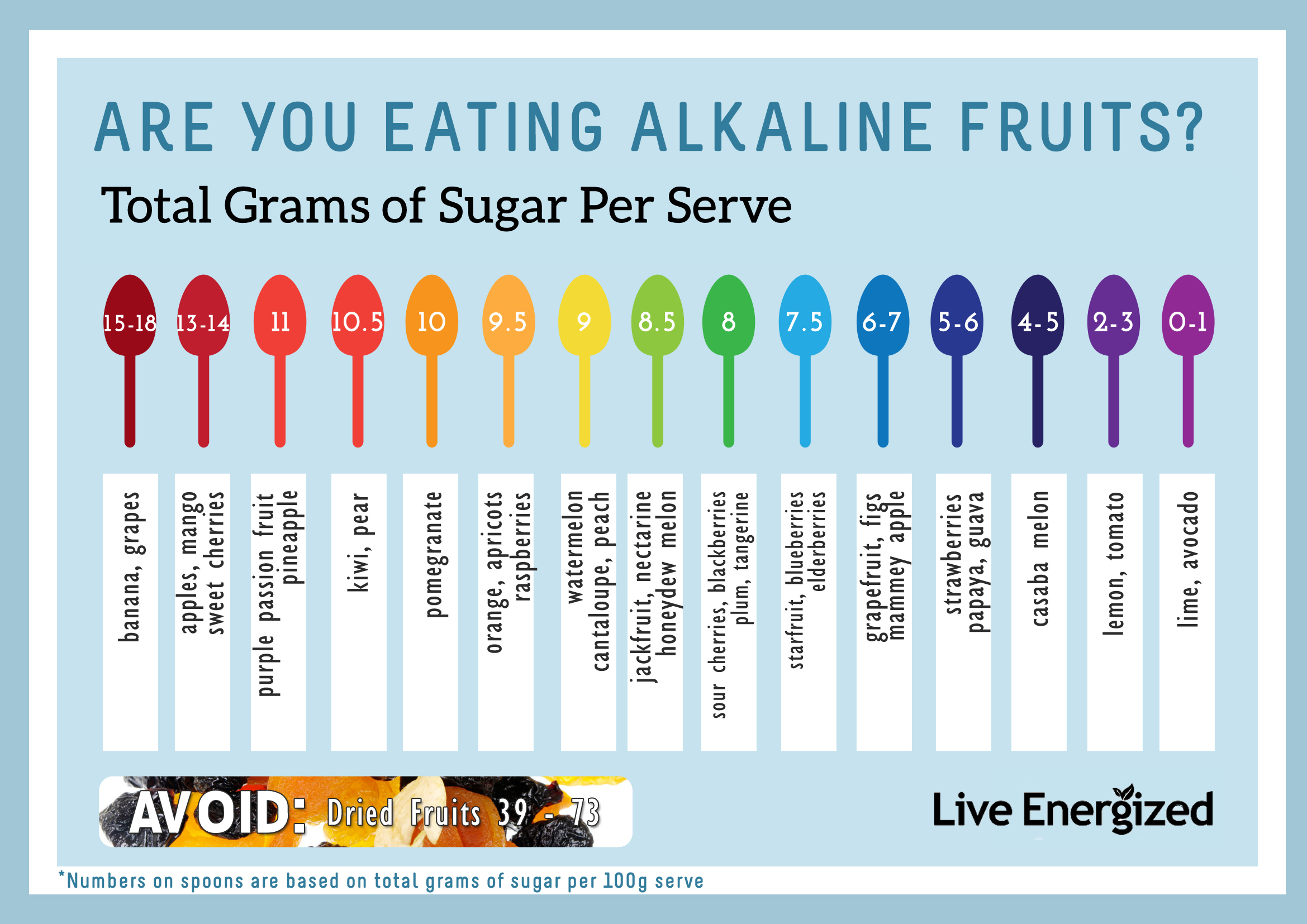
These are not alkaline fruits! They are most definitely acidic, and we need to make sure we don’t eat, juice and smoothie a ton of them every day.
In fact, see below for my rules on juicing fruits.
You should definitely still eat these fruits, alkaline or not, 1-2 times a day because they’re a delicious snack, way more healthy than something that contains the sugar but NOT the vitamins etc.
But it is clear to see that they are not alkaline fruits and shouldn’t be classified as such.
Alkaline Fruits & Acidic Fruits
There is a key distinction here, because we’re not actually talking about alkaline fruits or acidic fruits…we’re talking alkaline-FORMING fruits and acid-FORMING fruits.
Remember this: It is not the pH of the food BEFORE we consume it that is the biggest influence, it is the EFFECT the food has on the pH of the body AFTER consumption.
Sounds like a minor thing, but as you’re about to see, it’s very important.
(If you’re here because of reflux, the acidity of a fruit going down does matter for how it feels, and that’s a different question. I cover what to eat for reflux in my 14-day alkaline diet for acid reflux.)
Alkaline Fruits List
- Lemon Moderately Alkaline
- Lime Moderately Alkaline
- Avocado Highly Alkaline
- Cucumber Highly Alkaline
- Tomato Highly Alkaline
- Grapefruit Moderately Alkaline
- Pomegranate Mildly Alkaline
That’s it! And half of these you wouldn’t normally consider to be a fruit anyway!
Why Lemons & Limes Are Alkaline Fruits
Now, I mentioned alkaline-FORMING before and this rule applies most clearly to lemons and limes. This confuses a lot of people because, as we all know, lemons and limes are acidic in nature.
However, when metabolised they have an alkaline-forming effect on the body, and so are to be classified as alkaline forming fruits.
And they have barely any sugar: a lemon has about 2.5 g per 100 g, compared to over 12 g in a banana.
Acidic Fruits List
Well, this is a list of basically every other fruit…
- Banana Moderately Acidic
- Pineapple Moderately Acidic
- Melons Neutral / Mildly Acidic
- Grapes Moderately Acidic
- Oranges, mandarins, satsumas etc Moderately Acidic
- Berries: strawberries, blueberries, raspberries etc. Neutral / Mildly Acidic
- Pears Moderately Acidic
- Passionfruit Moderately Acidic
- Kiwifruit Neutral / Mildly Acidic
- Papaya Moderately Acidic
- Paw Paw Moderately Acidic
- Mango Moderately Acidic
- Apples Moderately Acidic
- Cherries Neutral / Mildly Acidic
- Plums Neutral / Mildly Acidic
- Peaches & apricots Moderately Acidic
- Figs Moderately Acidic
- Dried fruit: raisins, dates, dried apricots etc. Highly Acidic
- Fruit juice Highly Acidic
Before you ask about any other fruit, the easy answer is – if it’s not on the alkaline fruits list, it’s not alkaline. The acidic fruits list isn’t exhaustive! (You’ll find more fruits rated in my full alkaline foods list.)
A note on fruit in juices and smoothies & dried fruit
I strongly recommend you don’t juice, blend or dehydrate (dry) fruits. Eat them whole and raw.
Fructose is far less damaging when consumed with fibre, chewed and digested slowly.
When the fibre is removed (as with juices) it is even more rapidly metabolised by the liver. Same goes for dried fruits. These give a huge hit of fructose with very little fibre and immediately stress the liver.
Researchers at Princeton saw exactly this (in mice): the gut handles small amounts of fructose, but a big, fast hit overwhelms it and the rest spills over to the liver (Jang et al. 2018).
So there should be no fruit in juices (because the fibre is removed) and even in smoothies, because if your smoothie contained several serves of fruit and you drink the smoothie at a normal drinking pace, this would overload the liver very quickly (think about the time it takes to drink a drink vs to eat 2-3 pieces of fruit including chewing time).
The Best & Worst Acidic Fruits – A Rough Guide:
Really, it all comes down to the sugar content, as this pretty much overrides the nutritional content. So to keep it simple, you want to be eating less of the high-sugar fruits like pineapple, apple, oranges and bananas and instead, the alkaline forming fruits aside, sticking to the lower sugar fruits like berries and melons.
Honestly, all are fine in moderation as long as you’re sticking to the rules of:
- 1-2 pieces only per day
- Don’t juice or smoothie them
- Stay away from dried fruit
Stick to those simple rules and you’re all set to continue enjoying fruits each day – regardless of their pH!
I really don’t want you to freak out about fruits, but at the same time I don’t want you eating (and worse, juicing) a ton of fruit every day thinking that it’s healthy and fine to eat in huge quantities.
The simple truth is that you CAN still eat a little fruit, but keep it within my rules and you’ll be set.
Is My Favourite Fruit Acidic? Quick Answers
Are strawberries acidic?
Strawberries are Neutral / Mildly Acidic, and they’re one of the best fruits you can choose. They’re low in sugar (about 4.9 g per 100 g, less than a third of grapes) and they were one of only three sweet fruits to make the powerhouse foods list. Berries are one of the fruits I recommend most.
Are grapes acidic?
Yes, grapes are Moderately Acidic. They’re one of the highest-sugar fresh fruits at around 15.5 g per 100 g, and they’re SO easy to eat by the handful without noticing. Keep them to a small bunch as one of your 1–2 pieces of fruit for the day. Raisins (dried grapes) are Highly Acidic.
Are bananas acidic?
Yes. Bananas are Moderately Acidic because of their sugar: 12.2 g per 100 g, or about 14 g in a medium banana. I’ve written a whole guide on this one: Are bananas acidic?
Are cherries acidic?
Cherries are Neutral / Mildly Acidic. They’re sweeter than berries (about 12.8 g of sugar per 100 g), so a small bowl is plenty, and fresh is far better than dried or juiced.
Is kiwi acidic?
Kiwifruit is Neutral / Mildly Acidic. It has about 9 g of sugar per 100 g and loads of vitamin C, which makes it one of the better choices for your 1–2 pieces a day.
Are pears acidic?
Yes, pears are Moderately Acidic, with about 9.8 g of sugar per 100 g. Eat them whole with the skin on so you get all the fibre.
Are oranges acidic?
Yes, oranges (and mandarins) are Moderately Acidic, with about 9.4 g of sugar per 100 g. Eat them whole rather than juiced, because orange juice is Highly Acidic. Grapefruit is the citrus that’s alkaline, along with lemons and limes.
Are apples alkaline?
No, apples are Moderately Acidic, with about 10.4 g of sugar per 100 g. An apple a day is absolutely fine as one of your 1–2 pieces of fruit, just don’t juice it.
Is passion fruit acidic?
Yes, passionfruit is Moderately Acidic, with about 11.2 g of sugar per 100 g. A little spooned over a breakfast bowl goes a long way.
Are plums acidic?
Plums are Neutral / Mildly Acidic, with about 9.9 g of sugar per 100 g. Enjoy them fresh and in season, but go easy on prunes (dried plums).
What fruits are not acidic?
The alkaline fruits are lemons, limes, grapefruit, avocado, tomato, cucumber and pomegranate. After those, the best choices are the lower-sugar Neutral / Mildly Acidic fruits: berries, melons, kiwifruit, cherries and plums.
Is fruit juice alkaline?
No. Fruit juice is Highly Acidic. Juicing strips out the fibre and leaves a big, fast hit of fructose, so keep fruit out of your juices and stick to vegetable juices.
Free download
See where every food sits
My free alkaline food chart rates 400+ foods from Highly Alkaline to Highly Acidic, every common fruit included, with a one-page version for your fridge. Check any food in seconds while you shop or cook.
It’s free. Just tell me where to send it.
Any questions, please do ask below,
Ross

Ross has taught and coached realistic, sustainable alkaline eating since 2004, working with thousands of clients around the world. He’s the author of The Alkaline Reset Cleanse and The Alkaline Life (Hay House). Ross is a health educator, not a doctor or dietitian, so if you have a medical condition, talk to your own health professional before making big changes to your diet.
Alkaline Fruits Further Reading & Resources
Alkaline Foods List: 195 Foods Rated
Are Bananas Acidic? The Full Answer
Alkaline Nuts Guide
Why Alkaline Food Charts Are So Different
Sugar Alternatives: Complete Guide to Sugar & ‘Healthy’ Sugar
Full Alkaline Foods Chart
Introduction to the Alkaline Diet
Alkaline Diet Evidence
The Most Powerhouse Foods Study
Sources
- Remer and Manz (1995), Potential renal acid load of foods and its influence on urine pH, Journal of the American Dietetic Association
- Di Noia (2014), Defining powerhouse fruits and vegetables: a nutrient density approach, Preventing Chronic Disease (CDC)
- Tappy and Rosset (2019), Health outcomes of a high fructose intake: the importance of physical activity, Journal of Physiology
- Teff et al. (2004), Dietary fructose reduces circulating insulin and leptin, attenuates postprandial suppression of ghrelin, and increases triglycerides in women, Journal of Clinical Endocrinology & Metabolism
- Jang et al. (2018), The small intestine converts dietary fructose into glucose and organic acids, Cell Metabolism
- USDA FoodData Central (SR Legacy): sugar per 100 g for each fruit


Excellent article, excellently balanced, many thanks, Nick UK
Fruit is healthy. God made it. God would not put a harmful substance in man’s original diet. There is no way that fructose found naturally in any piece of fruit would be harmful. Vegetables weren’t even given for food until after Adam and Eve sinned. I eat both vegetables and fruit! What is bad for you is processed food.
A few things here. You’re right that processed food is largely the problem, because it is packed full of fructose. The article states having some fruit every day is fine, which is how a god would have intended, and for tens of thousands of years we’d have had some fruit, sometimes. Certainly not 5, 6, 7 serves a day.
And even a fruit juice, which is processed food, is not how a god would have intended.
Definitely do what you think is right. My suggestion here is 1-2 pieces of fruit per day is fine, and if you want to heal, rebalance, support the body then focus on the berries. Once in balance having a bit more would be totally fine.
Hi Ross,
I’m on a low carb diet so don’t eat much fruit these days and agree with your logic anyway.
What brought me here, but I still do not have the answer for, is the question of monk fruit. It is not on your list of alkaline fruits yet it has zero sugar. It is natural and not an artificial sweetener. If it is mainly the sugars that make fruits acid forming, then am I right to conclude monk fruit must be alkalising?
Lemons, limes, grapefruits, and cucumbers are all acidic, not alkaline. Their juices all have pH values below 7, which is acidic.
“Before you ask about any other fruit, the easy answer is – if it’s not on the alkaline fruits list, it’s not alkaline.”
FALSE.
Your list of alkaline fruits is not comprehensive (or accurate).
“half of these you wouldn’t normally consider to be a fruit anyway!”
All of those are botanically fruits. Don’t say “you wouldn’t normally consider” because you don’t know what the people reading your misinformation consider.
Hi Nola – the pH of the food in it’s natural state is irrelevant, it is the impact on the body, specifically the blood pH.
Generally speaking it’s pretty rude to rock up to someone’s business and tell them they’re wrong, without offering any evidence or counter argument.
I guess this is the way of the world now. But good luck going forward, you don’t have to listen to me or believe me.
What about freeze-dried or dehydrated carrot juice? This of course is a vegetable, but a bit sweet. I am interested in the juice powder as it is simpler than juicing.
I want to have it with enzymes intact.
I have read freeze-dried uses some heat briefly in the process of turning the ice to a gas, but I don’t see the temperature or for how long. Would freeze-dried or dehydrated have more enzymes intact?
I would appreciate your opinion.
Thanks !
Heh Bro
What about tomatillos
Alkaline forming?
Thx
Russ…….>
100% yep 💪
Can I heal acid reflux naturally? I’ve been constipated, now having acid reflux. Don’t want to go on antaacids or proton pump stuff.
Thank you
Hey Ellen, check out my guide here: https://liveenergized.com/alkaline-diet-acid-reflux
How long does it take to reverse the effect of your acidic ph?
What is the best way to determine your ph?
What about the oxidising effect of greens (leafy green vegetables)?
As we are preparing for food shortages, high costs, CDBC ‘s, dehydrating, freezing, to take advantage of seasonal foods, any advice on how to eat healthily?
Hi,
I used to always drink Orange juice with my breakfast (I’ve always had a problem with Acne) I’ve been on holiday for the past 6 weeks and was advised to abstain from my Orange juice and its made a significant difference to my skin. Is this a fluke or good advice. Looking forward to your response.
Regards,
Owen
Hello Ross,
that was rather surprising and I had to rub my eyes and pinch myself to make sure am reading correctly. I really do can follow you and you explained it very thoroughly but also quite simple. Can imagine, that it does not go over well with some people, but does it matter? Don’t think so.
Keep it up Ross. Learned something from you. Very interesting stuff. Thanks a lot
Richard
Thanks so much Richard 🙂
Idk, I agree with you on some of your points but ultimately it sounds like your scaring people from eating fruits when fruits are the Healthiest foods on the planet, typical when it comes to these blogs about this topic, and you lay out the term “Alkaline or Acid Forming” which can still create more confusion.
I stand by everything in the article. Any fruit in moderation is fine. Try to focus on the lower-sugar fruits. Don’t juice, blend, dehydrate fruit as you concentrate the fructose.
The outcomes of fructose metabolism by the liver are incredibly well documented.
You are following conventional nutrition advice from the medical establishment, who has a history of not healing. If you still believe the medical definition that nothing we eat changes the acidity in the body, you have been doing most of your research on censored Google and not in un-censored platforms like DuckDuckGo.
The medical establishment does not know what the interstitium is and how to measure interstitial fluids; which is the alkaline buffering system of the body. Also, the stomach produces a fire called sodium bicarbonate and the smoke (waste) is hydrochloric acid. Hydrochloric acid do to its molecular weight, sinks to the gastric pits; to be eliminated out of the body, as acid is really a toxin if not eliminated. The stomach not only alkalizes the food but also supplies sodium bicarbonate to the vascular, intracellular and interstitial fluids every second of your life.
He literally said “fruit is a wonderful treat and you should feel free to have 1-2 pieces per day. My point is that these fruits shouldn’t be eaten with wild abandon”. Just not “Wild Abandon”, Bozo.
I am a 70 year old male. I had my stomach removed because of stomach cancer in April of 2022. I’m 5’10” tall and I weigh 110 pounds. I suffer a lot from acid reflux. It’s hard for me to eat and I have no appetite. What foods should I be eating to help gain weight and regain muscles. My target calorie intake is 1500-1800 or more per day. Which I struggle to reach. I drink Boost plus other additives to help but still having a tough time. Needless to say, my energy level is pretty low. Although I do small activities each day.
Hi Ross,
Please talk about alkaline/acidic nuts as well.
Thanks,
Irwan
Ross,
Where are you getting your information from?? Half of the fruits you listed as acidic are alkaline lol. Who is teaching you these kids your posting. Natural sugar is what the body needs everyday. Process sugar is not what the body needs everyday. You need to consume 32 ounces of fruit juices everyday guys. Don’t listen to these lies. He’s probably getting paid by higher ups to write these lies. If you want a healthy frugivore lifestyle which we as humans are suppose to live by.
Hi James
I don’t agree with you. Although it would be nice to be ‘getting paid by higher ups’, sadly that’s not the case. I’m getting paid by working my ass off to help as many people as I can, researching hours a day, writing, coaching.
It’s pretty easy to sit back and say ‘YOU’RE WRONG’ – but not so easy to provide your evidence to back up your comment.
I’m ‘getting my information’ from the nutrient content of these foods. Fructose is acid-forming. YES we need some natural sugars, and we get plenty from lower-sugar fruits, and from vegetables such as carrots, bell pepper, beets etc.
PLUS nobody is eating ‘perfectly’ all day every day, so let’s be honest, we’re getting more from ‘other’ foods.
When fructose is processed by the liver it produces uric acid. This is a fact.
BUT, I would FAR rather you continue your fruit-rich diet than a Standard American Diet. It’s better. However, drinking 32oz of fruit juice a day is NOT a great idea.
Each to their own, but don’t come here saying that I’m talking nonsense and laughing at me without even putting forward any evidence for your counter argument. That’s just poor form.
R
We do not need sugar, period. Sugar is a fuel that can be used, but ferments into acid and really sugar is a waste product of metabolism (the brain produces sugar as one of the wastes)
The whole entire human body is alkaline in design and acidic by function. Every metabolic process produces acidic waste, which if not eliminated will cause disease.
The cells and the human body in general runs on electrons and uses alkaline salts as electrolytes that serve as electrical conductors and a matrix of energy.
Salt is one of the most important nutrients, as when people are in an ICU unit; they receive saline IVs to stay alive but notice no sugar. The medical establishment advices not to eat salt, but of course its a half-truth. We need to eat sea salt and not the processed table salt that causes heart disease and other problems.
Yes and I have read that Celtic salt is the best salt to use as it has more minerals and magnesium that any other salt . I take it first thing in the morning a few crystals on my tongue to dissolve then then my water with lemon.
What about Soursop, is it alkaline forming?
what about nori seaweed? – i gather on the sonoma, california coast and rinse and dry it
It’s fantastic!
Ross, I appreciate all you do…I have shared your opinion re: fructose in fruit and my naturpathic doctor who is now retired and has been in this health thing for over 6 decades..has said the natural sugar (fructose) in fruit WILL CAUSE NO HARM. He has plenty of his patients over the decades on a stricly fruit diet and gotten people healed of life threatening issues. He, himself is mostly fruit eater and is vibrant and healthy. Fructose From Added Sugars Is Bad for You, Fruit Is Not
It’s important to realize that all of this does not apply to whole fruit. Here is is take basically:
Fruits aren’t just watery bags of fructose, they are real foods with a low calorie density and lots of fiber.
They’re hard to overeat on and you would have to eat very large amounts to reach harmful levels of fructose. In general, fruit is a minor source of fructose in the diet compared to added sugars.
The harmful effects of fructose apply to a Western diet supplying excess calories and added sugars. It does not apply to the natural sugars found in fruits and vegetables.
is this juice protocol okay to use if i have barrett’s syndrome? thank you for answering my question
Hi,My name is Nadarajah,I having Nerd some kind of Non eurosive gastro esophagus disease.
I don’t trust Hospital medication all is acid booker.
Pls advise fruits that I need to eat everyday.
Recent reputable studies show daily strawberry consumption heals barretts oesophagus. I think the dosage used was 60mg per day of freeze dried strawberries (equating to c. 600mg of fresh strawberries). If you google “strawberries + barretts oesophagus” it should list all the research.
Censored Google is not the best resource, Google is bought for and paid for by big pharma and big medical. A lot of those “reputable” studies are funded by the medical establishment. If one wants to heal any health problem, one has to drop acidic fruits like strawberries and other high fructose, as well as an acidic lifestyle.
Hello 🙂 I am vegetarian and don’t consume eggs. I intend to overhaul my lifestyle and am looking for some help on how to make my diet more alkaline and what should I consume in the morning- empty stomach and the foods I should avoid. One bad habbit is that I consume 3 cups (roughly 420 ml) of black tea every day of which I drink 1 cup in the morning, almost empty stomach.
thank you so much for putting this information together! the effects of fructose on the metabolism seems to be effects of artificial fructose, but there’s been significant studies done on the positive effects of natural fructose. I like to stay neutral and take in all information / data – do you have research articles or sources that show the negative effects of natural fructose? thanks so much in advance!!
Hi Ross, I have a question about onions. I am dealing with some tooth decay issues and I would like to know your opinion on whether onions are acidic or not. Specifically are they the same as citrus in that they are acidic until consumed, (therefore harmful to teeth), or are they always alkaline or otherwise not damaging to the teeth. Onions also have a good bit of sugar.
Great site Ross! I got confused a lot on the internet as charts were saying different things about foods. I love tomatoes. Are they alkaline? Another food I love is rolled oats! Are they acidic? The final one is egg whites. Are they alkaline? Looking forward to hearing from you real soon.
There are a lot of fruits and they differ from country to country, some are seen or grown in a certain country only….. if I take your word, are you saying that on all fruits in all differences and varieties only the 7 are alkaline? Are you saying that fruits other than those 7 are basically not good and should be eaten in place of junk foods in case we have the craving?
I have a condition called oral lichen planus in my mouth. They are sores and swelling of the gums. I have been told to eat an alkaline diet. I do like fruits much more than vegetables. Do you think that this diet will help me? I am not overweight
Who and for what reason were you told not to eat an alkaline diet???
Surely your article is a volcanic eruption to many! It brings the alkaline/acidic food world upside down. Knowing that the body performs homeostasis to keep Ph 7.35-7.45, I try to help the situation by losing excess weight. Having followed the” FULLY RAW KRISTINA” diet since April 10, 2021 (19 days) I have come down from 273 lbs. to 245 lbs. (28 lbs.) and despite the initial craving shock (as a former meat lover), I now feel satisfied!
My cardiologist wants me at 140 lbs. in a year from now! Can I do it and if yes – how? I was 140 when I got married in 1980! I am now 68 years old. Please advise. Thanks.
One thing that the medical establishment does not know, is that although the body does everything to keep the blood at a narrow PH, it does that by doing everything it can to keep it that way, even if it leads to degeneration in other areas of the body.
The interstitium is all the fluids that every cell bathes in, the interstitium is the largest organ in the body and serves as the alkaline reserves. The medical establishment does not measure interstitial fluids and falsely assumes a blood count and ph is all there is to health.
Also, the medical establishment wrongly assumes that the kidneys filter acid from the blood, which in reality urine is a product of the interstitium.
Hey Ross! I am a little confused. The chart listed the amount of sugar in fruit and amongst those were lemon limes grape fruit and pomegranate; however, you also listed these fruits as alkaline forming fruits. I guess my question is, do these fruits contain fructose and if so are you saying that the alkaline in them overused the fructose they produce? Love this article! It was very helpful!
Does your book give you information of each individual foods that are acidic and alkaline.
Cause I have cystitus and I want to be cured from it, it’s painful and horrible to have ive been told about low histamine diet helps and I thought why not change the ph in my urine which makes sense so can this diet help me get my urine pH alkaline?
I have been reading about acid foods but there’s 3 that I go too and they are contradicting eachother so I’m very confused I just want a proper chart of alkaline and acid foods to help me and also I luv honey and almond milk according to 1 I can and the other I can’t.
Please help me as I am going a little insane.
Yes it does, I definitely recommend it, but also the free charts you can download from the top of this page (or on the right).
Ross
P.S…Ross, I didn’t realise my previous email to you would appear on your website, and I’m uncomfortable about broadcasting my Mum’s health issues, so will you please remove it? I’d be VERY HAPPY to rewrite my question; if you’d like me to do so, please let me know.
You can email it to me on [email protected] – I’ll delete the other one now