

Are Bananas Acidic or Alkaline? The Honest Answer
Are bananas acidic? It’s one of the questions I get asked the most, and it’s no wonder people are confused! One chart says bananas are one of the most alkaline foods on the planet, the next says they’re acidic, and if you suffer from reflux you’ve probably been told they’re either the best fruit you can eat or the one setting you off.
Here’s the straight answer, and then I’ll show you exactly why so many charts get bananas wrong.
| Question | Answer |
|---|---|
| Are bananas acidic? | Moderately Acidic Yes. Bananas are acid-forming because of their sugar: 12.2 g per 100 g, or about 14 g in a medium banana. |
| Their own pH | Acidic: pH 4.5–5.3 Less acidic than citrus, but still on the acid side of the scale. |
| Why some charts say alkaline | They use PRAL A formula that counts a banana’s potassium but treats its sugar as zero. |
| Where they fit | In your 20% Enjoy one now and then, rather than building your meals around them. |
So the short answer is yes, bananas are acidic. They’re not a ‘bad’ food (far from it!), but they’re not the alkaline superstar some charts make them out to be, and they belong in your 20%, not your 80%.
And so you know where I’m coming from: I’ve been coaching people to live alkaline for 22+ years, and I’m a bit of a science geek, so everything below links to the data and studies behind it. You never have to just take my word for it (question everything, even me!).
What is the pH of a banana?
The pH of a banana is about 4.5 to 5.3. That’s according to the FDA’s table of food pH values, the list food safety experts still use to work out how acidic a food is.
On the pH scale, 7 is neutral and anything below 7 is acidic, and each step down is ten times more acidic than the one before. So a banana at around pH 5 is roughly a thousand times less acidic than lemon juice at pH 2.
| Banana | pH |
|---|---|
| Bananas (FDA, all types) | 4.50–5.20 |
| Yellow bananas (FDA) | 5.00–5.29 |
| Red bananas (FDA) | 4.58–4.75 |
| Dr Jamie Koufman, reflux specialist | 5.7 |
Dr Jamie Koufman, a US throat and reflux specialist, gives bananas a pH of 5.7, a little higher than the FDA’s figures (Koufman). She points out that where a fruit is grown can change its pH, which is one reason you’ll see different numbers quoted online (Koufman, 2023). What you won’t find in any of the measurements is a banana with an alkaline pH, whatever some websites say. Anything below 7 is acidic.
Are green bananas more acidic than ripe bananas?
Almost every article you’ll read says green bananas are more acidic and ripe bananas are less so. It sounds logical… but when I went looking for the actual measurements, most of them show the OPPOSITE.
In a Brazilian study of silver bananas, pH fell from 5.1 when green to 4.4 when ripe, because their main acid, malic acid, went UP as they ripened (Carvalho et al.). A study of Williams, Zeling and Grand Nain bananas also found pH dropped as they ripened (Asian Journal of Dairy and Food Research), and a third found pH rose at first, then fell again once the bananas were overripe (Chiwate et al., 2023).
So why does a green banana taste so harsh? That’s the tannins (the same dry, furry feeling you get from strong tea), and they more than halve as a banana ripens. Meanwhile its starch turns to sugar: in that Brazilian study, the dissolved sugars went from about 2% in green bananas to about 20% in ripe ones.
Bottom line: the difference in pH between a green and a ripe banana is small, and if anything ripe bananas are a touch more acidic. Ripeness does matter for reflux, but for a different reason, which I’ll come to below.
Are bananas alkaline? Why some charts say so
If bananas are acidic, why do so many alkaline food charts put them right near the top? It comes down to how those charts are worked out.
Most of them use PRAL (potential renal acid load), a formula that estimates the acid a food leaves for your kidneys to clear. It only counts five nutrients: protein, phosphorus, potassium, magnesium and calcium (Remer and Manz, 1995).
Bananas are high in potassium: 358 mg per 100 g, or about 422 mg in a medium banana (NIH). So PRAL gives them a score of −6.9, and those charts read that as alkaline.
But PRAL counts sugar as zero. A formula that ignores 14 g of sugar in every banana isn’t telling you the whole story, and that’s why bananas end up on the wrong side of so many charts. You can see how 195 everyday foods compare, sugar included, on my alkaline foods list.
Why bananas are acid-forming: the sugar
A banana is around 12% sugar: 12.2 g per 100 g, or about 14 g in a medium banana, and roughly half of that is fructose (USDA FoodData Central).
Fructose is handled differently from other sugars. In larger amounts, most of it is processed by your liver, where it uses up energy (ATP) quickly and raises uric acid (2024 review), and part of it is turned into lactic acid (2019 review). That’s acid your body has to deal with, and it’s exactly what PRAL leaves out.
That’s why bananas are Moderately Acidic, alongside other higher-sugar fruits like mangoes and grapes, while dried fruit, with around five times the sugar, is Highly Acidic.
Now, that doesn’t mean you can never have a banana. A small amount of fructose, like one banana, is mostly handled by your gut (2019 review), and it comes packaged with fibre, potassium and magnesium. Where it goes wrong is quantity: two or three bananas blended into a smoothie, banana bread, banana chips (usually fried and sweetened). That’s when the sugar really starts to add up.
So my rule of thumb: enjoy a banana as part of your 20%, and keep higher-sugar fruit to 1-2 serves a day in total. Here’s how I measure 80/20, and I answer the big question, is fruit bad for your liver, in more detail here.
Free download
Where does every other fruit sit?
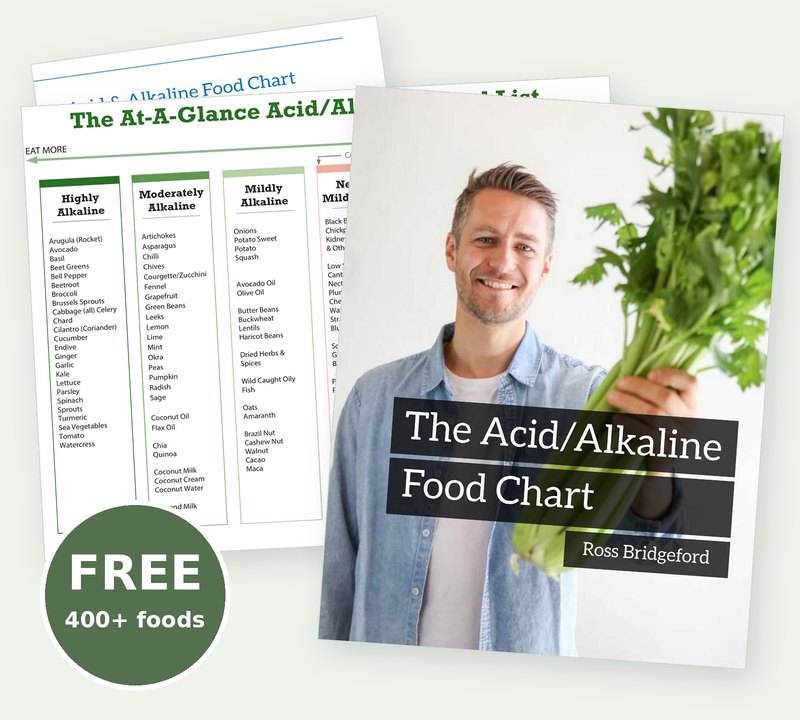
My free alkaline food chart rates 400+ foods from Highly Alkaline to Highly Acidic, fruit included, with a one-page version for your fridge. Check any food in seconds while you shop or cook.
It’s free. Just tell me where to send it.
Are bananas good for acid reflux and heartburn?
If you’re dealing with reflux, bananas aren’t the food to reach for. They’re Moderately Acidic, because a banana is around 12% sugar, and sugary, high-glycemic foods are on the list of things that may make reflux worse (Medical News Today). That puts bananas in your 20%, not in your reflux plan.
You’ll often see bananas on ‘reflux-friendly’ food lists described as ‘alkaline’. All those lists mean is that a banana is less acidic in the fruit bowl than citrus or tomatoes. That’s not the same as supporting your digestion, and there are far better foods to build your meals around. I’ll show you exactly which ones below.
Why ripe bananas can make reflux worse
There’s another reason to leave them out while reflux is flaring, and it’s ripeness. When Monash University (the team behind the low-FODMAP diet) re-tested bananas, they found ripe bananas are high in fructans, a type of carbohydrate your gut bacteria ferment, while firm, unripe bananas are low (Monash FODMAP). And in a small French study of people with reflux, a fructan-type fibre (FOS) increased the number of reflux episodes and their symptoms (Piche et al., 2003).
So a ripe, spotty banana could be adding to the problem rather than easing it.
What to eat for reflux instead
First, your stomach NEEDS its acid. That’s how you break your food down and kill off bacteria, and every time your stomach makes acid it releases bicarbonate back into your blood (it’s called the ‘alkaline tide’). So eating alkaline isn’t about neutralising your stomach acid. It’s about giving your digestion the foods that support it, and not overloading it with the ones that don’t. I explain this in more detail in why eat alkaline if your stomach needs acid?
For reflux, that means building your meals around foods that are at least mildly alkaline, and here’s where I’d start:
- Make greens and watery veg the base of every meal. Leafy greens, cucumber, celery, fennel, cauliflower and kale are all Moderately or Highly Alkaline, and Johns Hopkins recommends watery foods like cucumber, celery and lettuce for reflux because they help dilute stomach acid.
- Add healthy fats, a little at a time. Avocado, almonds and chia seeds are all alkaline. Just keep portions sensible, because big, fatty meals are a well-known reflux trigger.
- Bring in ginger. Fresh ginger is Highly Alkaline, and a ginger or chamomile tea after meals is a lovely habit to build.
- Swap the drinks. Fizzy drinks, coffee, alcohol and fruit juice are all acidic. Water, herbal teas and fresh green juices don’t.
- Eat smaller meals, and finish a few hours before bed. Smaller meals and no late-night snacks are on Johns Hopkins’ list too.
And this isn’t just theory. In a 2017 study of 184 people with throat reflux, 62.6% of those on alkaline water and a 90% plant-based, Mediterranean-style diet improved meaningfully, against 54.1% on reflux medication.
If you want somewhere to start today, my Reflux-Relief Alkaline Soothing Smoothie is creamy, chai-spiced and banana-free, made with almond milk, avocado, almonds, chia seeds and ginger. And my 14-day alkaline diet for acid reflux takes you through the whole thing step by step.
And please, if you’re getting heartburn two or more times a week and changing what you eat hasn’t helped, see your doctor.
Do bananas neutralise stomach acid?
You’ll see this one everywhere: bananas are a ‘natural antacid’. Honestly? This is what I call a dotted line theory. It sounds right on paper, but when you dig into it, the dots don’t join up.
An antacid works because it’s an alkali. A banana is mildly acidic itself, so it can’t neutralise stomach acid the way an antacid does. Your stomach acid sits at around pH 1 to 4 (Koufman), and that’s where it needs to be to digest your food.
So where did the idea come from? Mostly from two places:
- Rats, not people. In a 1984 study, dried, unripe plantain powder protected rats’ stomach lining from aspirin damage by helping the lining grow. Ripe bananas did nothing (Best et al., 1984).
- Banana powder, not fresh bananas. In one small trial, published as a letter in The Lancet in 1990, about three-quarters of people with indigestion (not reflux) felt better on banana powder (Arora and Sharma, 1990). A 2002 review of herbal remedies for indigestion included it, but said more research was needed (Thompson Coon and Ernst, 2002).
Interesting? Yes. Proof that eating a ripe banana settles your stomach acid? No. If reflux is what you’re dealing with, the foods I’ve listed above will do far more for you than a banana ever will.
Bananas vs other fruits: pH, acid load and sugar
Here’s how bananas compare with other everyday fruits on all three measures. The pH is the FDA’s range for the fresh fruit (rounded), PRAL and sugar are per 100 g from USDA data, and the rating takes the sugar into account. They run from most acidic to least acidic by pH.
| Fruit | Rating | pH | PRAL | Sugar (g) |
|---|---|---|---|---|
| Lemon (juice) | Moderately Alkaline | 2.0–2.6 | −2.3 | 2.5 |
| Grapes | Moderately Acidic | 2.9–3.8 | −3.2 | 15.5 |
| Grapefruit | Moderately Alkaline | 3.0–3.8 | −2.3 | 6.9 |
| Strawberries | Neutral / Mildly Acidic | 3.0–3.9 | −2.5 | 4.9 |
| Blueberries | Neutral / Mildly Acidic | 3.1–3.3 | −1.0 | 10.0 |
| Pineapple | Moderately Acidic | 3.2–4.0 | −2.2 | 9.8 |
| Apple | Moderately Acidic | 3.3–4.0 | −1.9 | 10.4 |
| Pear | Moderately Acidic | 3.5–4.6 | −2.1 | 9.8 |
| Orange | Moderately Acidic | 3.7–4.3 | −3.6 | 9.3 |
| Banana | Moderately Acidic | 4.5–5.3 | −6.9 | 12.2 |
| Watermelon | Neutral / Mildly Acidic | 5.2–5.6 | −2.0 | 6.2 |
| Papaya | Moderately Acidic | 5.2–6.0 | −4.0 | 7.8 |
| Rockmelon (cantaloupe) | Neutral / Mildly Acidic | 6.1–6.6 | −5.1 | 7.9 |
| Avocado | Highly Alkaline | 6.3–6.6 | −8.2 | 0.7 |
A few things jump out. Of the everyday fruits here, only watermelon, papaya, rockmelon and avocado are less acidic than bananas by pH, and only avocado has a lower PRAL score. But bananas are also near the top for sugar, which is why they’re rated Moderately Acidic. And look at lemons: the most acidic fruit here by pH, yet Moderately Alkaline. That’s exactly why alkaline food charts disagree. For more on fruit, see my guide to alkaline fruits.
How to enjoy bananas on an alkaline diet
I’m not here to take bananas off your plate! Here’s how to enjoy them and still keep your plate leaning alkaline:
- Half, not whole, in a green smoothie. Half a frozen banana makes a smoothie creamy and sweet, so the spinach, cucumber and avocado go down easily. Blend it with almond milk or coconut water rather than fruit juice.
- Pair it with healthy fats. Slice it over buckwheat or oat porridge with a spoonful of chia seeds, or have it with almond butter. The fat and fibre help slow the sugar down.
- Pick firmer bananas if your tummy is sensitive. A just-yellow banana has fewer fructans than a spotty one.
- Freeze the spotty ones for a treat. Blend frozen banana with a spoonful of almond butter and a pinch of cinnamon for a quick ‘nice cream’, a lovely part of your 20%.
- Go easy on the banana extras. Banana bread, banana chips and big banana smoothies are where the sugar piles up, so keep those for now and then.
Looking for more ideas? Try my nine alkaline breakfasts.
Free download
Get the full chart, free.
400+ foods rated from Highly Alkaline to Highly Acidic, plus a one-page version to print for your fridge or save to your phone. I also explain why food charts disagree and what makes a food acid or alkaline.
It’s free. Just tell me where to send it.
Are bananas acidic? Your questions answered
Are bananas acidic or alkaline?
Yes. Bananas are Moderately Acidic because they’re around 12% sugar, and their own pH is acidic too (about 4.5 to 5.3). Some charts call them alkaline because they use PRAL, which counts a banana’s potassium but treats its sugar as zero.
What is the pH of a banana?
About 4.5 to 5.3, according to the FDA’s food pH table. Yellow bananas measure 5.00 to 5.29 and red bananas 4.58 to 4.75.
Are green bananas more acidic than ripe bananas?
Not according to the measurements. Most studies find a banana’s pH drops slightly as it ripens, because its malic acid goes up. A green banana tastes harsher because of its tannins, not acid.
Is banana good or bad for acid reflux?
Bananas aren’t a reflux food. They’re Moderately Acidic because of their sugar, and ripe bananas are high in fructans, which can make reflux worse for some people. For reflux, build your meals around alkaline foods like leafy greens, cucumber, celery, fennel, avocado and ginger instead.
Which fruit is the least acidic?
By pH, melons and avocado (about pH 6 to 6.7), then papaya, watermelon and bananas. Lemons and limes are the most acidic, at about pH 2 to 2.8.
Do bananas neutralise stomach acid?
No. A banana is mildly acidic itself, so it can’t neutralise acid the way an antacid does. The ‘natural antacid’ idea comes mostly from rat studies of dried, unripe plantain powder. If reflux is your concern, leafy greens, cucumber, celery and ginger will do far more for you.
How many bananas can I eat on an alkaline diet?
One a day is fine as part of your 20%. I keep higher-sugar fruit to 2 or 3 serves a day in total, and save banana bread and banana chips for now and then.
Why do some doctors say not to eat bananas?
Mostly because of potassium. If you have kidney disease or take medicines that raise potassium, such as ACE inhibitors or potassium-sparing diuretics, your doctor may limit high-potassium foods like bananas (NIH). For healthy people, potassium from food isn’t a problem.
Are cooked bananas and banana bread acidic?
Cooking barely changes a banana’s minerals, so its acid load stays about the same. Banana bread is a different story: the flour, sugar and eggs push it firmly to the acidic side.

Ross has taught and coached realistic, sustainable alkaline eating since 2004, working with thousands of clients around the world. He’s the author of The Alkaline Reset Cleanse and The Alkaline Life (Hay House). Ross is a health educator, not a doctor or dietitian, so if you have a medical condition, talk to your own health professional before making big changes to your diet.
Sources
- US FDA, Approximate pH of Foods and Food Products (April 2007; earlier version archived by the US National Archives): banana and fruit pH
- USDA FoodData Central, Bananas, raw (FDC ID 173944): sugar, fructose, potassium and the nutrients behind the PRAL score
- My 195-food dataset (CSV spreadsheet): PRAL, sugar and rating for every fruit in the table above
- Remer and Manz (1995), Potential renal acid load of foods and its influence on urine pH, Journal of the American Dietetic Association
- NIH Office of Dietary Supplements, Potassium fact sheet for health professionals and fact sheet for consumers
- Baharuddin (2024), The impact of fructose consumption on human health, Cureus
- Tappy and Rosset (2019), Health outcomes of a high fructose intake: the importance of physical activity, Journal of Physiology
- Carvalho et al. (1989), Quality of silver banana ripened in a room with high relative humidity: acidity, soluble solids and tannins, Pesquisa Agropecuária Brasileira
- Physio-chemical changes during ripening in Williams, Zeling and Grand Nain banana, Asian Journal of Dairy and Food Research
- Chiwate et al. (2023), physical and chemical changes in Cavendish and Velchi bananas during ripening, Current Agriculture Research Journal
- Koufman, The ubiquitous banana: is it good or bad for reflux?
- Koufman (2023), Acid reflux? pH (acidity) measurements of fruits and vegetables
- Johns Hopkins Medicine, GERD diet: foods that help with acid reflux (heartburn)
- Monash University FODMAP team (2017), Update: bananas re-tested!
- Medical News Today, GERD diet: foods to eat and avoid
- Zalvan et al. (2017), A comparison of alkaline water and Mediterranean diet vs proton pump inhibition for treatment of laryngopharyngeal reflux, JAMA Otolaryngology–Head & Neck Surgery
- Piche et al. (2003), Colonic fermentation influences lower esophageal sphincter function in gastroesophageal reflux disease, Gastroenterology
- Best, Lewis and Nasser (1984), The anti-ulcerogenic activity of the unripe plantain banana, British Journal of Pharmacology
- Arora and Sharma (1990), Use of banana in non-ulcer dyspepsia, The Lancet
- Thompson Coon and Ernst (2002), Systematic review: herbal medicinal products for non-ulcer dyspepsia, Alimentary Pharmacology and Therapeutics