


Acidic Foods List: The Most Acidic Foods (and What to Swap Them For)

Acidic foods can be incredibly damaging to your health. They put your body into a state of high alert and stress, as your body has to work to buffer the acidity and neutralise it, maintaining the correct pH balance in your digestive system and blood. When we overload our system with acidic foods, something, eventually, will break.
Now, I’m pretty easy going compared to most. When it comes to helping, teaching and coaching people to get alkaline and break through their health goals, I have a very realistic, achievable, relaxed (but powerful) approach.
In the 22+ years I’ve been teaching and living the alkaline diet, I’ve learned over and over again that getting alkaline is easiest, most enjoyable and most likely to stick if you take it day-by-day, step-by-step, and don’t have perfection as the goal. You should always allow yourself treats, you never have to give up everything, and you can still live a normal life, go out with friends and have your favourite foods.
It’s all about my “Focus on the Good, Crowd Out the Bad” approach: getting the good stuff in, rather than going cold turkey and putting your brain into a state where you’re always restricting yourself and craving your favourite foods – even if they are acidic!
But…! There are certain acidic foods that you should try to let go of asap. The worst of the worst. And below I’ll show you exactly which ones they are, plus the full list of acidic foods so you know where everything sits.
The quick answer: the most acidic foods are sugar and sugary drinks (cola, fruit juice), alcohol, processed and cured meats like bacon, red meat and chicken, hard cheese and ice cream, white bread and pasta, artificial sweeteners and processed snacks. Below you’ll find 58 acidic foods rated, the seven I’d cut first, and easy swaps for each.
Acidic foods: the two kinds of “acidic”
This is where so much of the confusion comes from. When people talk about acidic foods, they mean one of two things:
- Acidic in your mouth: the pH of the food itself, before you eat it. Lemons, limes, vinegar, tomatoes, soda, coffee and wine are all acidic this way. This is what matters for your teeth, and for how a food feels going down if you have reflux.
- Acid-forming in your body: the acid load a food leaves behind once it’s digested. Sugar, meat, cheese, alcohol, refined grains and processed foods are acid-forming. This is what the alkaline diet is about, and it’s what this guide (and my food chart) is all about.
The two don’t always match. A lemon is acidic in your mouth but alkaline-forming in your body, because its alkaline minerals far outweigh its citric acid. Bacon is the opposite.
Lemon
In your mouth: Acidic
Moderately Alkaline Its alkaline minerals far outweigh its citric acid.
Tomato
In your mouth Acidic
Highly Alkaline Rich in potassium and low in sugar (2.6 g per 100 g).
Coffee
In your mouth Acidic
Moderately Acidic The caffeine is what tips it to the acidic side.
Cola
In your mouth Very acidic
Highly Acidic Acidic in your mouth AND in your body: sugar, caffeine and phosphoric acid.
Cheddar
In your mouth Mildly acidic
Moderately Acidic Dairy, with a high acid load (PRAL 16.5).
Bacon
In your mouth Close to neutral
Highly Acidic Not acidic to taste, but the highest acid load on this list (PRAL 24.0).
So how is “acid-forming” worked out? The starting point is PRAL (potential renal acid load), the research measure of the acid load a food leaves for your kidneys, calculated from its protein, phosphorus, potassium, magnesium and calcium (Remer and Manz, 1995). But PRAL counts sugar as zero and doesn’t look at what kind of food it is, so the ratings below also take in the sugar and whether a food is fresh and mineral-rich, or processed, refined, dairy, gluten, yeast, fermented, alcohol or caffeine. I explain all of this in why alkaline food charts are so different.
Acidic foods list: 58 foods rated
Here are the acidic foods from my full alkaline foods list, grouped so you can see where your everyday foods sit. Highly Acidic foods are the ones to keep for now and then; Moderately Acidic foods are fine in your 20%.
PRAL in mEq per 100 g (below zero means PRAL alone would call it alkaline). Sugar in g per 100 g. Figures from USDA FoodData Central.
Acidic drinks 10 foods
| Food | Rating | PRAL | Sugar (g) | What makes it acidic |
|---|---|---|---|---|
| Orange juice (fresh) | Highly Acidic | −3.7 | 8.4 | Sugar |
| Apple juice | Highly Acidic | −2.0 | 9.6 | Sugar |
| Cranberry juice (unsweetened) | Highly Acidic | −1.2 | 12.1 | Sugar |
| White wine | Highly Acidic | −1.2 | 1.0 | Alcohol |
| Beer | Highly Acidic | 0.0 | 0.0 | Alcohol |
| Cola | Highly Acidic | 0.2 | 9.9 | Sugar, caffeine |
| Red wine | Moderately Acidic | −2.2 | 0.6 | Alcohol |
| Coffee (brewed) | Moderately Acidic | −1.0 | 0.0 | Caffeine |
| Black tea (brewed) | Moderately Acidic | −0.8 | 0.0 | Caffeine |
| Green tea (brewed) | Moderately Acidic | −0.1 | 0.0 | Caffeine |
Drinks are the easiest place to start, because they’re the easiest to swap. Look at the fruit juices: all of the sugar, none of the fibre (more on that in my alkaline fruits guide). And coffee and tea are Moderately Acidic because of the caffeine, so they belong in your 20%, not your every-hour habit.
Sugar, sweeteners and processed snacks 7 foods
| Food | Rating | PRAL | Sugar (g) | What makes it acidic |
|---|---|---|---|---|
| Potato chips | Highly Acidic | −18.2 | 0.3 | Processed |
| Maple syrup | Highly Acidic | −6.2 | 60.5 | Sugar |
| Tomato ketchup | Highly Acidic | −5.0 | 21.3 | Processed, sugar |
| White sugar | Highly Acidic | −0.1 | 99.8 | Sugar |
| Apple cider vinegar | Moderately Acidic | −1.5 | 0.4 | Fermented |
| Honey | Moderately Acidic | −0.9 | 82.1 | Sugar |
| Soy sauce (tamari) | Moderately Acidic | 4.2 | 1.7 | Fermented, salt |
Sugar in all its forms is acid-forming, and yes, that includes honey and maple syrup. Potato chips and ketchup look alkaline on PRAL (it’s all the potassium), but chips are fried, salted and processed, and ketchup is around 21% sugar. Here’s my guide to sugars and the healthier alternatives.
Meat, eggs and seafood 10 foods
| Food | Rating | PRAL | Sugar (g) | What makes it acidic |
|---|---|---|---|---|
| Beef mince 85% lean (cooked) | Highly Acidic | 12.6 | 0.0 | Animal protein |
| Prawns (cooked) | Highly Acidic | 13.2 | – | Animal protein |
| Pork loin (cooked) | Highly Acidic | 13.3 | 0.0 | Animal protein |
| Lamb leg (lean, roasted) | Highly Acidic | 13.6 | 0.0 | Animal protein |
| Turkey breast (roasted) | Highly Acidic | 17.1 | 0.0 | Animal protein |
| Chicken breast (roasted) | Highly Acidic | 17.3 | 0.0 | Animal protein |
| Bacon (cooked) | Highly Acidic | 24.0 | 0.0 | Animal protein |
| Egg white | Moderately Acidic | 2.1 | 0.7 | Animal protein |
| Egg (whole) | Moderately Acidic | 9.5 | 0.4 | Animal protein |
| Egg yolk | Moderately Acidic | 18.1 | 0.6 | Animal protein |
Animal protein carries the heaviest acid load of anything on this list (PRAL counts the protein and phosphorus), and bacon tops the lot. You don’t have to cut these out. Keep them to your 20% and fill the rest of your plate with greens and veggies.
Dairy 9 foods
| Food | Rating | PRAL | Sugar (g) | What makes it acidic |
|---|---|---|---|---|
| Vanilla ice cream | Highly Acidic | −0.6 | 21.2 | Dairy, sugar |
| Whole milk | Moderately Acidic | 0.2 | 5.0 | Dairy |
| Skim milk | Moderately Acidic | 0.2 | 5.1 | Dairy |
| Cream cheese | Moderately Acidic | 2.7 | 3.8 | Dairy |
| Cottage cheese | Moderately Acidic | 6.4 | 4.0 | Dairy |
| Feta | Moderately Acidic | 11.2 | 0.0 | Dairy |
| Mozzarella | Moderately Acidic | 15.3 | 0.0 | Dairy |
| Cheddar | Moderately Acidic | 16.5 | 0.5 | Dairy |
| Parmesan | Moderately Acidic | 24.7 | 0.1 | Dairy |
We’ve been told for decades that milk builds strong bones, but the big long-term studies don’t back that up. A Harvard study of nearly 78,000 women found milk didn’t protect against fractures (Feskanich 1997), and in a Swedish study of 61,000 women, those drinking three or more glasses a day had 60% more hip fractures (Michaëlsson 2014). Interestingly, fermented dairy didn’t show the same pattern, which is one more reason kefir is my first choice if you’re having dairy.
You don’t have to be 100% – some dairy is OK. Kefir is the best choice, then butter, with milk and cheese kept occasional and ice cream best avoided.
Bread, pasta and grains 6 foods
| Food | Rating | PRAL | Sugar (g) | What makes it acidic |
|---|---|---|---|---|
| Barley (cooked) | Highly Acidic | 0.4 | 0.3 | Gluten |
| White bread | Highly Acidic | 2.8 | 5.7 | Refined wheat, gluten, yeast |
| Rye bread | Highly Acidic | 3.3 | 3.9 | Gluten, yeast |
| Pasta (cooked) | Highly Acidic | 3.5 | 0.6 | Refined wheat (gluten) |
| Wholemeal bread | Highly Acidic | 4.6 | 4.3 | Gluten, yeast |
| Couscous (cooked) | Moderately Acidic | 1.1 | 0.1 | Refined wheat (gluten) |
Refined wheat, gluten and yeast are the issue here, and white bread and pasta are the big two. Swap to quinoa (Moderately Alkaline), buckwheat or oats (Mildly Alkaline), or brown rice and millet (Neutral).
High-sugar and dried fruit 13 foods
| Food | Rating | PRAL | Sugar (g) | What makes it acidic |
|---|---|---|---|---|
| Dried apricots | Highly Acidic | −21.7 | 53.4 | Sugar |
| Dates (medjool) | Highly Acidic | −13.7 | 66.5 | Sugar |
| Raisins | Highly Acidic | −12.1 | 65.2 | Sugar |
| Banana | Moderately Acidic | −6.9 | 12.2 | Sugar |
| Apricot | Moderately Acidic | −4.3 | 9.2 | Sugar |
| Papaya | Moderately Acidic | −4.0 | 7.8 | Sugar |
| Orange | Moderately Acidic | −3.6 | 9.3 | Sugar |
| Grapes | Moderately Acidic | −3.2 | 15.5 | Sugar |
| Peach | Moderately Acidic | −3.1 | 8.4 | Sugar |
| Mango | Moderately Acidic | −3.0 | 13.7 | Sugar |
| Pineapple | Moderately Acidic | −2.2 | 9.8 | Sugar |
| Pear | Moderately Acidic | −2.1 | 9.8 | Sugar |
| Apple | Moderately Acidic | −1.9 | 10.4 | Sugar |
Fruit is fine in moderation, but the high-sugar fruits are acid-forming because of the sugar, and dried fruit is the most concentrated of all (dates are 66% sugar!). Here’s the full story on why bananas are acidic, and my alkaline fruits guide for the ones to choose instead.
Peanuts and mushrooms 3 foods
| Food | Rating | PRAL | Sugar (g) | What makes it acidic |
|---|---|---|---|---|
| Mushrooms (white) | Highly Acidic | −2.3 | 2.0 | Fungus |
| Peanuts | Highly Acidic | 6.2 | 4.7 | Mould toxins (aflatoxin) |
| Peanut butter | Highly Acidic | 6.6 | 10.5 | Mould toxins (aflatoxin) |
Peanuts are acidic because of the mould toxins they so readily store (aflatoxin) – see my alkaline nuts guide for the nuts to have instead. Mushrooms are a fungus, which is why they sit on the acidic side.
Free download
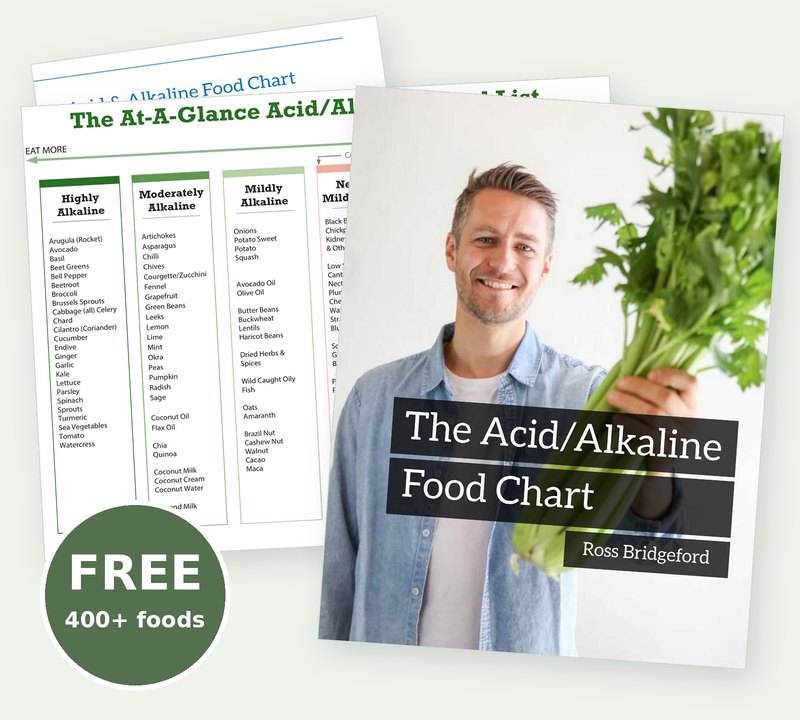
The full acid/alkaline chart, on one page
My free chart rates 400+ foods from Highly Alkaline to Highly Acidic, with a one-page version for your fridge, so you can check any food in seconds.
It’s free. Just tell me where to send it.
The seven most acidic foods (cut these first)
These are the worst of the worst. Certainly don’t let these exist in your everyday life. For each I’ve given some of the known negatives and some of the research, to help with your motivation the next time one of them is calling your name!
#1. Cola and soft drinks
Cola has to come in at number one, and I could write a whole thesis on why. Let’s just touch on the main points as to why I quite literally never touch colas, lemonades, sports drinks and other fizzy drinks:
- Sugar: about 9 teaspoons in a single can. This. Is. Crazy.
- Phosphoric acid: in a study of over 2,500 people, women who drank cola had lower bone density at the hip, and the more cola they drank, the lower it was. Other fizzy drinks didn’t show this (Tucker 2006).
- Caffeine: acid-forming, and around 30–50 mg a can. That’s a lot of caffeine from a drink that isn’t even coffee!
- High-fructose corn syrup: researchers have linked the rise of HFCS in drinks directly to the obesity epidemic (Bray 2004).
- Diet versions: swap the sugar for aspartame and you’re no better off (see #7).
And the simple fact is, sugar, caffeine, HFCS and sweeteners are all HIGHLY acid-forming, and sodas contain them in abundance. Let’s put it like this – you can’t be alkaline and consume cola on a daily basis.
Some other scary facts about regular soft drinks:
- In a study of 548 schoolchildren published in The Lancet, every extra sugary drink a day raised the odds of obesity by 60% (Ludwig 2001).
- Women drinking one or more sugary drinks a day had an 83% higher risk of type 2 diabetes than women who rarely drank them (Schulze 2004).
- Men drinking two or more sugary soft drinks a day had an 85% higher risk of gout (Choi 2008).
Linked to: obesity, type 2 diabetes, tooth decay, reflux, low bone density, gout and heart disease.
#2. Ice cream
All dairy is acid-forming, but ice cream is the worst of it, because it’s dairy AND sugar (over 21 g per 100 g), plus the additives, colourings, sweeteners and other acidic extras that go in to make it so addictive. That combination makes it one of the most acidic foods you can eat.
Personally, if I ever have even a little bit of ice cream, I feel tired instantly and get a headache. It’s instant. It literally couldn’t taste good enough for me to want that response in my body.
We’ve been told for decades that milk builds strong bones, but the big long-term studies don’t back that up. A Harvard study of nearly 78,000 women found milk didn’t protect against fractures (Feskanich 1997), and in a Swedish study of 61,000 women, those drinking three or more glasses a day had 60% more hip fractures (Michaëlsson 2014). Interestingly, fermented dairy didn’t show the same pattern, which is one more reason kefir is my first choice if you’re having dairy.
You don’t have to be 100% – some dairy is OK. Kefir is the best choice, then butter, with milk and cheese kept occasional and ice cream best avoided.
Ice cream is an easy one to get rid of. Do it! (Try blending frozen berries with coconut cream instead.)
Linked to: weight gain, acne, digestive issues and, for milk, no protection against fractures.
#3. Sugar
Sugar is sugar is sugar. It’s at the root of so much acidity! And this counts for all sugar: white, brown, raw, cane, corn syrup, malt, honey, molasses, sucrose, fructose (yes, fruit sugar), lactose, maltose, glucose and anything else ending in -ose.
I know this isn’t an easy one to give up entirely, but I want you to start to lower the amount of sugar in your life and move slowly away from it. Sugar drives a rapid rise in blood sugar, feeds yeast and candida in the gut, and the more you have, the more you crave. In one study, rats given the choice between sugar-sweetened water and cocaine chose the sweet water 94% of the time (Lenoir 2007).
Giving up sugar is normally really hard, but with the alkaline approach, the more alkaline you get, the less you’ll crave. It makes it so much easier and less stressful.
And it’s clear something needs to be done: the average American now eats around 17 teaspoons of added sugar a day, nearly three times the American Heart Association’s limit for women (6 teaspoons) and almost double the limit for men (9) (AHA). The food manufacturers KNOW it’s the way to keep us coming back to their products.
Here’s my complete guide to sugars and the healthier alternatives.
Linked to: inflammation, type 2 diabetes, weight gain, colon and pancreatic cancer, and cravings that keep you coming back for more.
#4. Trans fats (hydrogenated and partially hydrogenated fats)
As healthy as the healthy oils are to the body, the wrong fats are devastating. Trans fats are made when vegetable oils are hardened into margarine or shortening, and they turn up in the most acid-forming foods of all: takeaways, fried foods, cakes, biscuits, chocolate snacks, chips and pizza. You know the drill.
Trans fats raise your LDL (“bad”) cholesterol while lowering your HDL (“good”) cholesterol (Mensink and Katan 1990). The swines! And getting just 2% of your daily calories from trans fats is linked to a 23% higher risk of heart disease (Mozaffarian 2006).
Many countries have now restricted artificial trans fats, but they still sneak into fried and imported foods, so check labels for “partially hydrogenated” oils and steer clear of these fats!
Linked to: raised ‘bad’ cholesterol, lowered ‘good’ cholesterol, heart disease and type 2 diabetes.
#5. MSG (monosodium glutamate)
When we’re talking about acidic foods, we have to include this one, even though it’s more of an additive than a food. MSG is a very powerful flavour enhancer, and it’s used in crackers, chips, microwave meals, canned foods, stock cubes and fast food to make them taste fresher and more moreish. It’s not just in Chinese food – it’s everywhere, if you eat a lot of refined and fast foods.
The FDA classifies MSG as safe for most people, but acknowledges that some sensitive people report short-term reactions like headaches, numbness, flushing, tingling and palpitations after eating it (FDA). And in a study of over 750 Chinese adults, those eating the most MSG were more likely to be overweight (He 2008).
MSG also hides on labels, so look out for: yeast extract, autolyzed yeast, hydrolyzed protein, glutamate, glutamic acid, monopotassium glutamate, sodium caseinate and textured protein.
Linked to: headaches, numbness, flushing and palpitations in sensitive people, overeating and weight gain.
#6. Yeast
Yeast-based foods – bread, beer, baked goods and yeast extracts – are acid-forming, and they’re a vicious cycle when they come with lots of sugar: sugar feeds yeast, and an overgrowth of yeast (like candida) in the gut keeps the cravings for sugar going.
For so many people I’ve coached, cutting back on yeast and sugar together has made a huge difference to bloating, digestion and energy. You don’t have to be perfect, but the less of it in your everyday life, the better.
Linked to: bloating, digestive issues and candida overgrowth.
#7. Artificial sweeteners
As acidic foods go, this is a shocker. I’m talking about the super-commercial artificial ones here (aspartame, sucralose, saccharin, acesulfame, neotame, cyclamates), not the natural ones like stevia. If you use these sweeteners in your daily diet, please stop asap!
And this isn’t just me saying it. In 2023, the World Health Organization advised against using non-sugar sweeteners for weight control, because long-term use was linked to a higher risk of type 2 diabetes, heart disease and early death in adults (WHO 2023). The same year, the WHO’s cancer agency classified aspartame as “possibly carcinogenic to humans” (IARC 2023).
Sweeteners also keep your sweet tooth switched on, so you never get the chance to lose the cravings (Yang 2010).
Linked to: type 2 diabetes, heart disease, sugar cravings, and possible cancer risk (aspartame).
Easy swaps for acidic foods
Remember: focus on the good, crowd out the bad. Here are the simple swaps I recommend most:
| Instead of | Try |
|---|---|
| Cola, soft drinks | Sparkling water with fresh lime or lemon, or a green juice |
| Coffee (the second and third cup) | Herbal teas or a turmeric & ginger tea |
| Fruit juice | Whole fruit (lower-sugar berries are best), or vegetable juice |
| Ice cream | Frozen berries blended with coconut cream |
| Milk | Unsweetened almond milk (Moderately Alkaline) |
| Cheese on everything | Avocado, or a dollop of hummus |
| White bread, pasta | Quinoa, buckwheat, zucchini noodles, or my gluten-free bread |
| Sugary breakfast cereal | Oats or one of my 9 alkaline breakfasts |
| Peanut butter | Almond butter (Moderately Alkaline) |
| Sugar, artificial sweeteners | A little stevia, or cinnamon for sweetness |
| Chips, crackers | A handful of almonds or veggie sticks with guacamole |
Sauces and condiments are where acidic foods sneak in most. Here are the alkaline seasonings I use instead of soy sauce, ketchup and shop-bought dressings.
Acidic foods, reflux and your teeth
If you’re here because of reflux, the “acidic in your mouth” foods matter too: citrus, tomatoes, vinegar, coffee, wine and soda can all be triggers going down, along with fatty, fried and spicy meals. Everybody is different, so listen to your body. My 14-day alkaline diet for acid reflux walks you through what to eat instead (and no, bananas aren’t the answer).
And for your teeth, acidic drinks like soda, juice and wine soften the enamel. Sip water alongside them, and wait at least 30 minutes before brushing.
Where to start
I’m all about mastering the fundamentals: the handful of super-effective things that make the biggest difference (the 80/20 rule), rather than trying to do it all at once. Here they are:
The fundamentals
- Transition away from the seven most acidic foods above
- Eat the most alkaline foods daily, especially the greens
- Stay properly hydrated
- Move every day, even if it’s just a 15-minute walk
- Get your omega-3s daily
- Get plenty of alkaline minerals
- Get some sunshine, and smile!
You never have to be perfect. Consistency is FAR better than perfection.
For the full picture, here’s my alkaline diet guide and easy plan.
Acidic foods FAQ
What are the most acidic foods?
The most acidic foods are sugar and sugary drinks (cola, fruit juice), alcohol, processed and cured meats like bacon, red meat and chicken, hard cheese and ice cream, white bread and pasta, artificial sweeteners and processed snacks. The seven I’d cut first are cola and soft drinks, ice cream, sugar, trans fats, MSG, yeast and artificial sweeteners.
What acidic foods should you avoid?
Start with the worst of the worst: soft drinks, ice cream, added sugar, trans fats (anything ‘partially hydrogenated’), MSG, yeast-heavy foods and artificial sweeteners. Everything else, like coffee, meat, cheese and bread, you can keep in your 20% while you fill the other 80% with alkaline foods.
Which foods help reduce acidity?
Leafy greens, vegetables, avocado, lemons and limes, herbs and healthy fats. These are the most alkaline foods, and the more of your plate they fill, the less acid load your body has to deal with. Here are my 15 most alkaline foods.
How do I stop my body from being so acidic?
Your body works hard to keep your blood pH steady no matter what you eat. What you can change is how much acid load you’re asking it to deal with: crowd in greens and veggies at every meal, swap the most acidic foods on this list, stay hydrated and aim for about 80% alkaline foods. You never have to be perfect.
Is coffee acidic?
Yes. Coffee is Moderately Acidic, mainly because of the caffeine. It’s also acidic in your mouth (around pH 5), which matters for reflux and teeth. One a day is fine in your 20%; herbal teas make a great swap for the rest.
Are tomatoes acidic?
In your mouth, yes: tomatoes are naturally acidic. In your body, no: tomatoes are Highly Alkaline, because their alkaline minerals far outweigh their acid. If you have reflux, though, some people find tomatoes a trigger, so listen to your body.
Is milk acidic?
Yes, milk is Moderately Acidic, and ice cream is Highly Acidic. If you’re having dairy, kefir is the best choice, then butter, with milk and cheese kept occasional.
Are eggs acidic?
Yes, eggs are Moderately Acidic, as with all animal protein. They’re fine in your 20%, alongside plenty of greens.
Are bananas acidic?
Yes. Bananas are Moderately Acidic because of their sugar: 12.2 g per 100 g. Here’s the full answer.
Free download
See where every food sits
My free alkaline food chart rates 400+ foods from Highly Alkaline to Highly Acidic, with a one-page version for your fridge. Check any food in seconds while you shop or cook.
It’s free. Just tell me where to send it.
If you have any questions, just post them below in the comments and I’ll get back to you!
Ross

Ross has taught and coached realistic, sustainable alkaline eating since 2004, working with thousands of clients around the world. He’s the author of The Alkaline Reset Cleanse and The Alkaline Life (Hay House). Ross is a health educator, not a doctor or dietitian, so if you have a medical condition, talk to your own health professional before making big changes to your diet.
Sources
- USDA FoodData Central, SR Legacy: protein, minerals and sugar for every food in the tables
- My 195-food dataset (CSV spreadsheet), rating, PRAL and sugar for every food
- Remer and Manz (1995), Potential renal acid load of foods and its influence on urine pH, Journal of the American Dietetic Association
- Feskanich et al. (1997), Milk, dietary calcium, and bone fractures in women: a 12-year prospective study, American Journal of Public Health
- Michaëlsson et al. (2014), Milk intake and risk of mortality and fractures in women and men: cohort studies, BMJ
- Lanou, Berkow and Barnard (2005), Calcium, dairy products, and bone health in children and young adults: a reevaluation of the evidence, Pediatrics
- Tucker et al. (2006), Colas, but not other carbonated beverages, are associated with low bone mineral density in older women, American Journal of Clinical Nutrition
- Bray, Nielsen and Popkin (2004), Consumption of high-fructose corn syrup in beverages may play a role in the epidemic of obesity, American Journal of Clinical Nutrition
- Ludwig, Peterson and Gortmaker (2001), Relation between consumption of sugar-sweetened drinks and childhood obesity, The Lancet
- Schulze et al. (2004), Sugar-sweetened beverages, weight gain, and incidence of type 2 diabetes in young and middle-aged women, JAMA
- Choi and Curhan (2008), Soft drinks, fructose consumption, and the risk of gout in men, BMJ
- Lenoir et al. (2007), Intense sweetness surpasses cocaine reward, PLoS One
- American Heart Association, How much sugar is too much?
- Mensink and Katan (1990), Effect of dietary trans fatty acids on high-density and low-density lipoprotein cholesterol levels in healthy subjects, New England Journal of Medicine
- Mozaffarian et al. (2006), Trans fatty acids and cardiovascular disease, New England Journal of Medicine
- US FDA, Questions and answers on monosodium glutamate (MSG)
- He et al. (2008), Association of monosodium glutamate intake with overweight in Chinese adults: the INTERMAP Study, Obesity
- World Health Organization (2023), WHO advises not to use non-sugar sweeteners for weight control
- World Health Organization / IARC (2023), Aspartame hazard and risk assessment results released
- Yang (2010), Gain weight by “going diet?” Artificial sweeteners and the neurobiology of sugar cravings, Yale Journal of Biology and Medicine

Is nutritional yeast and honey bad for this diet?
My question is, SODA WATER. I have a soda fountain so I fill up a bottle of filtered water and then I carbonate the water to have a slightly sparkling soda.
Is this good or bad?
Thanks a lot
Hi, my son is 8 years old and has already had 9 cavities, two crowns and two root canals! Bad teeth run on my side of the family. I just started testing the ph of our saliva and he has acidic saliva. I’d like to put him on a high alkaline diet. How do I make this tolerable for an 8 year old?
What is the most important thing I can do to battle my skin cancer. It is coming up everywhere?
I have been alkaline now for 3 weeks.
Hi Candoo
I can’t make suggestions directly related to a personally diagnosed condition. The information on my site should help direct and guide you to implementing the alkaline diet.
Thanks – sorry I can’t be more specific – it’s all legal stuff.
Ross
Amazing facts there, thank you so much.
I give my children a daily multi vitamin and omega 3 supplement which a purchase from ‘natures Earth’ website. I was dissapointed to see that they both contain sweeteners.
I m sure my children do get quite a good diet but I have always believed in vitamins.
Can you recommend any good ones for children that don’t contain sweeteners ??
Thanks Kelly
I see leafy greens at the top of most alkaline lists. I am on a blood thinner, coumadin, for life and have to avoid them! Vit K. Can you recommend ways for someone like myself to stay alkaline w/o too much vit K?
Thanks.
I’m pretty confused trying to do a low carb, high fiber, low K and now alkaline diet. I’m trying to lose 20 lbs, have digestive problems (sluggish and constipation) taking psyllium, lots of water and walking daily but still not feeling optimal and have not been for on and off a year.
Hi excellent article didn’t know so many things. Question in regards to sugar, what can you use instead? I have an extremely sweet tooth when it comes to chocolate or even sweetening my oats in the morning. Sweet drinks are not the problem more the chocolate.
Thanks
Hey Angelika
Just transition up and up with the cocoa content until you get to 85% or 90% cocoa dark chocolate. It is the best way to go as you find you can take the edge off the craving, but you don’t crave more once you’ve eaten it. A cube does the trick!
Ross
Hi Ross,
What about Xylitol?
I cut out fast food, milk, red meat, sugar and sweet snacks. Eating lots of salads, vegetables but my problem is I don’t need to lose ANY weight. After cutting these out of my diet, I look too thin. I honestly don’t know what I can eat to get the weight I need back on. I’m not going to eat celery and carrots sticks all day, any suggestions of healthy foods that help you gain weight? Please help. Also would love to have access to healthy recipes. Thanks
As usual, your info and writings are on point! I frequently follow your Facebook page and share your posts with my fan page followers. Please keep up the GREAT work!
Randy Powell
Thanks Randy!
Hi Ross
The only sugar i eat is pure organic honey.Every thing i’ve read about the heeling properties of honey can’nt be that bad for you.
Thanks David
Hi David
It has healing properties for sure, in the same way that red wine does. But that doesn’t mean that it’s good for you. It’s largely a combination of fructose and glucose (and water) which is a bad combination of sugars. It also averages a pH of around 4.
It has uses, but I personally wouldn’t recommend using it daily or regularly.
Ross
Ross or Felicity,
Any advice for a hiatal hernia sufferer? The hernia causes reflux and so they put me on acid reducing drugs. I’m not too “keen” on that idea, any suggestions? Would an alkaline diet help in a case such as this where its more of a mechanical issue than dietary? I eat mainly a vegetarian diet with a couple of poultry-centered meals a week. No milk in my diet. Thank you!
hi ross
thanks so much for an easy reading web page…i have damaged teeth and dentists argue with me about sports drinks i am drinking a lollies i eat…which i do neither of…so they couldnt get why my teeth were being damaged by ‘acid’. i also realised (rather embarrasingly) that when i sweat (i am a very active person) that i stink of an acidic smell like cat pee!! gross. anyways….i started to investigate acidic foods and realise i eat a lot of them – love bread, for instance and yoghurt etc etc. not big on sugar but do like dark chocolate a lot. so here is my answer to get rid of or eliminate more acidic foods, hopefully help my teeth and my stench LOL!! thanks so much, this is easy quick reading for quick direction on what not to do and also what to do, thanks ross! kind regards charlene
Hi Ross my name is Jackson from Kenya.i have read your article and am now convinced that sugar is bad.Lately the doctors say I have an acidity problem so I would really appreciate it if I got more articles to read and practice so as to improve my health.
Dear ross,
I think it very funny how you make it seem that milk is this highly acidic liquid that we ingest. Its nowhere nearly as acidic as you make it seem. Most milk has a ph level slightly below 7. Making it barely acidic and if not in some or most cases ph neutral. If you are in posession of some milk that is highly acidic, please do a litmus test and show us the milk and results as proof.
A common misconception – it’s not the pH of the substance outside of the body that matters. It’s the affect it has once consumed – the effect on the body.
Thanks
Ross
This is great!! Yes, I know that sugar is bad just because of how it effects me. I have cut cane sugar out of my diet completely. But I am wondering about other sugars such as beet sugar, maple sugar, coconut sugar and agave. Especially coconut sugar is supposed to be very good for you. Please help me figure this out. I’m very health conscious and there is not much material on this subject.
Hey Elise
All sugar is sugar, sadly. You should try to avoid all forms if possible.
Ross
Dairy is alkaline not acidic its used as an antacid. U can become too alkaline u need to test your ph to see. When i eat too many alkaline foods i have to take acid wirh meals ir drink tea to acidify gut. The gut needs to be acid to digest food . U can go too alkaline. Do not recommend taking baking soda with meals it stops u digesting.
Hey Angela
Long time! Hope you’re going great.
Regarding your comment, I respectfully disagree. It’s not alkaline, it is acid forming. The lactose, hormones, chemicals, bacteria etc all contribute to it’s acidity.
It’s incredibly, incredibly difficult to be too alkaline to the point of it becoming a problem. Think of it this way, even people who are too acidic ALL DAY every day still live into their 70’s, 80’s and 90’s. If it were the case that you accidently became too alkaline your body would just regulate your pH in the same way as it does all day every day with acidity. It wouldn’t be a problem.
Being consistently over-alkaline in the same way as most of us are over acidic would be practically impossible.
Thanks
Ross
Where can I order your book about the diet? I’m much better with something I can carry around with me rather than look on the computer.Please let me know asap. Thank you, Becky
Hi Becky
See here: http://liveenergized.com/redirecttransition
Thanks
Ross
Hi Ross, Youve mentioned Omega 3, but why this trigger my acid reflux. My assumption is that it lowers (alkalize) my stomach acid. As i understand ph level on our stomach should be very high.
Hi Roel
The stomach produces HCl on demand, see here for more info: http://liveenergized.com/wordpress/2013/01/21/alkaline-diet-myth-1-you-cant-change-your-ph/
Cheers
Ross
I consume milk like a bottle a day so is that bad ? omg what should I do
I’d definitely be looking to cutting that down and then cutting it out.
Ross
I would ask a few questions but I c that there have not been any replys to the ones already made. Thanks for the post.
Hi Charles
Yeah, been super busy right now. Am actually hiring someone to be my assistant right now, so will have more time for comments, content and videos 🙂
Ross
Hi Ross,
thanx so much for your web site and recipe book!
Im on alkaline diet since January and lost 15kg ( base-70kg),
I have so much energy, I do not feel this strange “hunger” and unbalance need for sugar!I just feel great and look realy good! On other diets I have problems with my skin and hair- now my skin is perfect and hair are shiny – just love it!
I’ve stoped eating red meat, ( white meat and fish only once a week as extras in my salads), gluten and sugar ( only couple fav. fruits), drinking coffee and black tea.
I try to drink at least 3 l of water per day!
I do have issue with water- I was thinking about Reverse Osmosis- what is your opinion?
Still cant believe how much I achived during such a short time!
cheers!
best regards from Poland, Joanna
Hi Joanna!
Awesome work – well done you!
I’m not a big fan of reverse osmosis. I explain why here: http://liveenergized.com/wordpress/2010/08/25/the-ultimate-comparison-of-alkaline-water-methods/
Thanks
Ross
Hi,
Thanks for this great information. What about Xylitol as a sweetenerÉ
Hi Diana
Xylitol is better than the more chemical sweeteners like nutrasweet – but I still recommend keeping it to a minimum and transitioning away when possible.
Thanks
Ross
Hi Ross!
Dairy is in the list of acidic foods. Which brings me to this question: Milk is advised for children. I have a five-year-old who drinks milk everyday. What to make of this then?
Thanks and God bless you!
Hey Mich
That has to come down to your own beliefs and preferences. I don’t believe dairy is good for anyone, kids, adults – anyone. I recommend checking out the info on http://pcrm.org regarding dairy. It offers a good, alternative but medically based opinion.
Thanks
Ross
Hi Ross, thank you for the info, much appreciated, have you written an article on stevia? Thnx, have had some success on your diet, watched hungry for change and the food revolution and have found that what you offer seems to be more pertinent, food wise for me. Is there some where you post these questions above as some are interesting and I would like to see the answers….
Bye for now m
Hey Meriel
How are you?!
Stevia is probably the best of a bad bunch. I’d use it as a transitional tool, but do try to steer away from it in the end.
Hope all is well with you
Ross
Hi Ross,
My friend has been diagnosed with bowel cancer, he had an operation a week ago. He will have chemotherapy later. What kind of alkaline food or recipes you have is good for him?
Thanks
Hi Ross,
I eat Kale, broccoli, almonds every day and except for milk I do not eat any of the above acidic foods.
So I am basically alkaline.
What is your opinion on Reverse Osmosis systems and adding a FILTER which would alkalize the water. I wanted to get a system to minimize the flouride and chlorine that I digest, as I hear that’s bad for you too.
Thanks,
Deborah
Go to a doctor right now! You indicate that you are “basically alkaline.” If you are too far from the 7.35-7.45 pH you may be suffering from alkalosis! If you are below this level, I would be concerned as well. You may be diabetic (ketoacidosis) or suffer from other issues.
If your acidity is truly a concern I would recommend adding baking soda to all of your food. If you want to reduce the acidity, this is the most effective way (or drink a teaspoon of draino…don’t do this).
You could also try intravenously injecting a sodium bicarbonate solution (baking soda). This treatment is often used in cases of severe acidosis. Not only will this neutralize your acidity, but it will contribute to your blood buffering system. By the henderson-hasselbalch equation, we see how such substances can minimize pH fluctuations. pH=pKa + log(base/acid). Because of the nature of the log term, big changes in concentrations of H+ will contribute to a slightly alkaline pH.
I would also caution you with some of Ross’s recommendations in this article. I am not entirely sure of his qualifications/degrees, but looking at these recommendations and on previous articles, he does a excellent job of misinterpreting results and making crazy interpretations on the results of the studies. Many of these articles are behind pay walls, and I doubt he took the time to read them.
In this article, he states that “is not good for you and doesn’t lead to stronger bones, it actually leads to weaker bones.” No where on that page and in the articles is there an indication that bones are weakened. In fact, the studies clearly indicate that some studies show benefits, while most have no relation. He is effin with you pretending like there is science in this whole acidity thing, while citing articles on healthy foods to deceive you. The shocking truth is that you likely do not have any issues with your acidity. If you did, you would know (passing out/seizures/metallic taste in mouth).
Disregard my recommendations I said in the first few paragraphs. If you are on a municipal water system, you water is tightly regulated and should be fine (if you are concerned..get it tested by your water company). If you use wells, there may be benefits with water filtration systems because of the lack of processing.
Bah!
Hi,
I am new to this alkaline diet thing and I am really excited about all this great news and information! I only have basic chemistry knowledge (high school), so I am not sure about all of this acid/alkaline information.
Firstly, what feature of the foods define their acidity? If I recall correctly from HS and the different definitions of acidity, protons (H+ or H30+) are essentially the atom that contributes to the acidic nature of a substance.
Am I right in thinking this?
Secondly, if we are trying to neutralize acidic foods would it be alright to supplement with proton pump inhibitors (these are prescription, but i can get them from my friend) to reduce H+ stomach secretion. Maybe I can take some antacids or milk of magnesia. Would this provide any beneficial results? I am concerned because milk of magnesia relieves constipation (dont want any accidents, haha!).
Thanks,
Fred
Hi Ross,
I was then wondering about Kefir and the culturing of milk which has huge health benefits in the digestive system adding probiotic bacteria. Is this product, Kefir also acidic or has it been converted after the culturing process?
I enjoyed your article btw, thank you and I would like to know the 7 most alkalising foods to have daily
Regards, Andrea
Hi Ross,
Can you get back to me about the Chanson machine. The Microscopist that I have signed up with says that spring water would be more beneficial than a Chanson in terms of the filtration system used. Forvarious reasons my Chanson has not been used, and i am considering returning it this week.
Kind regards
Jenni
Hi Ross, I was wondering if you mean by “all milks” does that include nut milks like almond, soy and coconut milks?
What is your opinion of frozen and fresh yogurt.
Hi Ross, I am celiac and I do crave sweet things and chocolate . I do try to use brown sugar a little and never drink pop. Please advise on how to cut back on sugar intake . What is alkaline water? I drink Almond milk as I feel upset with dairy products. Is brown sugar the best product to use to sweeten food? Thanks
That milk and ice cream part broke my heart. T_T
I’m pretty much guilty of it.
Nevertheless, thanks for this very informative guide. 🙂
Ross, you say that potatoes are also acidic unless they are new potatoes. What is the difference?
Also, home made popcorn – a little bit of oil in the pan and then pop your own…..? Not microwave popcorn. Acidity levels?
Thanks.
Hi Ross,
Thank you for all the info you share with us. I have a question about omega 3 ‘s. can you please recommend a brand and type to buy. I always thought omega 3 is an acidic compound. I would appreciate your comments.
Thank you
What about soy milk?
What about Soy Milk?
Hi Ross, I just wanted to say thank you for all of the hard work that you do putting this together. It’s totally worth it for me. 🙂
I know dairy is a no no but I do include some cheese in my diet. For instance I take chunks of eggplant baked in the oven with lots of coconut oil, top it off with some tomato sauce and some cheese and boy is that good. I know I probably should lay off the cheese though but I just love it. I’m Italian.
Oh yeah, what are the best alkaline minerals in your opinion?
spoonful of baking soda every morning. works wonders.
very informative and truly inspiring.
If one has to use bottled water a lot, what are the best ones to buy that are the most alkaline. I have a good filtered water system at home but when traveling and out, I would like to know a good one to buy!
Thanks,
Nancy Hart
P’s. Animal milk is bad. Raw or otherwise. What decade are we living in people?
Hi Ross, I stay away from milk and diary, but wondering in regards to nut milks where they land. I love almond milk, I can make it fresh but sometimes the almonds are too expensive and I buy the bottle, unsweetened. It’s blue diamond, almond breeze. Thoughts? Thanks! Love and light. x
Hi Ross,
If even fructose (and I presume then raw honey as well) is bad, what sweetener does one use? I made the transition from sugar to fructose a few years back, since I’m allergic to honey, and heard it’s about the second best thing to raw honey.
Thanks
Nadèl
Thank you very much for your dedication to improving significantly the health of everyone through teaching mankind the good foods to eat and the bad ones to avoid. I have benefited tremendously from the good work you are doing and wish to encourage to continue on this path. God Bless
LOVED your article Ross! I just forwarded it to most of my list!
Thanks so much for sharing your knowledge!!
Kim ~
Could you please explain – The Cycle of Imbalance – diagram above: It says on the bottom of the diagram: “quickly turns healthy red blood cells into bacteria and yeast”? The acidic state may foster the growth of bacteria and yeast but red blood cells can’t be turned into bacteria or yeast!
its cause its bull. =).
Great article Ross, many thanks.
Dick a cow’s milk is for her calf not humans. Reasearch the dairy industry, associated politics and animal abuse and you might change your mind about wanting to consume dairy. The fact that its acidic is only one reason not to consume it, albeit a good one.
Hi when you say all dairy is sheep and goats yogurt I clouded in that?
Hi when you say all dairy are sheep and goat milk included I that?
Hi Sarah
They’re better than cows, but both still are acid forming.
Thanks
Ross
I know all that is true about pasteurized homogenized milk – but not for raw milk… which is a completely different food. Please clarify next time. 😉
Hi Natalie
It is my understanding that raw milk still contains lactose, and that alone would make it acid forming. Feel free to include raw milk as part of your diet – I always suggest following the approach 80/20 or 70/30.
Cheers
Ross
Hello Ross.
What’s your take on fermented vegetables and Kombucha tea.
I make & consume both. The sugar used to ferment the Kombucha is totally processed by the tea & we all know that raw fermented vegetables are really good to help fight bad bacteria in the digestive system but there is always yeast present in both & I am curious to hear your opinion on both. Kombucha was & still is a very popular drink in some villages of the Ukraine & China & many have attributed their good health & longevity to their drinking it. Thank you in advance. Davida
All dairy is acidic (yes, milk is not good for you and doesn’t lead to stronger bones), THIS IS WHERE I STOPED READING YOUR SO CALLED “INFORMATIVE” ARTICLE. ARE YOU REFERING TO “RAW MILK” OR UNPASTURISED? A STATEMENT LIKE THAT & WE ARE NOT EVEN ON THE SAME PAGE!!
Hi Dick
Yes, this is all milk, including unpasteurised and raw. Unfortunately, even though these less spoiled milks are much improved on the commercial pasteurised milk that makes it to our store shelves, dairy is still acidic.
Thanks
Ross
Can you site studies for your opinion, regarding raw milk?
Ross I am drinking Hemp milk when I have tea..is great..
Soya milk caused problems with thyroid.
Rice milk is nice but they add sugar. Please send any info for readers.
I have been told by more than one doctor and nutritionist that dairy products are ALKALINE not acidic. I agree that milk is not as good for us as we were lead to believe and it does create mucous in those sensitive to it but I stopped reading when I hit, in my opinion, your inaccurate info…
Lynn,
It’s after you digest it that it becomes acidic…