
Alkaline Foods List: 195 Foods Rated
If you’ve ever gone looking for a list of alkaline foods, you’ll know how quickly it gets confusing. One list tells you bananas are one of the most alkaline foods on the planet, the next says they’re acidic… and hardly any of them tell you why (a lot of them have just copied each other, if I’m honest). So let’s clear that up, once and for all.
Now, when you see which foods are the most alkaline and which are the most acidic, you’ll probably breathe a sigh of relief – but you might also be wondering what on earth you’re going to make for dinner tonight! Don’t worry, I’ve got that covered for you too.
Because I know most of the alkaline food lists out there look REALLY restrictive. But after 22+ years of coaching people to live alkaline, I can tell you it can be super easy, and it does NOT mean giving everything up (at all).
In fact, a lot of what you’ll see on these charts comes back to the good old-fashioned advice of ‘eat your veggies’ and ‘everything in moderation’ – and that alone will take you a long way! My job is to show you the handful of foods and simple swaps that make the biggest difference, so you get the most benefit from the fewest changes.
So why listen to me? Well, I’m Ross, and over the years I’ve worked with thousands of clients, written two books for Hay House (The Alkaline Reset Cleanse and The Alkaline Life), and I think I’ve heard just about every ‘is this food alkaline?’ question there is. I also came to all of this the hard way. In my early twenties I was living on six to eight coffees a day, with brain fog and crashes, and it was changing what I ate that gave me my energy back.
And I’m a bit of a science geek too. I love digging into the studies, keeping up with the latest research and making sure what I teach actually stands up to it. That’s why every food on this list has my rating and its acid load (PRAL) and sugar right next to it, so you can see exactly why it sits where it does – you never have to just take my word for it (question everything, even me!).
The easiest way to start
- Have a scan of the top 10
- Pick three foods you already enjoy
- Add them into your meals this week
Small wins add up fast, and I’ll show you how to build from there.
What my clients say
“I’m thrilled with this easy, delicious approach to food. I have been lazy and despondent about cooking for the last few years (empty nest biz). Tried new things but fizzled and was confused with so much Information out there. Ross Bridgeford’s alkaline program has changed all that. … I have loved every recipe I’ve tried …”
Everything on this page is free – no sign-up, nothing to buy. That’s 195 everyday foods, each with my rating, its acid load (PRAL) and its sugar per 100 g. And if you’d like it all on your fridge, my printable chart has 400+ foods plus a one-page version. It’s a gift from me to you.
Get the free printable chart →
How I rate alkaline foods.
Every food here has a rating and two numbers. The acid load (PRAL) is the measure researchers use. It estimates how much acid a food leaves for your kidneys to clear, based on its protein, phosphorus, potassium, magnesium and calcium. It’s a useful start, but it counts sugar as zero. That’s why dates and bananas look so alkaline on other lists. My rating starts with PRAL, then adds what it leaves out: the sugar (I show you the grams), and whether a food is fresh, green and mineral-rich, or processed, refined, dairy, gluten, yeast, fermented, alcohol or caffeine.
| My rating | How much of your plate |
|---|---|
| Highly Moderately Mildly Alkaline | Most of it: aim for about 80% |
| Neutral / Mildly Acidic Moderately Acidic | Fine in the other 20% |
| Highly Acidic | Keep these for now and then |
Top 10 alkaline foods
These are the 10 most alkaline foods on my chart: high alkaline foods you can eat every day, ranked by acid load per 100 g.
- 1
Beet greens
Wilt them into a stir-fry like spinach
- 2
A handful in smoothies, soups and curries
- 3
Half on toast or in a salad
- 4
Swiss chard
Sauté with garlic and olive oil
- 5
Massage with lemon for a raw salad
- 6
Rocket (arugula)
A bed for any meal
- 7
Collard greens
Shred into soups, or use the leaves as wraps
- 8
Watercress
Stir through salads and soups
- 9
Carrots
Grate raw into salads, or roast
- 10
Beetroot
Roast, or grate raw into salads
Fresh herbs, ginger and spices are Highly Alkaline too. They score even lower per 100 g, but you use a few grams at a time, so they’re in the full list instead. Dried fruit also scores very low on PRAL, but it’s Highly Acidic on my chart because of its sugar (see below). For my take on the most alkaline foods on earth, and why each one earns its place, see my top 15.
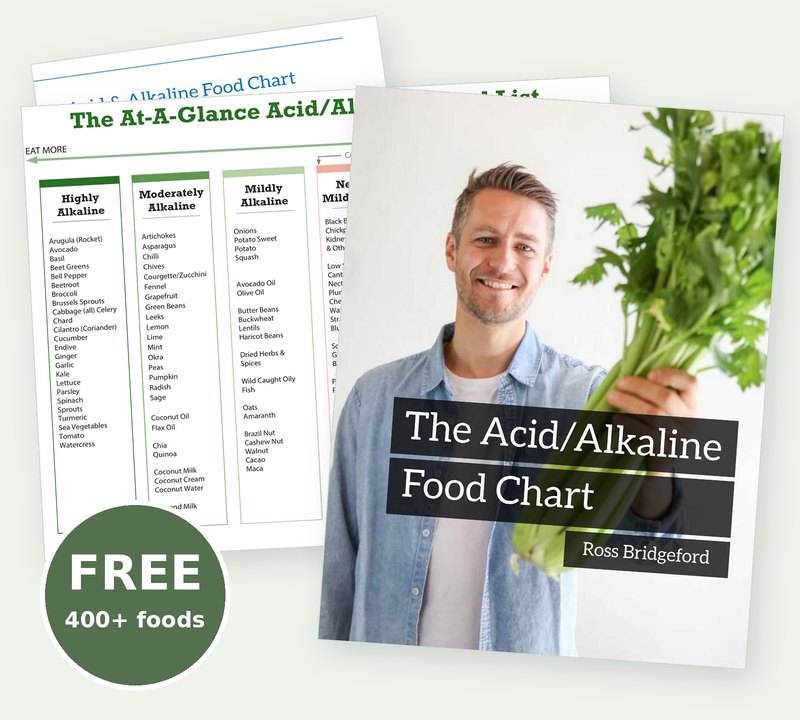
Free download
Want this on your fridge?
My free alkaline food chart gives you a colour-coded, one-page list to stick on your fridge, plus my full chart of 400+ foods rated from Highly Alkaline to Highly Acidic. Check any food in seconds while you shop or cook. It’s free.
It’s free. Just tell me where to send it.
Alkaline vs acidic foods: what the ratings mean
Alkaline is the opposite of acidic. On the pH scale from 0 to 14, 7 is neutral. Below 7 is acidic, and above 7 is alkaline (also called basic).
A food’s own pH and its effect in your body are two different things. Mixing them up is one reason alkaline food lists disagree.
| What it tells you | Lemon juice, for example | |
|---|---|---|
| The food’s own pH | How acidic it is in the glass or on your tongue. This matters for reflux and tooth enamel. | Very acidic, about pH 2 |
| Its acid load (PRAL) | The acid left for your kidneys to clear once you’ve digested it | −1.9: alkaline-forming |
| My rating | Acid load, plus sugar and the kind of food it is | Moderately Alkaline |
A lemon’s citric acid is broken down as you digest it, but its potassium stays. So it ends up alkaline-forming, which is why I love lemon water.
Your blood stays between pH 7.35 and 7.45 whatever you eat (Schwalfenberg, 2012). Eating alkaline isn’t about changing that number. It’s about giving your body plenty of the minerals it uses to hold it steady. I’ve busted the most common alkaline diet myths here.
What PRAL measures, and what it leaves out
PRAL (potential renal acid load) is the standard research measure of a food’s acid load. Remer and Manz published it in 1995. It estimates how much acid a food leaves for your kidneys to excrete, and they checked it against urine pH. It’s calculated from five nutrients per 100 g:
PRAL (mEq/100 g) = 0.49 × protein (g) + 0.037 × phosphorus (mg) − 0.021 × potassium (mg) − 0.026 × magnesium (mg) − 0.013 × calcium (mg)
A negative score means alkaline-forming. Every PRAL score on this page uses this formula with nutrient values from USDA FoodData Central. The downloadable dataset lists each food’s USDA ID, so you can check any number yourself.
Researchers use PRAL to score whole diets in studies of bone, muscle and kidney health. It’s good at what it measures. But it looks only at protein and four minerals, so it misses three things that matter on an alkaline diet:
- Sugar counts as zero. Your body burns sugar to carbon dioxide and water, so sugar adds nothing to the acid load PRAL estimates.
- It’s per 100 g, not per serving. Spices and seeds look extreme because you eat a few grams. Dried fruit looks extreme because its water has gone.
- It knows nothing else about the food. Fresh or processed, whole or refined, fermented, full of healthy fats or not: PRAL can’t tell.
That’s why my rating uses PRAL as its starting point, not its final word. It’s also the main reason alkaline food lists are so different from each other.
Why bananas and dried fruit are acidic on my chart
On PRAL, bananas (−6.9) and dried apricots (−21.7) look strongly alkaline, because they’re rich in potassium. My chart rates bananas Moderately Acidic and dried fruit Highly Acidic because of their sugar. A banana has 12.2 g of sugar per 100 g. Raisins have 65.2 g, and medjool dates 66.5 g.
Fruit sugar is a mix of fructose, glucose and sucrose, and fructose is handled differently from other sugars. In larger amounts, most of it is processed by the liver, where it uses up energy (ATP) quickly and raises uric acid (2024 review). Small amounts, like a piece of whole fruit, are mostly handled in the gut (2019 review). Drying fruit concentrates its sugar, and juicing strips the fibre, so both make it easy to take in a lot at once.
So I’m happy with low-sugar fruit like berries and citrus. I keep high-sugar fruit to 1-2 serves a day, and I treat dried fruit and fruit juice as occasional. I answer the big question, is fruit bad for your liver, in more detail here. If sugar is your sticking point, my guide to sugars and sweeteners will help.
To be clear about what this is: on the acid-load measure, fruit really is alkaline-forming. My rating adds sugar because on an alkaline diet, I care about the whole effect of a food, not just its minerals.
Why nuts and seeds rate alkaline on my chart
PRAL goes the other way on seeds. Protein and phosphorus push the score up. So per 100 g, pumpkin seeds (+27.5) and hemp seeds (+32.2) score higher than bacon (+24.0).
My chart rates most nuts and seeds Mildly or Moderately Alkaline. They’re rich in healthy fats, magnesium and fibre, and you eat them by the handful, not by the 100 g. A 30 g handful of pumpkin seeds comes to about +8. A 150 g chicken breast is about +26. My alkaline nuts guide covers every common nut, and here’s why I use chia seeds every day.
Acid load (PRAL) for a typical serving
Wild oily fish like salmon (+7.6) gets a lift from its omega-3 fats too. It’s Neutral / Mildly Acidic on my chart, while most meat is Highly Acidic. Lentils, quinoa and oats get a similar lift for their fibre and minerals. Peanuts and peanut butter are the exception, and they’re Highly Acidic on my chart. Peanuts readily carry moulds and the toxins they make, such as aflatoxin, which is why the FDA tests peanuts and peanut butter for it (National Cancer Institute). For more plant protein ideas, see how to get enough protein on an alkaline diet.
The full list of alkaline foods: 195 foods by group
Each food’s rating is mine, from my Acid/Alkaline Food Chart. Beside it are its acid load (PRAL) and its sugar, both per 100 g as you’d eat it. Grains, beans, meat and fish are cooked; everything else is raw unless it says so. Both numbers come from USDA FoodData Central.
The last column says why my rating differs from PRAL, where it does. Within each group, foods run from most alkaline to most acidic. A dash means USDA doesn’t report the sugar.
Highly Alkaline Moderately Alkaline Mildly Alkaline Neutral / Mildly Acidic Moderately Acidic Highly Acidic
PRAL in mEq per 100 g (below zero = alkaline-forming). Sugar in g per 100 g. * Not on my printed chart yet, rated by the same rules.
Alkaline vegetables 45 foods
| Food | Rating | PRAL | Sugar (g) | Why my rating differs |
|---|---|---|---|---|
| Beet greens | Highly Alkaline | −16.7 | 0.5 | |
| Spinach | Highly Alkaline | −11.8 | 0.4 | |
| Swiss chard | Highly Alkaline | −8.1 | 1.1 | |
| Kale | Highly Alkaline | −8.0 | 1.0 | |
| Rocket (arugula) | Highly Alkaline | −7.9 | 2.0 | |
| Ginger root | Highly Alkaline | −7.9 | 1.7 | |
| Collard greens | Highly Alkaline | −5.8 | 0.5 | |
| Watercress | Highly Alkaline | −5.7 | 0.2 | |
| Carrots | Highly Alkaline | −5.7 | 4.7 | |
| Beetroot | Highly Alkaline | −5.4 | 6.8 | |
| Brussels sprouts | Highly Alkaline | −5.1 | 2.2 | |
| Celery | Highly Alkaline | −5.0 | 1.3 | |
| Bok choy | Highly Alkaline | −5.0 | 1.2 | |
| Kelp (seaweed) | Highly Alkaline | −4.8 | 0.6 | |
| Cauliflower | Highly Alkaline | −4.4 | 1.9 | |
| Romaine lettuce | Highly Alkaline | −4.3 | 1.2 | |
| Tomato | Highly Alkaline | −4.1 | 2.6 | |
| Broccoli | Highly Alkaline | −4.0 | 1.7 | |
| Red capsicum (bell pepper) | Highly Alkaline | −3.4 | 4.2 | |
| Green capsicum (bell pepper) | Highly Alkaline | −2.9 | 2.4 | |
| Cabbage | Highly Alkaline | −2.8 | 3.2 | |
| Garlic | Highly Alkaline | −2.6 | 1.0 | |
| Cucumber | Highly Alkaline | −2.4 | 1.7 | |
| Iceberg lettuce | Highly Alkaline | −2.2 | 2.0 | |
| Alfalfa sprouts | Highly Alkaline | +1.8 | 0.2 | Sprouted |
| Fennel | Moderately Alkaline | −7.3 | 3.9 | |
| Pumpkin | Moderately Alkaline | −5.6 | 2.8 | |
| Okra | Moderately Alkaline | −5.6 | 1.5 | |
| Artichoke | Moderately Alkaline | −5.0 | 1.0 | |
| Zucchini | Moderately Alkaline | −4.2 | 2.5 | |
| Eggplant | Moderately Alkaline | −3.9 | 3.5 | |
| Green beans | Moderately Alkaline | −3.3 | 3.3 | |
| Leek | Moderately Alkaline | −3.2 | 3.9 | |
| Snow peas | Moderately Alkaline* | −2.1 | 4.0 | |
| Asparagus | Moderately Alkaline | −1.9 | 1.9 | |
| Green peas | Moderately Alkaline | +0.3 | 5.7 | Fresh green vegetable |
| Butternut squash | Mildly Alkaline | −7.2 | 2.2 | |
| Potato (with skin) | Mildly Alkaline | −6.6 | 0.8 | |
| Parsnip | Mildly Alkaline | −5.9 | 4.8 | |
| Sweet potato | Mildly Alkaline | −5.6 | 4.2 | |
| Radishes | Mildly Alkaline | −4.4 | 1.9 | |
| Turnip | Mildly Alkaline* | −3.2 | 3.8 | |
| Onion | Mildly Alkaline | −2.0 | 4.2 | |
| Sweet corn | Mildly Alkaline | −1.8 | 6.3 | |
| Mushrooms (white) | Highly Acidic | −2.3 | 2.0 | Fungus |
My free chart rates 70+ vegetables, with 400+ foods in all. Get the free chart →
Alkaline fruits and acidic fruits 32 foods
| Food | Rating | PRAL | Sugar (g) | Why my rating differs |
|---|---|---|---|---|
| Avocado | Highly Alkaline | −8.2 | 0.7 | |
| Lemon | Moderately Alkaline | −2.3 | 2.5 | |
| Grapefruit | Moderately Alkaline | −2.3 | 6.9 | |
| Lime | Moderately Alkaline | −1.7 | 1.7 | |
| Pomegranate | Mildly Alkaline | −3.2 | 13.7 | |
| Kiwifruit | Neutral / Mildly Acidic | −5.6 | 9.0 | Sugar |
| Rockmelon (cantaloupe) | Neutral / Mildly Acidic | −5.1 | 7.9 | Sugar |
| Cherries | Neutral / Mildly Acidic | −3.8 | 12.8 | Sugar |
| Nectarine | Neutral / Mildly Acidic | −3.1 | 7.9 | Sugar |
| Blackberries | Neutral / Mildly Acidic | −2.8 | 4.9 | Sugar |
| Plum | Neutral / Mildly Acidic | −2.6 | 9.9 | Sugar |
| Strawberries | Neutral / Mildly Acidic | −2.5 | 4.9 | Sugar |
| Raspberries | Neutral / Mildly Acidic | −2.4 | 4.4 | Sugar |
| Watermelon | Neutral / Mildly Acidic | −2.0 | 6.2 | Sugar |
| Cranberries | Neutral / Mildly Acidic | −1.3 | 4.3 | Sugar |
| Blueberries | Neutral / Mildly Acidic | −1.0 | 10.0 | Sugar |
| Olives (black) | Neutral / Mildly Acidic | −0.9 | 0.0 | |
| Banana | Moderately Acidic | −6.9 | 12.2 | Sugar |
| Fig | Moderately Acidic* | −4.9 | 16.3 | Sugar |
| Passionfruit | Moderately Acidic* | −4.6 | 11.2 | Sugar |
| Apricot | Moderately Acidic | −4.3 | 9.2 | Sugar |
| Papaya | Moderately Acidic | −4.0 | 7.8 | Sugar |
| Orange | Moderately Acidic | −3.6 | 9.3 | Sugar |
| Grapes | Moderately Acidic | −3.2 | 15.5 | Sugar |
| Peach | Moderately Acidic | −3.1 | 8.4 | Sugar |
| Mango | Moderately Acidic | −3.0 | 13.7 | Sugar |
| Pineapple | Moderately Acidic | −2.2 | 9.8 | Sugar |
| Pear | Moderately Acidic | −2.1 | 9.8 | Sugar |
| Apple | Moderately Acidic | −1.9 | 10.4 | Sugar |
| Dried apricots | Highly Acidic | −21.7 | 53.4 | Sugar |
| Dates (medjool) | Highly Acidic | −13.7 | 66.5 | Sugar |
| Raisins | Highly Acidic | −12.1 | 65.2 | Sugar |
My free chart rates 40 fruits, so you can see at a glance which to enjoy freely. Get the free chart →
For the full story on each fruit, read my alkaline fruits guide.
Alkaline nuts and seeds 19 foods
| Food | Rating | PRAL | Sugar (g) | Why my rating differs |
|---|---|---|---|---|
| Coconut (fresh) | Moderately Alkaline | −2.7 | 6.2 | |
| Almond butter | Moderately Alkaline | +1.6 | 4.4 | Healthy fats, minerals |
| Flaxseed | Moderately Alkaline | +2.1 | 1.6 | Healthy fats, minerals |
| Almonds | Moderately Alkaline | +2.3 | 4.3 | Healthy fats, minerals |
| Chia seeds | Moderately Alkaline | +14.5 | — | Healthy fats, minerals |
| Pumpkin seeds | Moderately Alkaline | +27.5 | 1.4 | Healthy fats, minerals |
| Macadamias | Mildly Alkaline | −1.4 | 4.6 | |
| Sesame seeds | Mildly Alkaline | +0.3 | 0.3 | |
| Brazil nuts | Mildly Alkaline | +8.1 | 2.3 | Healthy fats, minerals |
| Cashews | Mildly Alkaline | +8.9 | 5.9 | Healthy fats, minerals |
| Sunflower seeds | Mildly Alkaline | +11.6 | 2.6 | Healthy fats, minerals |
| Tahini | Mildly Alkaline | +18.7 | 0.5 | Healthy fats, minerals |
| Hemp seeds | Mildly Alkaline | +32.2 | 1.5 | Healthy fats, minerals |
| Hazelnuts | Neutral / Mildly Acidic | −1.9 | 4.3 | |
| Pistachios | Neutral / Mildly Acidic | +2.0 | 7.7 | |
| Pecans | Neutral / Mildly Acidic | +2.1 | 4.0 | |
| Walnuts | Neutral / Mildly Acidic | +5.6 | 2.6 | |
| Peanuts | Highly Acidic | +6.2 | 4.7 | Mould toxins (aflatoxin) |
| Peanut butter | Highly Acidic | +6.6 | 10.5 | Mould toxins (aflatoxin) |
Beans and legumes 13 foods
| Food | Rating | PRAL | Sugar (g) | Why my rating differs |
|---|---|---|---|---|
| Mung bean sprouts | Highly Alkaline | −0.4 | 4.1 | Sprouted |
| Hummus | Moderately Alkaline | +1.4 | 0.6 | Plant protein, fibre |
| Lima beans (cooked) | Mildly Alkaline | −4.1 | 2.9 | |
| Navy beans (cooked) | Mildly Alkaline | −1.1 | 0.4 | |
| Split peas (cooked) | Mildly Alkaline* | −1.0 | 2.9 | |
| Kidney beans (cooked) | Mildly Alkaline | −0.7 | 0.3 | |
| Black beans (cooked) | Mildly Alkaline | −0.1 | 0.3 | |
| Edamame | Mildly Alkaline | +0.4 | 2.2 | |
| Lentils (cooked) | Mildly Alkaline | +2.1 | 1.8 | Plant protein, fibre |
| Soybeans (cooked) | Mildly Alkaline | +3.6 | 3.0 | Plant protein, fibre |
| Tofu (firm) | Neutral / Mildly Acidic | +0.1 | — | |
| Chickpeas (cooked) | Neutral / Mildly Acidic | +2.6 | 4.8 | |
| Tempeh | Neutral / Mildly Acidic | +7.6 | — |
Grains 15 foods
| Food | Rating | PRAL | Sugar (g) | Why my rating differs |
|---|---|---|---|---|
| Quinoa (cooked) | Moderately Alkaline | +2.3 | 0.9 | Gluten-free whole grain |
| Buckwheat (cooked) | Mildly Alkaline | +1.0 | 0.9 | Gluten-free whole grain |
| Amaranth (cooked) | Mildly Alkaline | +2.2 | — | Gluten-free whole grain |
| Oats (dry) | Mildly Alkaline | +9.7 | 1.0 | Whole grain, fibre |
| White rice (cooked) | Neutral / Mildly Acidic | +1.7 | 0.1 | |
| Wild rice (cooked) | Neutral / Mildly Acidic* | +2.0 | 0.7 | |
| Brown rice (cooked) | Neutral / Mildly Acidic | +2.3 | 0.2 | |
| Millet (cooked) | Neutral / Mildly Acidic | +2.9 | 0.1 | |
| Couscous (cooked) | Moderately Acidic | +1.1 | 0.1 | |
| Barley (cooked) | Highly Acidic | +0.4 | 0.3 | Gluten |
| White bread | Highly Acidic | +2.8 | 5.7 | |
| Rye bread | Highly Acidic | +3.3 | 3.9 | |
| Pasta (cooked) | Highly Acidic | +3.5 | 0.6 | |
| Wholemeal pasta (cooked) | Highly Acidic* | +4.0 | 0.8 | |
| Wholemeal bread | Highly Acidic | +4.6 | 4.3 |
My free chart rates 20+ grains and flours, with 400+ foods in all. Get the free chart →
Eggs, fish and meat 14 foods
| Food | Rating | PRAL | Sugar (g) | Why my rating differs |
|---|---|---|---|---|
| Salmon (wild, cooked) | Neutral / Mildly Acidic | +7.6 | — | |
| Cod (cooked) | Neutral / Mildly Acidic | +9.9 | 0.0 | |
| Tuna (canned in water) | Neutral / Mildly Acidic | +12.7 | 0.0 | |
| Sardines (canned, with bones) | Neutral / Mildly Acidic | +15.9 | 0.0 | |
| Egg white | Moderately Acidic | +2.1 | 0.7 | |
| Egg (whole) | Moderately Acidic | +9.5 | 0.4 | |
| Egg yolk | Moderately Acidic | +18.1 | 0.6 | |
| Beef mince 85% lean (cooked) | Highly Acidic | +12.6 | 0.0 | |
| Prawns (cooked) | Highly Acidic | +13.2 | — | |
| Pork loin (cooked) | Highly Acidic | +13.3 | 0.0 | |
| Lamb leg (lean, roasted) | Highly Acidic | +13.6 | 0.0 | |
| Turkey breast (roasted) | Highly Acidic | +17.1 | 0.0 | |
| Chicken breast (roasted) | Highly Acidic | +17.3 | 0.0 | |
| Bacon (cooked) | Highly Acidic | +24.0 | 0.0 |
Dairy and milk alternatives 16 foods
| Food | Rating | PRAL | Sugar (g) | Why my rating differs |
|---|---|---|---|---|
| Almond milk (unsweetened) | Moderately Alkaline | −3.4 | 0.8 | |
| Coconut milk (canned) | Moderately Alkaline | −1.5 | — | |
| Soy milk (unfortified) | Neutral / Mildly Acidic | +0.1 | 4.0 | |
| Kefir (plain, low-fat) | Neutral / Mildly Acidic | +0.3 | 4.6 | |
| Butter | Neutral / Mildly Acidic | +0.4 | 0.1 | |
| Plain yogurt (whole milk) | Moderately Acidic* | +0.1 | 4.7 | Dairy |
| Whole milk | Moderately Acidic | +0.2 | 5.0 | Dairy |
| Skim milk | Moderately Acidic | +0.2 | 5.1 | Dairy |
| Cream cheese | Moderately Acidic | +2.7 | 3.8 | |
| Greek yogurt (plain, non-fat) | Moderately Acidic* | +5.3 | 3.2 | |
| Cottage cheese | Moderately Acidic | +6.4 | 4.0 | |
| Feta | Moderately Acidic | +11.2 | 0.0 | |
| Mozzarella | Moderately Acidic | +15.3 | 0.0 | |
| Cheddar | Moderately Acidic | +16.5 | 0.5 | |
| Parmesan | Moderately Acidic | +24.7 | 0.1 | |
| Vanilla ice cream | Highly Acidic | −0.6 | 21.2 | Dairy, sugar |
You don’t have to be 100% anything, and some dairy is fine. If you have it, kefir is the best choice, then butter. Keep milk and cheese occasional, and try to avoid ice cream. My favourite swaps are in my dairy alternatives guide.
Fats and oils 4 foods
| Food | Rating | PRAL | Sugar (g) | Why my rating differs |
|---|---|---|---|---|
| Coconut oil | Moderately Alkaline | 0.0 | 0.0 | Healthy fats |
| Flaxseed oil | Moderately Alkaline | +0.1 | 0.0 | Healthy fats |
| Olive oil | Mildly Alkaline | 0.0 | 0.0 | |
| Avocado oil | Mildly Alkaline | 0.0 | — |
Alkaline drinks 17 foods
| Food | Rating | PRAL | Sugar (g) | Why my rating differs |
|---|---|---|---|---|
| Vegetable juice | Highly Alkaline | −3.2 | 2.8 | |
| Coconut water | Moderately Alkaline | −5.1 | 2.6 | |
| Tomato juice | Moderately Alkaline | −3.9 | 2.6 | |
| Lemon juice | Moderately Alkaline | −1.9 | 2.5 | |
| Carrot juice | Mildly Alkaline | −4.8 | 3.9 | |
| Chamomile tea | Mildly Alkaline | −0.2 | 0.0 | |
| Water (tap) | Neutral / Mildly Acidic | −0.1 | 0.0 | |
| Red wine | Moderately Acidic | −2.2 | 0.6 | Alcohol |
| Coffee (brewed) | Moderately Acidic | −1.0 | 0.0 | Caffeine |
| Black tea (brewed) | Moderately Acidic | −0.8 | 0.0 | Caffeine |
| Green tea (brewed) | Moderately Acidic | −0.1 | 0.0 | Caffeine |
| Orange juice (fresh) | Highly Acidic | −3.7 | 8.4 | Sugar |
| Apple juice | Highly Acidic | −2.0 | 9.6 | Sugar |
| Cranberry juice (unsweetened) | Highly Acidic | −1.2 | 12.1 | Sugar |
| White wine | Highly Acidic | −1.2 | 1.0 | Alcohol |
| Beer | Highly Acidic | 0.0 | 0.0 | Alcohol |
| Cola | Highly Acidic | +0.2 | 9.9 | Sugar, caffeine |
My printable chart covers 40 drinks, from teas and juices to wine. Get the free chart →
Herbal teas are an easy win: here are my top alkaline herbal teas, and my pick for the most alkaline drink on earth.
Alkaline herbs and spices 10 foods
Per 100 g these score very low, but you use them a few grams at a time, so their real effect is small. For how I use them every day (and the acidic sauces to swap out), see my alkaline seasonings guide.
| Food | Rating | PRAL | Sugar (g) | Why my rating differs |
|---|---|---|---|---|
| Turmeric (ground) | Highly Alkaline | −35.5 | 3.2 | |
| Ginger (ground) | Highly Alkaline | −24.1 | 3.4 | |
| Parsley (fresh) | Highly Alkaline | −11.1 | 0.8 | |
| Coriander leaves (fresh) | Highly Alkaline | −9.7 | 0.9 | |
| Basil (fresh) | Highly Alkaline | −6.5 | 0.3 | |
| Dill (fresh) | Moderately Alkaline | −15.5 | — | |
| Mint (fresh) | Moderately Alkaline | −10.0 | — | |
| Chives | Moderately Alkaline | −4.8 | 1.9 | |
| Cumin seed | Mildly Alkaline | −32.0 | 2.2 | |
| Cinnamon (ground) | Mildly Alkaline | −19.3 | 2.2 |
Sweeteners, condiments and treats 10 foods
| Food | Rating | PRAL | Sugar (g) | Why my rating differs |
|---|---|---|---|---|
| Cocoa powder | Mildly Alkaline | −9.9 | 1.8 | |
| Dark chocolate (70–85%) | Neutral / Mildly Acidic | −6.7 | 24.0 | Sugar |
| Mustard (yellow) | Neutral / Mildly Acidic | +0.6 | 0.9 | |
| Apple cider vinegar | Moderately Acidic | −1.5 | 0.4 | Fermented |
| Honey | Moderately Acidic | −0.9 | 82.1 | Sugar |
| Soy sauce (tamari) | Moderately Acidic | +4.2 | 1.7 | |
| Potato chips | Highly Acidic | −18.2 | 0.3 | Processed |
| Maple syrup | Highly Acidic | −6.2 | 60.5 | Sugar |
| Tomato ketchup | Highly Acidic | −5.0 | 21.3 | Processed, sugar |
| White sugar | Highly Acidic | −0.1 | 99.8 | Sugar |
The free chart rates 400+ foods, with a one-page version for your fridge, so you’ll know in seconds what to swap. Get the free chart →
For the other end of the scale, see my list of the most acidic foods.
Alkaline foods people get wrong
These are the foods alkaline charts most often disagree on, and where mine stands.
Lemons and limes
Other lists say Acidic, so acid-forming
Moderately Alkaline Acidic in the glass, alkaline-forming once digested (PRAL −2.3 and −1.7). Go easy if you have reflux.
Tomatoes
Other lists say Acidic
Highly Alkaline PRAL −4.1 and 2.6 g sugar, though some people with reflux find them a trigger.
Eggplant and other nightshades
Other lists say Acidic
Moderately Alkaline Eggplant scores PRAL −3.9. Here’s the truth about nightshades.
Olives
Other lists say Alkaline
Neutral / Mildly Acidic Black olives score PRAL −0.9.
Bananas
Other lists say Strongly alkaline (PRAL −6.9)
Moderately Acidic 12.2 g sugar per 100 g.
Dried fruit
Other lists say The most alkaline foods of all
Highly Acidic Dates are 66.5 g sugar per 100 g.
Mushrooms
Other lists say Alkaline (PRAL −2.3)
Highly Acidic I keep fungi to a minimum.
Coffee
Other lists say Close to neutral (PRAL −1.0)
Moderately Acidic Because of the caffeine.
Milk
Other lists say Neutral (PRAL +0.2)
Moderately Acidic Keep it occasional. Kefir is the better choice (Neutral / Mildly Acidic).
Cheese
Other lists say Acidic
Moderately Acidic Cheddar +16.5, parmesan +24.7. Keep it occasional.
Butter
Other lists say Acidic
Neutral / Mildly Acidic PRAL +0.4. After kefir, it’s the dairy I’m happiest with.
Eggs
Other lists say Neutral
Moderately Acidic PRAL +9.5 for a whole egg.
Potato chips and ketchup
Other lists say Alkaline (PRAL −18.2 and −5.0)
Highly Acidic Processed, salted or sweetened. This is why PRAL on its own isn’t a food guide.
How to use this alkaline food chart: the 80/20 plate
You don’t need to cut out every acidic food. Build about 80% of your plate from the alkaline diet foods in the three alkaline bands, mostly vegetables. Let the other 20% come from the neutral and moderately acidic foods you enjoy. There’s nothing to weigh or count: just look at your plate.
80% from the three alkaline bands, mostly vegetables
20% neutral and moderately acidic foods you enjoy
Now and then: the Highly Acidic foods
Keep the Highly Acidic foods for now and then: sugar, processed food, most alcohol, most meat and ice cream. You never have to be perfect, and a treat from time to time is fine.
New to eating alkaline? Start with my alkaline diet guide: what it is, how it works and an easy plan.
A sample alkaline day

Breakfast
A green smoothie with spinach, cucumber, avocado, lemon and almond milk, or one of these 9 alkaline breakfasts

Lunch
My alkaline power bowl of greens, roast vegetables, avocado and quinoa
Snack
A handful of almonds, or one of these portable alkaline snacks

Dinner
My spiced lentil soup with a big side salad
Planning a whole week? Here’s how I do alkaline meal planning on a budget.
What the research says about alkaline diets
Now, this is the bit I get really excited about. First, let’s clear up the biggest myth: eating alkaline is NOT about changing your blood pH (your body keeps that tightly in range whatever you eat). It’s about your dietary acid load – how much acid your diet leaves your body to buffer and clear every single day. And that’s exactly what researchers measure with PRAL.
There’s now a big body of research on it, and the message keeps coming back the same: the more acid-forming the diet, the higher the risk of the chronic diseases we’re all trying to avoid. Here are some of the strongest studies.
The most acid-forming diets, compared with the least
Tap a number to see the study. These are large population studies, so they show a strong link rather than proving cause.
The alkaline diet and weight loss
This is the one I get asked about most, so let’s start here. In a 2020 trial, 22 sedentary women did the same eight weeks of step aerobics on either an alkaline or an acidic diet – and it was the alkaline group that lost more weight and more body fat. A 2024 trial found the same pattern: eight weeks of an alkaline diet plus aerobic exercise cut BMI by 5.2%, with triglycerides down 37.6% and LDL cholesterol down 20.2%. They’re small trials, but they point exactly the right way.
The bigger population studies back this up. A 2019 review of 32 studies linked more acid-forming diets with higher rates of obesity and higher triglycerides. In 306 women in Tehran, those with the highest dietary acid load had more than twice the odds of obesity, and of carrying weight around the middle. And in 2,689 women in the TwinsUK study, the most alkaline diets went with more muscle mass – which is exactly what you want to hold on to while you lose fat, especially as we get older.
The alkaline diet and type 2 diabetes
In a Harvard-led analysis of three big US cohorts, covering more than 187,000 adults, people eating the most acid-forming diets had a 29% higher risk of type 2 diabetes. And in 66,485 French women followed for 14 years, those in the top quarter for acid load had a 56% higher risk.
The alkaline diet and cancer
In the Sister Study of 43,570 women, the most acid-forming diets were linked with a 21% higher risk of invasive breast cancer, and more than double the risk of triple-negative breast cancer. In 95,708 US adults, the highest dietary acid load went with a 73% higher risk of pancreatic cancer.
Smaller case-control studies point the same way. People with the most acid-forming diets had 2.3 times the odds of colorectal cancer in a Korean study, and in studies from Uruguay, between 1.7 and 2.5 times the odds of oesophageal, bladder and breast cancer.
The alkaline diet and heart health
In a Japanese study of more than 92,000 adults followed for almost 17 years, the most acid-forming diets were linked with 16% more deaths from cardiovascular disease (and 13% more deaths overall). In 6,788 German adults, those in the top third for acid load had 1.45 times the odds of high blood pressure, and a 2019 review of 14 studies and more than 306,000 people also linked a higher dietary acid load with high blood pressure.
The alkaline diet and kidney health
Among 1,486 US adults with kidney disease, followed for a median of 14 years, those eating the most acid-forming diets were about three times more likely to develop kidney failure. And in a trial of people with stage 4 kidney disease, adding fruit and vegetables corrected acid build-up and reduced markers of kidney injury about as well as bicarbonate tablets. (If you have kidney disease, check with your doctor before eating more potassium-rich foods.)
The alkaline diet and acid reflux
In a 2017 study of 184 people with throat reflux, 62.6% of those on alkaline water and a 90% plant-based, Mediterranean-style diet improved meaningfully, against 54.1% on reflux medication. In the lab, pH 8.8 alkaline water also switched off pepsin, the enzyme behind reflux damage (Koufman and Johnston, 2012). My alkaline diet for acid reflux puts it into practice.
What it all adds up to
These are mostly large population studies, so on their own they show a strong link rather than proving cause. But when study after study, across different countries and hundreds of thousands of people, points the same way, I think that’s well worth acting on.
And here’s the best bit: an alkaline-forming plate is mostly vegetables, with nuts, seeds and beans, which mainstream nutrition advice already backs. Most people in the US also get less potassium than recommended (NIH), and vegetables and fruit are the richest sources (MedlinePlus). My ratings are a simple way to see whether your plate leans that way.
Alkaline foods FAQ
What are the 10 most alkaline foods?
Beet greens, spinach, avocado, Swiss chard, kale, rocket, collard greens, watercress, carrots and beetroot. All ten are Highly Alkaline on my chart and have the lowest acid load scores of the everyday foods here.
What are high alkaline foods?
The foods rated Highly Alkaline on my chart: leafy greens like spinach, kale, chard and beet greens, plus avocado, cucumber, celery, broccoli, tomatoes, fresh herbs, garlic and ginger. They’re at the top of each group in the full list above.
What is the most alkaline food?
Of everyday foods, beet greens (PRAL −16.7 per 100 g). Spinach, fresh herbs and avocado are close behind.
What is PRAL?
PRAL (potential renal acid load) estimates how much acid a food leaves for your kidneys to clear, from its protein, phosphorus, potassium, magnesium and calcium. Below zero is alkaline-forming. It’s a research measure, and it counts sugar as zero (see What PRAL measures, above).
Why do alkaline food charts disagree?
Most use PRAL alone, so they list bananas and dried fruit as very alkaline. Others go by a food’s own pH, so they list lemons and tomatoes as acidic. My chart starts with PRAL, then adds sugar and the kind of food it is. More on why alkaline food lists are different.
Is there a printable list of alkaline foods (PDF)?
Yes. My free alkaline food chart is a printable PDF. It has a colour-coded, one-page list for your fridge and my full chart of 400+ foods, rated from Highly Alkaline to Highly Acidic. Get the chart.
Are bananas alkaline?
On PRAL, yes (−6.9), because of their potassium. On my chart they’re Moderately Acidic, because a banana is about 12% sugar. Enjoy one as part of your 20%.
Is fruit alkaline?
Lemons, limes, grapefruit, avocado and tomatoes are alkaline on my chart. Berries and melons are close to neutral. Higher-sugar fruit like bananas, mangoes and grapes is moderately acidic, and dried fruit and fruit juice are highly acidic.
Are eggs alkaline or acidic?
Acid-forming on both measures. A whole egg scores +9.5 per 100 g, most of it from the yolk (+18.1), and eggs are Moderately Acidic on my chart.
Is dairy alkaline or acidic?
Most dairy is on the acidic side of my chart, but you don’t have to be 100% anything. Kefir is the best choice, then butter (both Neutral / Mildly Acidic). Milk, cheese and yogurt are Moderately Acidic, so keep them occasional, and try to avoid ice cream (Highly Acidic).
What drink is most alkaline?
Fresh vegetable juice, then lemon water, tomato juice, coconut water and almond milk. Herbal teas such as chamomile are mildly alkaline. Coffee, alcohol, soft drinks and fruit juice sit at the acidic end.
What should I eat for breakfast on an alkaline diet?
A green smoothie with spinach, cucumber, avocado and almond milk, or avocado and tomato on sprouted bread. Here are nine more alkaline breakfasts.
What is the 80/20 rule?
Aim for about 80% of your plate from the alkaline bands, mostly vegetables, and let the other 20% come from neutral and moderately acidic foods you enjoy.
Can an alkaline diet help you lose weight?
Yes, it can help. In two small eight-week trials, women eating an alkaline diet alongside regular exercise lost more weight and body fat, and larger studies link acid-forming diets with higher rates of obesity. It works best the 80/20 way: plenty of vegetables, healthy fats and protein, without giving up everything you love (see What the research says, above).
Can food make your body alkaline?
Food can make your urine more alkaline and lower the acid your kidneys have to clear. It can’t change your blood pH, which your body keeps between 7.35 and 7.45. To lower your acid load, eat more vegetables, swap sweet drinks for lemon water or herbal tea, and keep Highly Acidic foods for now and then.
How can I tell if my body is alkaline or acidic?
A urine pH strip shows how acid-forming your recent meals were. It doesn’t measure your blood. Here’s how to test your pH.
Are alkaline foods the same as non-acidic foods?
No. A non-acidic food has a high pH in the glass, which is what matters for reflux. An alkaline-forming food leaves less acid behind once digested. Lemons are acidic but alkaline-forming. If reflux is your concern, see the alkaline diet for acid reflux.
Is the opposite of acidic alkaline?
Yes. On the pH scale, anything above 7 is alkaline, also called basic, and anything below 7 is acidic.
Does an alkaline diet prevent cancer?
No single diet can promise that. But large studies link more acid-forming diets with a higher risk of breast and pancreatic cancer. In the Sister Study of 43,570 women, those eating the most acid-forming diets had a 21% higher risk of breast cancer (see What the research says, above). A plate built mostly from vegetables is one of the simplest ways to tip the odds in your favour.
Free download
Get the full chart, free.
400+ foods rated from Highly Alkaline to Highly Acidic, plus a one-page version to print for your fridge or save to your phone. I also explain why food charts disagree and what makes a food acid or alkaline.
It’s free. Just tell me where to send it.

Ross has taught and coached realistic, sustainable alkaline eating since 2004, working with thousands of clients around the world. He’s the author of The Alkaline Reset Cleanse and The Alkaline Life (Hay House) Ross is a health educator, not a doctor or dietitian, so if you have a medical condition, talk to your own health professional before making big changes to your diet.
Sources
- USDA FoodData Central, SR Legacy dataset (April 2018): the nutrient and sugar values behind every score
- My 195-food dataset (CSV spreadsheet): each food’s USDA ID, nutrients, PRAL, sugar and my rating
- Remer and Manz (1995), Potential renal acid load of foods and its influence on urine pH, Journal of the American Dietetic Association
- Schwalfenberg (2012), The alkaline diet: is there evidence that an alkaline pH diet benefits health?, Journal of Environmental and Public Health
- Kiefte-de Jong et al. (2017), Diet-dependent acid load and type 2 diabetes: pooled results from three prospective cohort studies, Diabetologia
- Fagherazzi et al. (2014), Dietary acid load and risk of type 2 diabetes: the E3N-EPIC cohort study, Diabetologia
- Park et al. (2019), Higher diet-dependent acid load is associated with risk of breast cancer: findings from the Sister Study, International Journal of Cancer
- Shi et al. (2021), Dietary acid load and the risk of pancreatic cancer: a prospective cohort study, Cancer Epidemiology, Biomarkers & Prevention
- Akter et al. (2017), Dietary acid load and mortality among Japanese men and women: the Japan Public Health Center-based Prospective Study, American Journal of Clinical Nutrition
- Parohan et al. (2019), Dietary acid load and risk of hypertension: a systematic review and dose-response meta-analysis of observational studies, Nutrition, Metabolism and Cardiovascular Diseases
- Banerjee et al. (2015), High dietary acid load predicts ESRD among adults with CKD, Journal of the American Society of Nephrology
- Abbasalizad Farhangi et al. (2019), Higher dietary acid load potentially increases serum triglyceride and obesity prevalence in adults: an updated systematic review and meta-analysis, PLOS ONE
- Yalcinkaya et al. (2020), Effect of alkaline diet with 8-week step aerobic exercise on body composition and aerobic exercise performance of sedentary women, Progress in Nutrition
- Yalcinkaya et al. (2024), Effects of 8-week alkaline diet and aerobic exercise on body composition, aerobic performance, and lipid profiles in sedentary women, Frontiers in Nutrition
- Fatahi et al. (2021), Associations between dietary acid load and obesity among Iranian women, Journal of Cardiovascular and Thoracic Research
- Krupp et al. (2018), Dietary acid load and potassium intake associate with blood pressure and hypertension prevalence in a representative sample of the German adult population, Nutrients
- Tran et al. (2024), The association of diet-dependent acid load with colorectal cancer risk: a case-control study in Korea, British Journal of Nutrition
- Ronco et al. (2022), Dietary acid load and esophageal cancer risk: a case-control study, Thoracic Cancer
- Ronco et al. (2022), Dietary acid load and bladder cancer risk: an epidemiologic case-control study, Multidisciplinary Cancer Investigation
- Ronco et al. (2021), Epidemiologic evidence for association between a high dietary acid load and the breast cancer risk, SciMedicine Journal
- Welch et al. (2013), A higher alkaline dietary load is associated with greater indexes of skeletal muscle mass in women, Osteoporosis International
- Goraya et al. (2013), Treating metabolic acidosis in CKD stage 4 with fruits and vegetables or sodium bicarbonate, Clinical Journal of the American Society of Nephrology
- Zalvan et al. (2017), A comparison of alkaline water and Mediterranean diet vs proton pump inhibition for treatment of laryngopharyngeal reflux, JAMA Otolaryngology–Head & Neck Surgery
- Koufman and Johnston (2012), Potential benefits of pH 8.8 alkaline drinking water as an adjunct in the treatment of reflux disease, Annals of Otology, Rhinology & Laryngology
- Baharuddin (2024), The impact of fructose consumption on human health, Cureus
- Tappy and Rosset (2019), Health outcomes of a high fructose intake: the importance of physical activity, Journal of Physiology
- NIH Office of Dietary Supplements, Potassium fact sheet for consumers
- MedlinePlus, Potassium in diet
- National Cancer Institute, Aflatoxins