


Alkaline Diet Questions Answered: The 28 I Get Asked Most

I’ve been teaching the alkaline approach for over 22 years now and I’ve learned a LOT about how to get alkaline and stay alkaline.
I get a LOT of questions every day, through my Facebook page, by email, and from my coaching members and private clients, and I just love answering them!
So I decided to log them and find the ones that come up again and again, and put the answers here for everyone to learn from. This page started life back in 2009 as my top 10, and it’s grown a bit since then: here are the 28 questions I get asked most, with a short answer for each and a link to my full article when you want to go deeper.
So if you are new to alkalising, or if you are a seasoned pro, you might learn something (or a lot!), so here goes.
If you only read one thing: the alkaline diet isn’t about changing your pH. It’s about eating so your body doesn’t have to work so hard to keep it where it needs to be. Aim for around 80% of your plate to be alkaline foods, get the good in before worrying about cutting the bad out, and don’t try to be perfect.
The big picture
But you can’t change your pH… can you?
No, and that’s exactly the point. The alkaline diet isn’t trying to raise your blood pH. Your body holds it at around 7.365 whatever you eat. The aim is to stop your body having to work so hard to keep it there.
So many times I’m emailed by concerned people saying they had just gotten on board with the whole alkaline thing, but then their friend sent them to a website, or their doctor told them:
“You can’t alter the pH of the body, the body has strict regulating mechanisms to keep its pH the same – so there is no point eating alkaline to try and make the body alkaline.”
The short answer to this is: THAT’S EXACTLY THE POINT.
The aim of the alkaline diet is NOT to try and raise the pH of the blood. Yes, that’s right. The aim of the alkaline diet is NOT to try and raise the pH of the blood. The whole purpose of the alkaline diet is to prevent the body from having to do the regulating!
This is the biggest misconception that so-called experts have, who are so quick to criticise the alkaline diet. When the truth is, they simply haven’t done their research and are making themselves look like idiots.
Your doctor and friend are absolutely right, in that the body will do whatever it takes to regulate your blood pH (and the pH of other cellular fluids). But the constant need to do this regulating is what causes the massive problems with an overly acidic diet and lifestyle.
The human body creates its own acids (metabolic acids) and we evolved with a buffering system which can happily, easily neutralise the acid that comes from our body’s internal processes and metabolism. However, when we throw a modern, acid-forming diet on top of this all day long, the body has to work desperately hard to keep the pH of the blood at a slightly alkaline 7.365. Calcium is pulled from the bones, magnesium is pulled from the muscle, and the damage snowballs.
So the summary is this
The body will ALWAYS retain your blood pH in a very tight range close to pH 7.365. Your aim is NOT to change this, it is to support the body’s efforts to keep it there. The real damage is done not in simply consuming acid-forming foods, but in the fallout of the body having to work dramatically hard to neutralise the acids and retain the pH at 7.365.
So the next time someone tells you the alkaline diet is pointless, you now know the response to this. Let them keep on slurping their soda and eating their burger. I mean, what does it matter anyway – the body will always keep this pH, right?
I explain this in a quick video here:
Read more: Alkaline Diet Myth #1: You Can’t Change Your pH! · the ‘safe zone’ and diet-induced acidosis
So what is the alkaline diet, in a nutshell?
Eating so that around 80% of your plate is fresh, mineral-rich, alkaline-forming food (greens, vegetables, healthy fats, nuts, seeds, beans), and keeping the acid-forming stuff (sugar, processed food, alcohol, coffee, lots of meat and dairy) to the other 20%.
Find me a doctor or reporter or friend that doesn’t agree that the following is a healthy diet:
- loads of fresh foods – lots of vegetables, low-sugar fruits, nuts, seeds, salads, green juices and smoothies
- exercise daily
- keep stress down and avoid toxins
- go easy on trans fats, sugar, refined foods, fast foods, takeaways, alcohol, tobacco, pizza, chips, chocolate and ice cream
- enjoy everything in moderation
That is the alkaline diet. Of course, it helps (and is surely no coincidence) that the alkaline foods are also nutrient-dense, fresh, high-water-content foods that are full of vitamins, minerals, phytonutrients and antioxidants. It’s why I teach it as my Triple-A approach: alkaline, antioxidant-rich and anti-inflammatory.
Read more: The Alkaline Diet: what it is, how it works and an easy plan
How do I know if I’m eating 80/20?
Just look at your plate. If around 80% of it is covered with alkaline foods, you’re set. Don’t weigh, count or measure anything.
The measurement can and should be entirely visual. Don’t worry about weight, calories, fat, protein or carbs – just look at your plate. The trick with the alkaline diet is not to over-think it and be too hung up on being exact and specific.
Make sure that at most meals 80% of your plate is alkaline, and in your general food choices go for alkaline whenever you can. Then look back at your day and ask: was this mostly alkaline today? What can I do to improve or keep going tomorrow? You don’t have to give up meat, for instance – just make the serving smaller so most of your plate is delicious, fresh vegetables.
Read more: How to measure 80% alkaline to 20% acid
How long does it take to get alkaline?
It’s a ‘how long is a piece of string’ question, but most people start to feel clearer and more energised pretty quickly, often within a few days, with more restful sleep within a week or so. Give it a few weeks of consistency and you’ll really feel the difference.
It depends on where you’re starting from, HOW you alkalise and how consistent you are. If you’re coming from quite an acid-forming background you may feel a little worse for a few days before you feel better. You have two options when starting out:
- An alkaline cleanse: a short reset of alkaline soups, juices, smoothies and plenty of water for anywhere between 3 and 10 days. You’ll see a change very quickly (I wrote the whole process up in The Alkaline Reset Cleanse).
- A gentle transition: hit the main stuff first (lots of greens, hydration, healthy fats, alkaline minerals, exercise) and then work on perfecting it over time.
Either way, I definitely recommend ‘getting the good in’ before worrying about ‘cutting the bad out’. The more good stuff you eat, the less room there is for the bad, and the less you crave it.
Read more: How long does it take to get alkaline?
Can I become too alkaline?
From food? Practically impossible. Your body is creating acids all day long, and it would simply buffer any excess straight back. True alkalosis comes from medical problems (or from overdoing baking soda), not from eating your greens.
Basically, yes, you can become over-alkaline, of course, but it is very, very difficult to achieve! Your body is constantly creating acids in its daily workings, which is why we focus on eating 80/20 alkaline foods to help neutralise these acids.
But if we did manage to eat SO alkaline that our body fluids went above 7.365, your body would simply buffer this and regulate you back down to the correct pH. And given that 99% of us are too acid 99% of the time, I don’t think it would have too much of an effect on us. Plus it would be pretty short-lived, as the body creates acids all of the time, so you’d soon be neutralised!
The one way people do overdo it is taking lots of baking soda, which is why I never recommend it for your daily water. I answer this one fully in this quick video:
Read more: Can you get too alkaline?
Is there any research behind the alkaline diet?
Yes. Large studies following hundreds of thousands of people link a more acid-forming diet with a higher risk of type 2 diabetes, some cancers, heart disease, kidney disease and weight gain.
The research looks at dietary acid load: how acid-forming your overall diet is. And study after study comes back the same: the more acid-forming the diet, the higher the risk of the chronic diseases we’re all trying to avoid. A few of the strongest:
- Across three big US cohorts of more than 187,000 adults, the most acid-forming diets were linked with a 29% higher risk of type 2 diabetes (Kiefte-de Jong et al., 2017).
- In the Sister Study of 43,570 women, the most acid-forming diets were linked with a 21% higher risk of breast cancer (Park et al., 2019).
- In a 2020 trial, sedentary women doing the same eight weeks of step aerobics lost more weight and more body fat on an alkaline diet than on an acidic one (Yalcinkaya et al., 2020).
Read more: the full research section · my alkaline diet research library
Alkaline and acidic foods
What foods are alkaline?
Leafy greens, most vegetables, avocado, cucumber, tomatoes, lemons and limes, herbs and spices, most nuts and seeds, beans and lentils, and healthy oils.
My top 10 everyday alkaline foods are beet greens, spinach, avocado, Swiss chard, kale, rocket, collard greens, watercress, carrots and beetroot. Build your meals around greens and vegetables, add healthy fats, nuts, seeds and legumes, and you’re most of the way there.
Read more: Alkaline Foods List: 195 Foods Rated · The 15 most alkaline foods
What foods are acidic?
Sugar and soft drinks, processed and fast food, alcohol, coffee, most meat and dairy, refined wheat, yeast and artificial sweeteners. These are the foods to keep to your 20%.
My seven ‘worst of the worst’ are cola, ice cream, sugar, trans fats, MSG, yeast and artificial sweeteners. Higher-sugar fruits like bananas, grapes and pineapple are acid-forming too, because of their sugar.
One thing that trips people up: there are two kinds of ‘acidic’. Some foods are acidic in your mouth (lemons, tomatoes, vinegar) but alkaline-forming once eaten. Others, like meat and cheese, don’t taste acidic at all but are acid-forming in the body. On the alkaline diet, it’s the second kind that counts.
Read more: Acidic Foods List: the most acidic foods and what to swap them for · the two kinds of acidic
Which vegetables are the most alkalising?
Leafy greens and grasses, cucumber, avocado and tomatoes, and honestly, any salad or high-water, low-sugar vegetable. Just think big bowls of salad and big plates of veggies!
Not really something you need to worry too much about, but if you do need to know, I believe it is a toss-up between wheatgrass and cucumber. Here is my quick and dirty list of the foods to aim for if you want to be super-alkalising:
- Green grasses, such as wheatgrass and barley grass
- Green leafy veg, such as spinach, kale, rocket and watercress
- Cucumbers
- Avocados
- Tomatoes
- Any other salad, vegetable or high-water-content, low-sugar food!
Read more: The 15 most alkaline foods · what a serve of alkaline foods looks like
Are tomatoes acidic or alkaline?
Both, depending on what you mean. Tomatoes are acidic in your mouth (a pH of about 4.3 to 4.9), but they’re Highly Alkaline in your body, because they’re rich in potassium and very low in sugar.
This is the perfect example of the two kinds of acidic. On the pH scale, tomatoes are mildly acidic: the FDA lists them at around pH 4.3–4.9 (FDA). But once eaten, they’re alkaline-forming. They’re packed with potassium and have only about 2.6 g of sugar per 100 g, which is why they’re Highly Alkaline (they’re alkaline on the PRAL measure too, at about −4.1, per Remer and Manz).
The one exception is reflux. Because tomatoes are acidic going down, some people with reflux find them a trigger, especially as sauces. If that’s you, listen to your body. And watch out for tomato ketchup: with around 21 g of sugar per 100 g, it’s Highly Acidic.
Read more: the two kinds of acidic · should you avoid nightshades? · the alkaline diet for acid reflux
Everyone knows lemons are acidic. Why do you recommend them?
Because it’s about the effect a food has on your body once eaten, not how acidic it is in its natural state. Lemons are rich in alkaline minerals (especially potassium) and very low in sugar, so they’re alkaline-forming.
This is a quite common question, so I’m getting quite good at answering it in a nice and simple way! It is basically about what effect the food has on the body once consumed, rather than its acidity or alkalinity in its natural state. Lemons, while containing citric acid, are rich in the alkaline mineral potassium, and these minerals have a very alkalising effect on the body.
The reason this doesn’t work with oranges is that the sugar content of the orange is so much higher, which cancels out the alkalising minerals and makes it acid-forming. The same goes for most higher-sugar fruits (unfortunately).
Read more: Alkaline fruits guide · Lemon water benefits
Why are the lists of alkaline and acidic foods so different?
Because most charts are based on PRAL, a formula that counts a food’s protein and minerals but treats sugar as zero. That’s why some charts call bananas and dried fruit alkaline. Mine factors in the sugar, so they’re acid-forming here.
I know it is quite confusing to see such differences in the charts. This amount of conflicting information is the main reason I set up this site in the first place.
Most charts are based on Potential Renal Acid Load (PRAL), which is calculated from a food’s protein, phosphorus, potassium, magnesium and calcium. It’s a useful starting point, but it completely misses the sugar. That is why on some charts high-sugar fruits are listed as alkaline. Bananas, for instance, are high in the alkaline mineral potassium, BUT they also carry about 12 g of sugar per 100 g, and that sugar makes them acid-forming.
So my ratings start with PRAL and then take the sugar, the food’s natural state and its mineral content into account.
Read more: Why alkaline food charts are all so different · Are bananas acidic or alkaline?
Should I avoid nightshades?
No. Tomatoes, capsicum, eggplant and potatoes are packed with alkaline minerals and antioxidants. Unless you’ve personally found one is a trigger for you, there’s no need to avoid them.
There are a lot of myths surrounding nightshade vegetables, and a lot of it is in that name! The poisonous weed ‘deadly nightshade’ has nothing to do with the vegetables we eat. We have to remove the word ‘deadly’ from the vocabulary when talking about these plants. And the nightshades are so rich in alkaline minerals that they actually help your body avoid drawing calcium from the bones.
Read more: The truth about nightshades · Q&A: should I avoid nightshades?
Do I need to avoid oxalates?
For the vast majority of people, no. Oxalate is only a real concern if you form calcium oxalate kidney stones, have kidney disease, or have a gut condition that makes you absorb more of it. And kale is LOW in oxalate. It’s spinach, Swiss chard, beet greens and rhubarb that are high.
Oxalates have had a LOT of fear-mongering attention lately, and fresh green vegetables are being called toxic. But your body makes about half of the oxalate it deals with itself, and big studies show vegetable-rich diets actually LOWER the risk of kidney stones. If you’re in one of the at-risk groups, mix up your greens, boil the very high ones, and work with your doctor rather than cutting out vegetables.
Read more: The truth about oxalates (is kale bad after all?)
What about lectins and ‘anti-nutrients’?
Nothing to worry about for most people. Beans, lentils and whole grains are some of the healthiest foods there are, and soaking and cooking them properly takes care of the lectins.
Like oxalates, lectins and ‘anti-nutrients’ are a classic ‘dotted line’ theory: a logical-sounding idea that falls apart when you look at the research. The foods we’re being told to avoid are so abundant in minerals, fibre and antioxidants that you’d miss out on FAR more by avoiding them.
Read more: The truth about lectins · The truth about anti-nutrients
Do I have to give up gluten?
Ideally, yes: I’d love everyone to cut gluten out completely, and far more people react to it than just coeliacs. But if you’re just starting out, ease in rather than going cold turkey.
Wheat foods like bread, pasta and pastries are some of the biggest blood-sugar spikers in the modern diet: white and wholemeal bread both raise blood sugar more than a soft drink does, gram for gram of carbohydrate. So swap them out bit by bit: cauliflower rice, sweet potato, quinoa, buckwheat and gluten-free sprouted breads all make it easy.
Read more: Is gluten inflammatory? 7 benefits of cutting wheat
Free download
Every food, rated
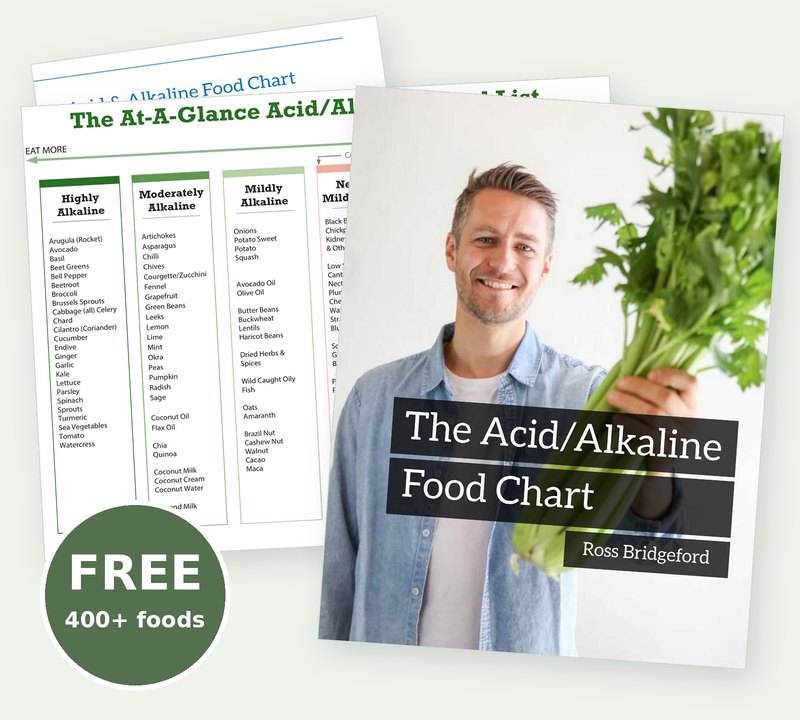
My free Acid/Alkaline Food Chart rates 400+ foods from Highly Alkaline to Highly Acidic, with a one-page version for your fridge.
It’s free. Just tell me where to send it.
Fruit, juices and drinks
Can I eat fruit?
Yes, in moderation. Enjoy 1–2 pieces of whole fruit a day, have the low-sugar fruits (lemon, lime, grapefruit, avocado, tomato) as often as you like, and skip the fruit juice.
Certainly don’t think of fruit the way most people do, as a ‘health food’ to eat with wild abandon. Better than a chocolate bar, yes, but the sugar content of most fruit makes it acid-forming. There are a small number of alkaline fruits which I eat a TON of, but most you’d think of (bananas, oranges, pineapple, grapes) are acid-forming.
So have your 1–2 pieces a day, ideally in season and with a little healthy fat and fibre at the same time to keep your blood sugar steady. And as for fruit juice? Fresh or not, fruit juice is simply highly concentrated fruit sugar without the fibre. DO NOT DRINK FRUIT JUICE!
Sure, if it’s the choice between an apple and a Mars bar then go for the apple, because you’re at least getting some goodness. But better still, give yourself better choices so you don’t have to go for the lesser of two evils!
Read more: Alkaline fruits guide · Is fruit really bad for the liver? · How to beat sugar cravings
Are bananas alkaline?
No. Bananas are Moderately Acidic because of their sugar (about 12 g per 100 g). Some charts call them alkaline because their formula ignores sugar. One fits fine in your 20%, but they’re not the answer for reflux.
Read more: Are bananas acidic or alkaline? The honest answer
What is a ‘green juice’?
A juice made mostly from green vegetables (cucumber, celery, leafy greens and herbs) with a squeeze of lemon or lime and some ginger for zing, and no sweet fruit. It’s the quickest way I know to get 6–8 serves of greens in before you’ve left the house.
Having a green juice every morning is the most simple and powerful thing you can do. Everything else that day becomes a bonus! Keep it vegetable-based (the moment you add apples, pineapple or orange, it becomes a sugar drink), mix up your greens from day to day, and drink it fresh.
A ‘green drink’ is something different: a powdered greens supplement you stir into water. Handy when you can’t juice, but it doesn’t replace fresh vegetables.
Read more: Green juice hacks: how to make one quickly · Alkaline green juice for gout · Energy-boosting green juice
Is coffee acidic?
Yes. Coffee is Moderately Acidic, so it belongs in your 20%. If you love your coffee, enjoy it rather than living on it, and lean on water and herbal teas for the rest of the day.
Read more: Acidic foods list · My favourite alkaline herbal teas · How to beat caffeine and sugar cravings
Can I have dairy?
Some dairy is OK. You don’t have to be 100% anything. Kefir is the best choice, then butter. Keep milk and cheese occasional, and try to avoid ice cream.
Milk and cheese are Moderately Acidic and ice cream is one of my seven most acidic foods. There are some brilliant dairy alternatives now, from almond and oat milks to cashew ‘cheeses’.
Read more: Dairy alternatives · the seven most acidic foods
Do I need to drink alkaline water?
You don’t need it, but it helps. The most important thing is drinking enough clean, filtered water (I aim for 3–4 litres a day). If budget allows, a good ionizer is the best way to make alkaline water; a squeeze of lemon is the cheapest.
Read more: How to make alkaline water at home: every method compared · Is bottled water alkaline?
Protein, meat and supplements
Where do I get my protein?
From beans, lentils, chickpeas, tofu and tempeh, quinoa, nuts and seeds, plus fish or eggs if you eat them. I recommend around 1.2–1.5 g of protein per kg of body weight a day.
That is a very, very valid question, and when most people ask it about the alkaline diet it’s out of fear that they won’t get enough. The more important question is: what is the SOURCE of your protein? Make sure it’s a good one. Plant proteins come packaged with fibre, minerals and antioxidants, and they’re far less acid-forming than meat and dairy.
The RDA of 0.8 g per kg is the minimum. For most people, and especially as we get older or if you’re training, I recommend around 1.2–1.5 g per kg. At 60 kg, that’s roughly 72–90 g a day, which is very doable from plants.
Read more: Alkaline protein: how to get enough without meat
Can I eat meat on the alkaline diet?
Yes. You don’t have to be vegetarian. Make the meat the side rather than the main, so most of your plate is still vegetables, and cut processed meats first.
Read more: Meat on the alkaline diet: is meat acidic? · Q&A: unless I’m vegetarian, I’ll never be alkaline?
Which supplements (and green drinks) do you recommend?
Supplements are there to SUPPLEMENT, not replace. Get the food right first. After that, my most important three are a good greens powder, omega oils and a sulforaphane/glutathione supplement, then alkaline minerals and a multi.
Taking supplements without changing your diet is like buying a sports car and putting no petrol in it. But when you nourish your body correctly AND use supplements, the benefits are magnified.
For a greens powder (green drink), look for an organic, non-GMO blend of around 8–10 ingredients, with little or no fruit, only a little mushroom, no algae (spirulina and chlorella are acid-forming) and no xylitol. The best blends hit all three of my Triple-A goals: alkaline, antioxidant-rich and anti-inflammatory.
Read more: My core alkaline diet supplements
Weight, testing and getting started
Will I lose weight (or can I gain weight)?
Most people lose weight naturally, because you’re eating loads of fresh, filling, nutrient-rich food and cutting out the sugar and processed food. And if you’re underweight, nourishing your body properly helps you gain healthy weight and muscle.
The body is alkaline by design and one of the most common symptoms of being over-acid is weight gain. When you’re over-acid your body both hangs onto fat to protect your major organs, and is less able to process the excess fat. When you start to alkalise you quickly shred through this fat. Bulges and cellulite disappear pretty darn quick.
There is some complex science behind this, but if you consider that on a daily basis you are going to be eating loads of fresh salads, vegetables, nuts, seeds and healthy fats, and be totally hydrated, while cutting out the sugar, trans fats, crisps, sweets and alcohol, it is pretty clear to see that you’re not going to have to worry about weight for too much longer.
The same goes for being underweight. Being underweight is an acid problem too: an over-acidic digestive system struggles to absorb the nutrients you do consume. Once you start to alkalise you will find yourself filling out in all the right places and gaining muscle.
Read more: the alkaline diet and weight loss: the research · How to maintain or gain weight on the alkaline diet
How do I test my pH, and why are my readings so erratic?
Use pH strips on your first saliva and first urine of the day, before you eat, drink or brush your teeth, then on your second urine. Do it daily for 30 days and watch the trend. A single reading tells you very little.
Testing your pH is a great way of tracking your progress, but it has to be done right. Random testing through the day will only give you a measure of what you just ate or drank. My method:
- Sunrise saliva test: as soon as you wake up, before anything else goes in your mouth. Goal: at least 7.0, ideally above 7.2.
- First urine of the day: a record of your body’s overnight work. Goal: at or above 7.0.
- Second urine, before breakfast if you can.
- Repeat daily for 30 days and follow the trend.
Readings jump around because your mouth and urine respond to everything: what you ate last night, how much you drank, what your body is clearing out. That’s why the average over weeks matters, not any one reading. And remember, these tests tell you about your diet’s acid load, not your blood: blood pH is only measured with a blood test, and it stays in its tight range whatever you eat (which is the whole point!).
Read more: How to test your pH (the right way) · Q&A: why are my pH levels still so low?
What’s the easiest way to get started?
Get the good in first. Drink more water, add greens to every meal, include healthy fats, and add anti-inflammatory foods like turmeric and ginger. Once those are habits, start crowding out the sugar and processed food.
Don’t try to be perfect, and definitely take everything one step at a time. Small, easy changes that stick will beat a perfect plan you give up on after a week. Start with breakfast: it’s the easiest meal to make alkaline.
Read more: Your alkaline diet plan · 9 quick alkaline breakfasts
Any more questions?
I really hope this has helped and has given you a good framework and answered some of the questions you might have had. If you do have any other questions, feel free to leave a comment below!
Free download
Get my free Acid/Alkaline Food Chart
400+ foods rated from Highly Alkaline to Highly Acidic, with a one-page version for your fridge.
It’s free. Just tell me where to send it.
Ross

Ross has taught and coached realistic, sustainable alkaline eating since 2004, working with tens of thousands of people around the world. He’s the author of The Alkaline Reset Cleanse and The Alkaline Life (Hay House). Ross is a health educator, not a doctor or dietitian, so if you have a health condition, talk to your own health professional before making big changes to your diet.
References
- Kiefte-de Jong et al. (2017), Diet-dependent acid load and type 2 diabetes: pooled results from three prospective cohort studies, Diabetologia
- Park et al. (2019), Higher diet-dependent acid load is associated with risk of breast cancer: findings from the Sister Study, International Journal of Cancer
- Yalcinkaya et al. (2020), Effect of alkaline diet with 8-week step aerobic exercise on body composition and aerobic exercise performance of sedentary women, Progress in Nutrition
- Remer and Manz (1995), Potential renal acid load of foods and its influence on urine pH, Journal of the American Dietetic Association
- US FDA, Approximate pH of foods and food products

I’ve been suffering from chronic bacterial vaginosis for almost 1 year. No traditional medication has helped me. My gynecologists are baffled. I’ve done a lot of research, and I now know it’s because my body is too acidic. I’m now starting an alkaline diet to help. Can you offer any help to jump start this process for someone who has been suffering from a bacterial infection for so long? I’m drinking a ton of lemon water in addition to the diet. Should I cut that out since the fruit has some sugar?
What if sugar is alkalized… would it help?
Not sure how this could be possible Joseph.
why do i get sick for an hour after juicing?.Judith
Hi Judith
Difficult for me to answer without knowing a bit more about your diet really.
Is this your first time juicing?
yes.this is the second week
i started the alkaline diet3 weeks ago
Thanks Ross! I want to get alkaline as my health is so poor even though I have always led a “healthy” diet with plenty of fruits and veggies and soy and supplements etc. My question is Do you recommend or discourage a liver cleansing program prior to or during the diet change? I feel that my liver and gallbladder may not be working properly and I feel that because of it the positive effects of getting alkaline might be hindered or rejected?
Thank you.
Hi Ross. I’ve had rosacea for about 5 years. I’m 24 years old now. I usaually go out every weekend drinking with my friends.. But ofcourse, alcohol is total acidicying right? So is there any type of alcohol that is more ok?? I could imagine that redwine might be better than beer in the long run due to the level of sugar in alcohol. But what do you say?
And. How long would it usaually take for the alkaline diet to clear up rosacea? There is defiently a differens to my skin when I eat more alkaline but it never clears up completly. Maybe because of the alcohol in weekends. But my idea was to try to eat as alkaline as possible from monday to friday and then in the weekends it would be ok for me to eat more acid. Which was me trying to do a 30/70% weekly alkaline/acid. But it seems it isn’t a great plan. What do you think?
Hi Ross
Thank you for your inspiring and informative posts. I am two weeks in to converting and already starting to enjoy a lightness, and more energy.
QUESTION: Does cooking with lemon, to boost an alkine recipe by adding it in to a curry, stew etc reduce its alkilinity?
Thank you.
Janine
Hello Ross! I was wondering two things!
One, other sources for protein. And two – isn’t watermelon alkaline? I read that it is one of the most alkaline besides lemon, when it comes to fruit.
Thanks a lot
Hi Ross,
your site is full of great information. Here’s a question I have though. On the chart of alkaline and acid foods, hazelnuts is listed 3 times: once as a neutral, once as an eat as much as you want alkaline, and once as an acid forming food to avoid. So which is is… the list of nuts that are alkalizing includes other nuts, such as walnuts that I’ve seen on the acid side of your charts as well.
Thanks so much for your insight,
Patti
I am a 70 year old male with type 2 diabetes just diagnosed with bowel cancer. I am advised that I should have a high protein diet but eat neither fish nor poultry. Can you offer any advice? Avocados are beyond my budget.
There is so much conflicting advice regarding high alkaline foods. I am now getting very confused and will have to revert to my ‘normal’, everyday, diabetic diet unless I cand find an answer.
‘But if we did manage to eat SO alkaline that your cells and body fluids went above 7.365 then your body would simply buffer this to regulate you back down to the correct pH.’
Doesn’t this negate the idea of an alkaline/acid diet??
Hi AShleigh
No, the point of the acid/alkaline diet is not to make the body more alkaline – it’s point is to support the body in staying in it’s slightly alkaline natural state.
Thanks
Ross
If the alkaline diet works for everyone how come tribes from different continents can eat lots of meat or sugars and are more healthy than “civilized” countries? I have a hard time believing one size fits all when it comes to diet. Is it possible that its the high consumption of processed foods, sugars, grains and chemical-infused foods that are causing our dis-ease? I have been studying diet a lot and the only thing all diets agree on is eating an abundance of organic, whole foods and limiting sugars and processed foods and empty-calorie drinks…So what gives?
two questions: what about if you are trying to alkalinize your body for coldsores/the herpes virus? The very sources of protein that you suggest are high in arginine and can trigger outbreaks. additionally, soy is controversial to be consuming daily, especially if you are a woman with a family history of breast cancer(and most is genetically modified). Quinoa and eggs, staples in my vegetarian diet, seem to be no nos. so what do you suggest in this case?
Hi,
I suffer from acid reflux and every time I have lemons or tomatoes it makes it worse coz they’re so acidic. However you mention they’re good. I’m not sure if I understand.
I use to have acid reflux. I ate fermented vegetables and drank plain white kefir milk for a while. My acid reflux is gone. I made my on fermented vegetables with carrots, ginger root and Celtic sea salt. I got me recipe from the book called ” The Maker’s Diet”. I suggest you read the whole book written by Jordan Rubin. You will find it quite interesting. If you can’t drink dairy there are other kefir milks. Make sure there are no added sugars and no flavors just plain.
Hi Faye – we were just talking about fermented foods in the Alkaline Base Camp membership yesterday…
I was saying that it definitely works for some, and that folks should try it out and see how it goes for them. One size fits one, so what works for me may not work for you and vice versa.
There’s definitely something in fermentation and fermented foods, and the benefits of that for some conditions could outweigh the acidity effect.
Thanks for sharing
Ross
Could you tell me , can i put my alkaline drops into the kettle and boil them for tea etc
As far I know that you can do it.
Hi Ross, we just started with your beginner’s guide today (day 1 today). Since I’m a control freak, it made me feel very unsettled not knowing how to measure the 70%, 30% ratio – is it be volume? weight? alkaline/acidic value times weight ratio? Thank you so much! Deon
Hey Deon
Great, GREAT idea for an article – I’ll write about this tomorrow and post it on the site!
Ross
Hello,
I am doing a homeostasis project for my biology class, and I will be eating alkaline only foods for a short period of time. I will attempt to not eat any acid forming foods. How long would it take (if I only ate alkalizing foods) for me to notice the effects on my body?
Quick question.
Whey protein Isolate. How would this fit into an alkaline diet?
Nicole – firstly, I love your email address.
OK, so WPI is not alkaline. I would suggest looking into other sources of protein such as hemp, rice and pea protein. I really like the Sun Warrior brand as it’s made with sprouted organic hemp – which is about as alkaline as it gets when it comes to protein.
Cheers
Ross
Hi! I understand from the question about fruits is that sugar is the number one enemy, right? Yould you say that alkalising the body is a cure for diabetes?
Thank you for that write up!
It helped answer some questions of mine!
My buddy told me about the whole alkaline diet awhile back and i kind of jumped on board, but was skeptical. I enjoy eating! LOL But then he had me listen to Anthony Robbins’ Living Health. WOW! Game changer!
But there are a few things i still don’t understand. Like what is the best recovery food/drink when I get done training? Whether long distances, sprints or weights. I usually have a whey protein shake that says it contains 0 sugar carbs… What are your thoughts? Just stick with almond milk or green drink, spinach leaves, almonds and broccoli? But doesn’t broccoli break down really slow? Bananas i know unripe are better, but if i’m trying to alkalize my body, are they good or bad before or after running?
I know soy is alkaline, but i was always told it… Well… Gives guys “b*tch t*ts”. LOL So i have always stayed away from anything soy… Any thoughts?
Lastly, so many of the charts i’ve read online have shown a lot of foods in the alkaline side that i am now finding are not alkaline! I see on your chart that Blackberries are on the acidic side. Are raspberries acidic too? I’m cutting them out for my 10 day challenge, but i know they have a LOT of antioxidants and taste great. So maybe i’ll include them in my 20-30% section? What are your thoughts?
Sorry for so many questions!
Thanks!!!
-Rich
Hi Ross,
I’m currently on the alkaline diet way of eating.
I find it very healty and aggree with many things stated.
As a sportsman (montainbiker that swim, run, gym, cycle a lot and a full time employee), how do I go about having a balanced diet with enough proteins, carbs etc and still stay away from too much acid forming foods..??
Your answer will be very appreciated!
Best regards,
Armand
Hi Ross.. I am so grateful for all this information. THANK YOU. I am on day 3 and a half of the cleanse and i feel so nauseas that I cannot get the green drinks down.. do you have any advice? I hope this will pass. I also have a health condition – recurring Graves Disease – so i don’t know if this makes a difference. I just feel incredibly sick. Am managing water. Any advice would be HUGELY appreciated.
thank you!
In Firefox I normally use right-click > “Open in new tab” when browsing web pages. This can also be done when clicking on a bookmark. . . Is there any way to get Firefox to do this automatically (by default) when left-clicking a bookmark instead of having to do the right click?.
Thanks Ross. great article. Relative to ionized alkaline water…if it sits for days/weeks does it lose alkalinity? What if it is exposed to high heat…greater than 85 degrees F?
Hi
Ross,
need some information on alkalinizing , is it safe to begin & continue on green tea, brown rice, Capsicum and pH drops, if we go ahead with this, how much time to take our body become alkaline content, and how much time to take try for ?
One last information
If we go with PH drop, how we can use and where we can buy this?
Hi Ross,
What’s the required / safe number of pH drops to put into tap water to raise the alkalinity? I’ve been putting 5 drops per litre because I thought above that was unsafe (not sure where I saw that) but the pH is 6.5 so still acidic.
Thanks, Daphne
Hi, I’ve only recently found your site – and love all the information you give and how you really do seem to care. One question. I have heard that Coral Calcium is good for the body – is it Acid or Alkaline? Many thanks for all your support. Elizabeth Tyler
Thanks for this GREAT article. I love it!!
Hi there, is it safe to begin & continue on green drinks and pH drops when trying to get pregnant?
Hiya,HIya, I live in Ireland, i have just been tested and had a positive result for Helicobacter pylori, I’ve been on a course of doble anti-biotics to clear it but with no success. Could you recommend a good alkaline diet I should follow. Also, i bought myself a course of Udo’s Super 8 Probiotic, ust reading through your website I will now invest in a course of Omega 3,6,9, any other advice would be gratefully appreciated. I always feel tired, with a flue like feeling all over and recently a little bit of depression, hopefully hear from you soon and thanks in advance
im wondering why nature provided us with so many varieties of fruit if it is so bad for us. While i find the information interesting im not convinced i could stick to the way of life not completely
Actually, nature didn’t provide us with so many fruits. We only recently added all those big, sweet, juicy fruits to our diet, once we learned modern agriculture. Have you ever seen a wild apple? Wild cherry? Wild peach?
I’ve also never seen a wild tomato, avocado, cucumber, etc.!
I work 3 to 4 twelve hour nightshifts and stay on the run so much, I sometimes having trouble getting to the restroom and getting anything to drink. I have tried day shifts but I’m a creature of the night. Also I hate spicy foods, celery, & black olives and always thought Stevia was a natural sweetener. How can someone with my work lifestyle, minimal time to prepare & cook, manage to not only find the time to learn and utilize all the alkalizing lifestyle but also store my 3 to 4 day supply of food and fit exercise in? I have always been fighting sweet and salt cravings and as much as I love tea, I thought it was OK to use Stevia? Thanks a million, a somewhat lost healthcare worker trying to avoid healthcare problems that could end me in the hospital.
Hi Ross,
I am thinking about starting this diet 25% for the health benefits but 75% for the weight loss. On this diet, will I lose a lot of weight?
Thank you!
I too, would like to have clarified the point of apple cider vinegar added to water and this being alkalizing. I also have been given a bi carb soda by my naturopath…..so I sip bi carb and apple cider from a 1 litre bottle of water throughout day……is this a sound alkalizing action ?
thankyou
cheers…heather
Hello Heather,
If you want your water to be alkalized just put in pH drops or put lemon in it. The components of the Apple cider vinegar are acidic. If you take a look at the food chart you would see where the components would fall under acid or alkaline.
Hello, I am so confused, thought I knew a lot about nutrition etc; but only recently began to look @ PH balance, however, after being told that tomatoes, lemons & grapefruit are alkaline I then hear from Money Vital that tomatoes are poisonous and that all citrus fruits should be avoided @ all cost !!!.
Please help me, thank you,
Janie Still, x
Hi
I’m not sure what you’re asking for help with? Can you be a bit more specific?
Thanks
Ross
is dry roasted almond butter with sea salt a solid high alkaline food and ———– would millet combined with lima beans be anouter solid alkaline food
Ross,
We are having a problem with the PH question. You say the only way to truly test PH is through live blood analysis, and we have had that done, but are we talking about the actual PH reading of the blood here? A medical doctor told us that the test that measures this is a blood gas test, and that if your blood was too acidic, you would die. He said that all blood is close to neutral PH. I didn’t think this was true. Are we talking about two different things here?
The doctor is right. The pH of the blood must be slightly alkaline, but the pH of the body (flesh) can be quite acidic from stored waste products (uric acid), which causes all types of illnesses. If the pH of the blood reads below or close to 7, it means that the pH of the body (flesh) has reached a saturation point and is highly acidic (prone to illness). Normal pH of the blood is 7.4 (slightly alkaline), which provides maximum health for the body. However, the acid load on the body is constant from burning food for energy, therefore we need a constant supply of alkaline minerals from our diet to maintain a slightly alkaline body pH.
Thanks,I’m learning many facts on alakaline food and its effect.it is time to start now.
I am not allowed to have Tofu due to certain health restrictions.
What are the options?Is lactose free milk as acidic?
wow this is such full of knowledge and enlightenment. i was searching for h pylori and alkaline diet and now i conclude that i absolutely lack alkaline minerals. my acidophilus, charcoal, baking soda, garlic, VCO, blood type diet, and non-carb diet never helped!
I don’t see why this site is so anti-acid.
Stumak acid is vital. e.coli or h.pylori both need an alkaline habitat to fester…by the same token pepsin, vitamins, mineral eg silica abzorpshn need an acid invirun – els u hav big helth problums.
Great information. Thank you. I’d like to recommend an author whose information completely resonates with yours – three time Chiropractor of the Year, Dr. David Yachter. His new book, “BORN A CHAMPION: The Master Strategy for Maximum Health and Lasting Success” is filled with great information about the optimal alkaline diet (“Food by God” he calls them), the taboo acidic foods and toxic over processed foods (“Food by Man”), phenomenal information about the ideal exercises, and vital knowledge about the importance of spinal adjustments to bring the full benefits of the Life Force into your nervous system.
Dr. Yachter appears on YouTube with an excellent presentation, along with testimoniaols from his patients. He has not only gotten patients off their pills and over processed foods, he has put cancer patients into remission, brought diabetic patients back to normalcy WITHOUT pills or insulin, and has helped thousands of people lose weight, come back from depression and high blood pressure.
Here is link to his YouTube appearance:
Hey Ross
many thanks
Leslie
Hey Leslie
Your pH is likely to be more acidic in the morning because your body has been working out the toxins all night.
This ol’ blog post might be able to help:
http://liveenergized.com/wordpress/2006/04/12/alkaline-test-how-to-test-your-ph-levels-saliva-urine/
Ross
Thank you for sharing greater insight into staying alkalized. I have added a link to this page to my blog–I hope you don’t mind.
Not at all! Thanks for stopping by!
Thanks for this post , just what i needed to get back on track with both myself and my boys. I have been trying to tell the “do-gooders” for a while now that just putting obese kids on a “fruit and vege” diet isnt always the answer !!
Both my boys have Autism , one is obese and the other too thin , both have shocking toxic issues , this is the diet I have been after for a while now , thankyou !
No worries! Thanks for the thanks!
Good luck with everything and if you have any specific questions remember you can get me on [email protected]
Great information. I have long known about this subject, but have always found contradicting charts on the different foods. Sorry to read about fruits though. I thought there might be a way around the not eating fruits. I only eat fruit though when they are in season like late summer and fall.
Someone asked about B12, a strict vegan could be low in B12, but any good supplement would help. We dont need that much B12.
Thanks Ever for Listing These 11 Important Points, Ross!
I, for one, really appreciate your *GENEROSITY in Sharing Your Knowledge with us!
[You really DO Love Us!]
[It’s Good to Have THAT LIST, So We Can Refer to It, Whenever ….]
What I’m a little concerned about ( & I just wrote it, to Bibi, on ‘The Forum’) is the Fact that Vegans can Very Easily become Vitamin B12 Deficient!
[Also Vitamin D Deficient….though we in Queensland get MASSES of [FREE/ *STRONG] SUNLIGHT!
Are You Aware of The Vitamin B 12 Deficiency Issue?
I’m hoping it’s Not a Serious Issue…
Have You HEard Anything About It?
Cheers & Thanks,
[MANY THANKS!]
Heidi.
Hi There
Great info in the 11 questions, thank you. I have a problem with low stomach acid and one suggestion was to drink pineapple juice before a meal. This seems a bad idea in view of the above answers. Do you have any suggestions?
Yep – cucumber to the water is a fair idea, but with the lemon water it is more that you are actually squeezing the lemon juice in, to increase the alkalinity of the water rather than just steeping a slice in.
Here is a blog post all about it: http://liveenergized.com/wordpress/2006/02/10/lemon-water-alkalising-superstar/
Ross
What about adding Apple Cider Vinegar to water? I heard that was good for you and alkalizing. Also, what about adding a slice of cucumber to your water instead of lemon?
Thanks Ross!