


Alkaline Diet Questions Answered: The 28 I Get Asked Most

I’ve been teaching the alkaline approach for over 22 years now and I’ve learned a LOT about how to get alkaline and stay alkaline.
I get a LOT of questions every day, through my Facebook page, by email, and from my coaching members and private clients, and I just love answering them!
So I decided to log them and find the ones that come up again and again, and put the answers here for everyone to learn from. This page started life back in 2009 as my top 10, and it’s grown a bit since then: here are the 28 questions I get asked most, with a short answer for each and a link to my full article when you want to go deeper.
So if you are new to alkalising, or if you are a seasoned pro, you might learn something (or a lot!), so here goes.
If you only read one thing: the alkaline diet isn’t about changing your pH. It’s about eating so your body doesn’t have to work so hard to keep it where it needs to be. Aim for around 80% of your plate to be alkaline foods, get the good in before worrying about cutting the bad out, and don’t try to be perfect.
The big picture
But you can’t change your pH… can you?
No, and that’s exactly the point. The alkaline diet isn’t trying to raise your blood pH. Your body holds it at around 7.365 whatever you eat. The aim is to stop your body having to work so hard to keep it there.
So many times I’m emailed by concerned people saying they had just gotten on board with the whole alkaline thing, but then their friend sent them to a website, or their doctor told them:
“You can’t alter the pH of the body, the body has strict regulating mechanisms to keep its pH the same – so there is no point eating alkaline to try and make the body alkaline.”
The short answer to this is: THAT’S EXACTLY THE POINT.
The aim of the alkaline diet is NOT to try and raise the pH of the blood. Yes, that’s right. The aim of the alkaline diet is NOT to try and raise the pH of the blood. The whole purpose of the alkaline diet is to prevent the body from having to do the regulating!
This is the biggest misconception that so-called experts have, who are so quick to criticise the alkaline diet. When the truth is, they simply haven’t done their research and are making themselves look like idiots.
Your doctor and friend are absolutely right, in that the body will do whatever it takes to regulate your blood pH (and the pH of other cellular fluids). But the constant need to do this regulating is what causes the massive problems with an overly acidic diet and lifestyle.
The human body creates its own acids (metabolic acids) and we evolved with a buffering system which can happily, easily neutralise the acid that comes from our body’s internal processes and metabolism. However, when we throw a modern, acid-forming diet on top of this all day long, the body has to work desperately hard to keep the pH of the blood at a slightly alkaline 7.365. Calcium is pulled from the bones, magnesium is pulled from the muscle, and the damage snowballs.
So the summary is this
The body will ALWAYS retain your blood pH in a very tight range close to pH 7.365. Your aim is NOT to change this, it is to support the body’s efforts to keep it there. The real damage is done not in simply consuming acid-forming foods, but in the fallout of the body having to work dramatically hard to neutralise the acids and retain the pH at 7.365.
So the next time someone tells you the alkaline diet is pointless, you now know the response to this. Let them keep on slurping their soda and eating their burger. I mean, what does it matter anyway – the body will always keep this pH, right?
I explain this in a quick video here:
Read more: Alkaline Diet Myth #1: You Can’t Change Your pH! · the ‘safe zone’ and diet-induced acidosis
So what is the alkaline diet, in a nutshell?
Eating so that around 80% of your plate is fresh, mineral-rich, alkaline-forming food (greens, vegetables, healthy fats, nuts, seeds, beans), and keeping the acid-forming stuff (sugar, processed food, alcohol, coffee, lots of meat and dairy) to the other 20%.
Find me a doctor or reporter or friend that doesn’t agree that the following is a healthy diet:
- loads of fresh foods – lots of vegetables, low-sugar fruits, nuts, seeds, salads, green juices and smoothies
- exercise daily
- keep stress down and avoid toxins
- go easy on trans fats, sugar, refined foods, fast foods, takeaways, alcohol, tobacco, pizza, chips, chocolate and ice cream
- enjoy everything in moderation
That is the alkaline diet. Of course, it helps (and is surely no coincidence) that the alkaline foods are also nutrient-dense, fresh, high-water-content foods that are full of vitamins, minerals, phytonutrients and antioxidants. It’s why I teach it as my Triple-A approach: alkaline, antioxidant-rich and anti-inflammatory.
Read more: The Alkaline Diet: what it is, how it works and an easy plan
How do I know if I’m eating 80/20?
Just look at your plate. If around 80% of it is covered with alkaline foods, you’re set. Don’t weigh, count or measure anything.
The measurement can and should be entirely visual. Don’t worry about weight, calories, fat, protein or carbs – just look at your plate. The trick with the alkaline diet is not to over-think it and be too hung up on being exact and specific.
Make sure that at most meals 80% of your plate is alkaline, and in your general food choices go for alkaline whenever you can. Then look back at your day and ask: was this mostly alkaline today? What can I do to improve or keep going tomorrow? You don’t have to give up meat, for instance – just make the serving smaller so most of your plate is delicious, fresh vegetables.
Read more: How to measure 80% alkaline to 20% acid
How long does it take to get alkaline?
It’s a ‘how long is a piece of string’ question, but most people start to feel clearer and more energised pretty quickly, often within a few days, with more restful sleep within a week or so. Give it a few weeks of consistency and you’ll really feel the difference.
It depends on where you’re starting from, HOW you alkalise and how consistent you are. If you’re coming from quite an acid-forming background you may feel a little worse for a few days before you feel better. You have two options when starting out:
- An alkaline cleanse: a short reset of alkaline soups, juices, smoothies and plenty of water for anywhere between 3 and 10 days. You’ll see a change very quickly (I wrote the whole process up in The Alkaline Reset Cleanse).
- A gentle transition: hit the main stuff first (lots of greens, hydration, healthy fats, alkaline minerals, exercise) and then work on perfecting it over time.
Either way, I definitely recommend ‘getting the good in’ before worrying about ‘cutting the bad out’. The more good stuff you eat, the less room there is for the bad, and the less you crave it.
Read more: How long does it take to get alkaline?
Can I become too alkaline?
From food? Practically impossible. Your body is creating acids all day long, and it would simply buffer any excess straight back. True alkalosis comes from medical problems (or from overdoing baking soda), not from eating your greens.
Basically, yes, you can become over-alkaline, of course, but it is very, very difficult to achieve! Your body is constantly creating acids in its daily workings, which is why we focus on eating 80/20 alkaline foods to help neutralise these acids.
But if we did manage to eat SO alkaline that our body fluids went above 7.365, your body would simply buffer this and regulate you back down to the correct pH. And given that 99% of us are too acid 99% of the time, I don’t think it would have too much of an effect on us. Plus it would be pretty short-lived, as the body creates acids all of the time, so you’d soon be neutralised!
The one way people do overdo it is taking lots of baking soda, which is why I never recommend it for your daily water. I answer this one fully in this quick video:
Read more: Can you get too alkaline?
Is there any research behind the alkaline diet?
Yes. Large studies following hundreds of thousands of people link a more acid-forming diet with a higher risk of type 2 diabetes, some cancers, heart disease, kidney disease and weight gain.
The research looks at dietary acid load: how acid-forming your overall diet is. And study after study comes back the same: the more acid-forming the diet, the higher the risk of the chronic diseases we’re all trying to avoid. A few of the strongest:
- Across three big US cohorts of more than 187,000 adults, the most acid-forming diets were linked with a 29% higher risk of type 2 diabetes (Kiefte-de Jong et al., 2017).
- In the Sister Study of 43,570 women, the most acid-forming diets were linked with a 21% higher risk of breast cancer (Park et al., 2019).
- In a 2020 trial, sedentary women doing the same eight weeks of step aerobics lost more weight and more body fat on an alkaline diet than on an acidic one (Yalcinkaya et al., 2020).
Read more: the full research section · my alkaline diet research library
Alkaline and acidic foods
What foods are alkaline?
Leafy greens, most vegetables, avocado, cucumber, tomatoes, lemons and limes, herbs and spices, most nuts and seeds, beans and lentils, and healthy oils.
My top 10 everyday alkaline foods are beet greens, spinach, avocado, Swiss chard, kale, rocket, collard greens, watercress, carrots and beetroot. Build your meals around greens and vegetables, add healthy fats, nuts, seeds and legumes, and you’re most of the way there.
Read more: Alkaline Foods List: 195 Foods Rated · The 15 most alkaline foods
What foods are acidic?
Sugar and soft drinks, processed and fast food, alcohol, coffee, most meat and dairy, refined wheat, yeast and artificial sweeteners. These are the foods to keep to your 20%.
My seven ‘worst of the worst’ are cola, ice cream, sugar, trans fats, MSG, yeast and artificial sweeteners. Higher-sugar fruits like bananas, grapes and pineapple are acid-forming too, because of their sugar.
One thing that trips people up: there are two kinds of ‘acidic’. Some foods are acidic in your mouth (lemons, tomatoes, vinegar) but alkaline-forming once eaten. Others, like meat and cheese, don’t taste acidic at all but are acid-forming in the body. On the alkaline diet, it’s the second kind that counts.
Read more: Acidic Foods List: the most acidic foods and what to swap them for · the two kinds of acidic
Which vegetables are the most alkalising?
Leafy greens and grasses, cucumber, avocado and tomatoes, and honestly, any salad or high-water, low-sugar vegetable. Just think big bowls of salad and big plates of veggies!
Not really something you need to worry too much about, but if you do need to know, I believe it is a toss-up between wheatgrass and cucumber. Here is my quick and dirty list of the foods to aim for if you want to be super-alkalising:
- Green grasses, such as wheatgrass and barley grass
- Green leafy veg, such as spinach, kale, rocket and watercress
- Cucumbers
- Avocados
- Tomatoes
- Any other salad, vegetable or high-water-content, low-sugar food!
Read more: The 15 most alkaline foods · what a serve of alkaline foods looks like
Are tomatoes acidic or alkaline?
Both, depending on what you mean. Tomatoes are acidic in your mouth (a pH of about 4.3 to 4.9), but they’re Highly Alkaline in your body, because they’re rich in potassium and very low in sugar.
This is the perfect example of the two kinds of acidic. On the pH scale, tomatoes are mildly acidic: the FDA lists them at around pH 4.3–4.9 (FDA). But once eaten, they’re alkaline-forming. They’re packed with potassium and have only about 2.6 g of sugar per 100 g, which is why they’re Highly Alkaline (they’re alkaline on the PRAL measure too, at about −4.1, per Remer and Manz).
The one exception is reflux. Because tomatoes are acidic going down, some people with reflux find them a trigger, especially as sauces. If that’s you, listen to your body. And watch out for tomato ketchup: with around 21 g of sugar per 100 g, it’s Highly Acidic.
Read more: the two kinds of acidic · should you avoid nightshades? · the alkaline diet for acid reflux
Everyone knows lemons are acidic. Why do you recommend them?
Because it’s about the effect a food has on your body once eaten, not how acidic it is in its natural state. Lemons are rich in alkaline minerals (especially potassium) and very low in sugar, so they’re alkaline-forming.
This is a quite common question, so I’m getting quite good at answering it in a nice and simple way! It is basically about what effect the food has on the body once consumed, rather than its acidity or alkalinity in its natural state. Lemons, while containing citric acid, are rich in the alkaline mineral potassium, and these minerals have a very alkalising effect on the body.
The reason this doesn’t work with oranges is that the sugar content of the orange is so much higher, which cancels out the alkalising minerals and makes it acid-forming. The same goes for most higher-sugar fruits (unfortunately).
Read more: Alkaline fruits guide · Lemon water benefits
Why are the lists of alkaline and acidic foods so different?
Because most charts are based on PRAL, a formula that counts a food’s protein and minerals but treats sugar as zero. That’s why some charts call bananas and dried fruit alkaline. Mine factors in the sugar, so they’re acid-forming here.
I know it is quite confusing to see such differences in the charts. This amount of conflicting information is the main reason I set up this site in the first place.
Most charts are based on Potential Renal Acid Load (PRAL), which is calculated from a food’s protein, phosphorus, potassium, magnesium and calcium. It’s a useful starting point, but it completely misses the sugar. That is why on some charts high-sugar fruits are listed as alkaline. Bananas, for instance, are high in the alkaline mineral potassium, BUT they also carry about 12 g of sugar per 100 g, and that sugar makes them acid-forming.
So my ratings start with PRAL and then take the sugar, the food’s natural state and its mineral content into account.
Read more: Why alkaline food charts are all so different · Are bananas acidic or alkaline?
Should I avoid nightshades?
No. Tomatoes, capsicum, eggplant and potatoes are packed with alkaline minerals and antioxidants. Unless you’ve personally found one is a trigger for you, there’s no need to avoid them.
There are a lot of myths surrounding nightshade vegetables, and a lot of it is in that name! The poisonous weed ‘deadly nightshade’ has nothing to do with the vegetables we eat. We have to remove the word ‘deadly’ from the vocabulary when talking about these plants. And the nightshades are so rich in alkaline minerals that they actually help your body avoid drawing calcium from the bones.
Read more: The truth about nightshades · Q&A: should I avoid nightshades?
Do I need to avoid oxalates?
For the vast majority of people, no. Oxalate is only a real concern if you form calcium oxalate kidney stones, have kidney disease, or have a gut condition that makes you absorb more of it. And kale is LOW in oxalate. It’s spinach, Swiss chard, beet greens and rhubarb that are high.
Oxalates have had a LOT of fear-mongering attention lately, and fresh green vegetables are being called toxic. But your body makes about half of the oxalate it deals with itself, and big studies show vegetable-rich diets actually LOWER the risk of kidney stones. If you’re in one of the at-risk groups, mix up your greens, boil the very high ones, and work with your doctor rather than cutting out vegetables.
Read more: The truth about oxalates (is kale bad after all?)
What about lectins and ‘anti-nutrients’?
Nothing to worry about for most people. Beans, lentils and whole grains are some of the healthiest foods there are, and soaking and cooking them properly takes care of the lectins.
Like oxalates, lectins and ‘anti-nutrients’ are a classic ‘dotted line’ theory: a logical-sounding idea that falls apart when you look at the research. The foods we’re being told to avoid are so abundant in minerals, fibre and antioxidants that you’d miss out on FAR more by avoiding them.
Read more: The truth about lectins · The truth about anti-nutrients
Do I have to give up gluten?
Ideally, yes: I’d love everyone to cut gluten out completely, and far more people react to it than just coeliacs. But if you’re just starting out, ease in rather than going cold turkey.
Wheat foods like bread, pasta and pastries are some of the biggest blood-sugar spikers in the modern diet: white and wholemeal bread both raise blood sugar more than a soft drink does, gram for gram of carbohydrate. So swap them out bit by bit: cauliflower rice, sweet potato, quinoa, buckwheat and gluten-free sprouted breads all make it easy.
Read more: Is gluten inflammatory? 7 benefits of cutting wheat
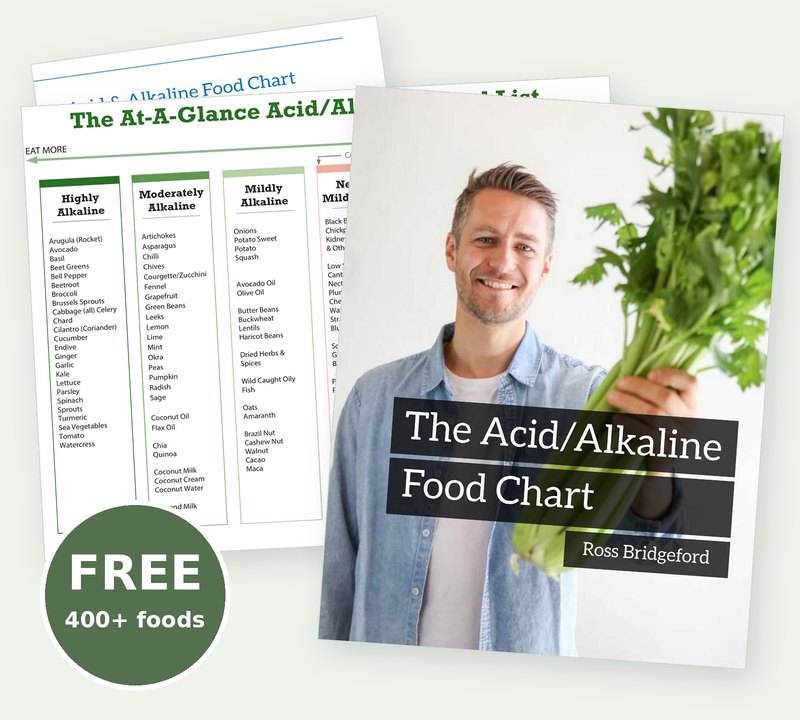
Free download
Every food, rated
My free Acid/Alkaline Food Chart rates 400+ foods from Highly Alkaline to Highly Acidic, with a one-page version for your fridge.
It’s free. Just tell me where to send it.
Fruit, juices and drinks
Can I eat fruit?
Yes, in moderation. Enjoy 1–2 pieces of whole fruit a day, have the low-sugar fruits (lemon, lime, grapefruit, avocado, tomato) as often as you like, and skip the fruit juice.
Certainly don’t think of fruit the way most people do, as a ‘health food’ to eat with wild abandon. Better than a chocolate bar, yes, but the sugar content of most fruit makes it acid-forming. There are a small number of alkaline fruits which I eat a TON of, but most you’d think of (bananas, oranges, pineapple, grapes) are acid-forming.
So have your 1–2 pieces a day, ideally in season and with a little healthy fat and fibre at the same time to keep your blood sugar steady. And as for fruit juice? Fresh or not, fruit juice is simply highly concentrated fruit sugar without the fibre. DO NOT DRINK FRUIT JUICE!
Sure, if it’s the choice between an apple and a Mars bar then go for the apple, because you’re at least getting some goodness. But better still, give yourself better choices so you don’t have to go for the lesser of two evils!
Read more: Alkaline fruits guide · Is fruit really bad for the liver? · How to beat sugar cravings
Are bananas alkaline?
No. Bananas are Moderately Acidic because of their sugar (about 12 g per 100 g). Some charts call them alkaline because their formula ignores sugar. One fits fine in your 20%, but they’re not the answer for reflux.
Read more: Are bananas acidic or alkaline? The honest answer
What is a ‘green juice’?
A juice made mostly from green vegetables (cucumber, celery, leafy greens and herbs) with a squeeze of lemon or lime and some ginger for zing, and no sweet fruit. It’s the quickest way I know to get 6–8 serves of greens in before you’ve left the house.
Having a green juice every morning is the most simple and powerful thing you can do. Everything else that day becomes a bonus! Keep it vegetable-based (the moment you add apples, pineapple or orange, it becomes a sugar drink), mix up your greens from day to day, and drink it fresh.
A ‘green drink’ is something different: a powdered greens supplement you stir into water. Handy when you can’t juice, but it doesn’t replace fresh vegetables.
Read more: Green juice hacks: how to make one quickly · Alkaline green juice for gout · Energy-boosting green juice
Is coffee acidic?
Yes. Coffee is Moderately Acidic, so it belongs in your 20%. If you love your coffee, enjoy it rather than living on it, and lean on water and herbal teas for the rest of the day.
Read more: Acidic foods list · My favourite alkaline herbal teas · How to beat caffeine and sugar cravings
Can I have dairy?
Some dairy is OK. You don’t have to be 100% anything. Kefir is the best choice, then butter. Keep milk and cheese occasional, and try to avoid ice cream.
Milk and cheese are Moderately Acidic and ice cream is one of my seven most acidic foods. There are some brilliant dairy alternatives now, from almond and oat milks to cashew ‘cheeses’.
Read more: Dairy alternatives · the seven most acidic foods
Do I need to drink alkaline water?
You don’t need it, but it helps. The most important thing is drinking enough clean, filtered water (I aim for 3–4 litres a day). If budget allows, a good ionizer is the best way to make alkaline water; a squeeze of lemon is the cheapest.
Read more: How to make alkaline water at home: every method compared · Is bottled water alkaline?
Protein, meat and supplements
Where do I get my protein?
From beans, lentils, chickpeas, tofu and tempeh, quinoa, nuts and seeds, plus fish or eggs if you eat them. I recommend around 1.2–1.5 g of protein per kg of body weight a day.
That is a very, very valid question, and when most people ask it about the alkaline diet it’s out of fear that they won’t get enough. The more important question is: what is the SOURCE of your protein? Make sure it’s a good one. Plant proteins come packaged with fibre, minerals and antioxidants, and they’re far less acid-forming than meat and dairy.
The RDA of 0.8 g per kg is the minimum. For most people, and especially as we get older or if you’re training, I recommend around 1.2–1.5 g per kg. At 60 kg, that’s roughly 72–90 g a day, which is very doable from plants.
Read more: Alkaline protein: how to get enough without meat
Can I eat meat on the alkaline diet?
Yes. You don’t have to be vegetarian. Make the meat the side rather than the main, so most of your plate is still vegetables, and cut processed meats first.
Read more: Meat on the alkaline diet: is meat acidic? · Q&A: unless I’m vegetarian, I’ll never be alkaline?
Which supplements (and green drinks) do you recommend?
Supplements are there to SUPPLEMENT, not replace. Get the food right first. After that, my most important three are a good greens powder, omega oils and a sulforaphane/glutathione supplement, then alkaline minerals and a multi.
Taking supplements without changing your diet is like buying a sports car and putting no petrol in it. But when you nourish your body correctly AND use supplements, the benefits are magnified.
For a greens powder (green drink), look for an organic, non-GMO blend of around 8–10 ingredients, with little or no fruit, only a little mushroom, no algae (spirulina and chlorella are acid-forming) and no xylitol. The best blends hit all three of my Triple-A goals: alkaline, antioxidant-rich and anti-inflammatory.
Read more: My core alkaline diet supplements
Weight, testing and getting started
Will I lose weight (or can I gain weight)?
Most people lose weight naturally, because you’re eating loads of fresh, filling, nutrient-rich food and cutting out the sugar and processed food. And if you’re underweight, nourishing your body properly helps you gain healthy weight and muscle.
The body is alkaline by design and one of the most common symptoms of being over-acid is weight gain. When you’re over-acid your body both hangs onto fat to protect your major organs, and is less able to process the excess fat. When you start to alkalise you quickly shred through this fat. Bulges and cellulite disappear pretty darn quick.
There is some complex science behind this, but if you consider that on a daily basis you are going to be eating loads of fresh salads, vegetables, nuts, seeds and healthy fats, and be totally hydrated, while cutting out the sugar, trans fats, crisps, sweets and alcohol, it is pretty clear to see that you’re not going to have to worry about weight for too much longer.
The same goes for being underweight. Being underweight is an acid problem too: an over-acidic digestive system struggles to absorb the nutrients you do consume. Once you start to alkalise you will find yourself filling out in all the right places and gaining muscle.
Read more: the alkaline diet and weight loss: the research · How to maintain or gain weight on the alkaline diet
How do I test my pH, and why are my readings so erratic?
Use pH strips on your first saliva and first urine of the day, before you eat, drink or brush your teeth, then on your second urine. Do it daily for 30 days and watch the trend. A single reading tells you very little.
Testing your pH is a great way of tracking your progress, but it has to be done right. Random testing through the day will only give you a measure of what you just ate or drank. My method:
- Sunrise saliva test: as soon as you wake up, before anything else goes in your mouth. Goal: at least 7.0, ideally above 7.2.
- First urine of the day: a record of your body’s overnight work. Goal: at or above 7.0.
- Second urine, before breakfast if you can.
- Repeat daily for 30 days and follow the trend.
Readings jump around because your mouth and urine respond to everything: what you ate last night, how much you drank, what your body is clearing out. That’s why the average over weeks matters, not any one reading. And remember, these tests tell you about your diet’s acid load, not your blood: blood pH is only measured with a blood test, and it stays in its tight range whatever you eat (which is the whole point!).
Read more: How to test your pH (the right way) · Q&A: why are my pH levels still so low?
What’s the easiest way to get started?
Get the good in first. Drink more water, add greens to every meal, include healthy fats, and add anti-inflammatory foods like turmeric and ginger. Once those are habits, start crowding out the sugar and processed food.
Don’t try to be perfect, and definitely take everything one step at a time. Small, easy changes that stick will beat a perfect plan you give up on after a week. Start with breakfast: it’s the easiest meal to make alkaline.
Read more: Your alkaline diet plan · 9 quick alkaline breakfasts
Any more questions?
I really hope this has helped and has given you a good framework and answered some of the questions you might have had. If you do have any other questions, feel free to leave a comment below!
Free download
Get my free Acid/Alkaline Food Chart
400+ foods rated from Highly Alkaline to Highly Acidic, with a one-page version for your fridge.
It’s free. Just tell me where to send it.
Ross

Ross has taught and coached realistic, sustainable alkaline eating since 2004, working with tens of thousands of people around the world. He’s the author of The Alkaline Reset Cleanse and The Alkaline Life (Hay House). Ross is a health educator, not a doctor or dietitian, so if you have a health condition, talk to your own health professional before making big changes to your diet.
References
- Kiefte-de Jong et al. (2017), Diet-dependent acid load and type 2 diabetes: pooled results from three prospective cohort studies, Diabetologia
- Park et al. (2019), Higher diet-dependent acid load is associated with risk of breast cancer: findings from the Sister Study, International Journal of Cancer
- Yalcinkaya et al. (2020), Effect of alkaline diet with 8-week step aerobic exercise on body composition and aerobic exercise performance of sedentary women, Progress in Nutrition
- Remer and Manz (1995), Potential renal acid load of foods and its influence on urine pH, Journal of the American Dietetic Association
- US FDA, Approximate pH of foods and food products

Hi, we have just started your program which we got from onboard a ship (pacific dawn) . We are home now and are going through the “diet”. What we have noticed is that there is no mention of yogurt and milk. My husband has normal milk and eats normal yoghurt but I have the lactose free milk and yogurt. Do we add these as a point to our diet or does it not matter which or how much milk or yogurt we have.
Thanks
Mandy and Trevor
Hey Mandy
It’s best to skip dairy – while lactose-free is better, it still contains the sugar d-galactose which is, in fact, more problematic. And even then it’s acid-forming on top of the galactose. I know it might seem a pain, but I would move away from dairy and to non-dairy milks where you can.
Now, better news(!) here’s the workbook: https://training.liveenergized.com/14-days-resources-replay
Thanks
are egg whites alkaline or acidic? Thanks. Joe
Hey, i think fruit is the best food we can eat. It is what we designed for.
Thanks for all your research and thorough answers! I’d like to ask where eggplant falls on the list. I absolutely love it. And also, do cooked vegetables count or does everything have to be raw? Thanks in advance for answering! 🙂
I have silent reflux. This makes the body regurgitate acid into your lungs , throat and even ears. This is one of the reasons many people eat alkaline. But you also need to ear alkaline ion the way down your throat or you are aggravating your esophagus which is already aggravated . You may have phlegm that you cough up.
Eating any alkaline foods like lemon is very bad for us because it is very acidic on the way down your throat.
I find most people like yourself have great knowledge and information but never qualify this in their advice!!
That is why. So many people are giving different advice on what to eat. Very few people are acknowledging this disease and you must . Please address this situation so people who have silent reflux can finally find out why they aren’t getting better . Thank you keep up the great work!!
Ross can you please send me the recipe for your avocado smoothie! It is made with kale spinach avocado and nuts, I just cannot find it.
I am suffering with digestive isuues and am too acidic! Will your diet program help me? Where do I start?
Thanks for your amazing site! I cannot wait to connect.
http://liveenergized.com/alkaline-diet-resources/the-smoothie-that-keeps-you-going-until-lunch/
This one??
if not, when you subscribe to his newsletter, he send you some guide with 10 recipes, i’m pretty sure it has your smoothie.
Get well soon!
Just wondered what your thoughts on cell salts are?
This article is amazing. Thank you beyond measure!
how many people are currently living on this diet for more than five or ten years?
What about dairy/eggs
I’d transition away from dairy as quickly as you can – it’s acidifying, mucous forming and full of d-galactose and lactose which cause inflammation, bone degeneration and stress the liver.
Eggs are ok in moderation, not alkaline, but fine once or twice a week.
You don’t have to give up anything 100% (except for soda, cigarettes!) but I would try not to include dairy and eggs daily if possible.
R
Hi Ross. From reading the recommended supplements you seem to have a bit of an aversion to
Spiralina . Am I getting this wrong or what?
Hey Judy
The jury is out – I don’t mind it as part of a mix of other greens in a product, but not a fan of a pure spirulina supplement.
Ross
Thank you, Ross, for this useful guide. My question is this – my husband gets a rapid and strong reaction when working in amongst trees (picking apples or felling/trimming trees) which shows itself as hot, red, itchy patches on his arms, legs and groin. Our doctor says he is phyto-sensitive. Our concern is that our daily consumption of fresh green juice (spinach, celery, cucumber, ginger and lemon) will be aggravating this sensitivity. Can you please advise. Thank you.
Our body temperature in the states is 98.6 degrees 🙂
Are dehydrated foods good for you?
Deyhydrated Vegetables = YES
Dehydrated FRUITS = BIG NO
R
Very good data thank you Ross,
some new some reconfirming what I knew…. all good.
i have a not so good kidney.the doctors put me on phospherus potassium and protein limits.that meaNS NO NUTS Avacodo’s tomato’s etc. i really do not like what the doctors are trying to cram down my throat
i want to try the kidney flush but how much in numbers is the tumeric and ginger root.thank you
Hi Ross
I have LHR and wonder if I can eat Onions and Garlic as they apparently let off gases.
Also should I go low fat?
Lastly, I know Lemons and Limes are alkalising but would they be okay for LHR?
Thank you
Jenni
I have been living on a medium to high alkaline diet for many years and at 87 I feel like i’m fifty. One problem I have is I have to go to the bathroom too often. I am back to eating some sourdough bread each day and that helps a little.. I eat dairy and eggs and lots of pecans and almonds.
Very little meat. Any suggestions.
My 20 year old son has had reflux all of his life. He used to live on PPI’s and then then zantac and tums. He got very sick a few months ago and was unable to eat much without vomiting. He was in and out of the hospital and wound up having a stretta procedure and pyloric dialation. He got sicker and was diagnosed with gastroparesis.
. A few months ago he went on the GAPS diet and ate mostly protein. He was a little better nut couldn’t add anybfoods and eventually had reflux from the dew foods he was eating. He started the alkaline diet and started taking some natural constipation seeds and triphala after every meal last week. His stomach aches stopped and his bowel movements became regular. However he is still having heartburn. He is a college student and just returned to school after a medical leave. He is in the orlando area and needs support. What would you suggest?
Having had extreme acid reflux and the stomach twisted and stitched to create a form of valve to resist acid being passed into the gullet I can sympathise greatly. Key, apart from any dietary changes is reducing food portions. Eat little and often. This stops the stomach being overloaded and forcing acid back up.
Avoiding many of the things mentioned like coffee, carbonated drinks pastries, cakes, etc will also cause the stomach not to generate so much acid.
If you check ‘pain free foods’ on the web they are primarily concerned with Diverticulitis and IBS, but their food combinations which do not align with modern eating practices will enable the stomach to utilise the salver and natural bacteria to digest the food instead of washing the digestive tract with horrendous levels of acid which can and will wreak havoc on the lower sphincter of the stomach and on into the bowels stripping the natural mucosa and leaving the person open to all kinds of internal drama.
I suspect many things proposed by them will be parallel to things mentioned for other reasons here.
So reduce food portions, and don’t quaff pints of beer, and gallons of coffee.
Ross it is Howard ( not to be confused with any other Howard I will in future call myself HowD5 ) just a probable silly question is it easy to get an alkaline stick on a plane without questions or being refused if so where do you put it!!!
The more important subject is if I were to order the Chanson Miracle Max under your special offer first 50 can I delay this until 14th-15th September 2017 for my delivery and trial period also delaying payment until then ( so I am saying will you trust me on this or is it out of the question ).
Reason being that I am not available due to being ultra busy over this summer period involving several countries and cannot see my way clear for a slot to give your Chanson a good workout.
Would be grateful for this gesture and appreciate meeting you someday as I am a great believer in face to face communication in an otherwise crazy world of always on the go phone,I pad whatever.
Have a great day…………. How D5
P.S. sorry should have written through email no time to change it now
What ingredients make the most healthy green smoothie?
wat’s th process of burnin-veggies2determine th minerals&sugar content?
Hello Ross,
I have been a vegetarian since 1970 and a vegan for 20 years plus gluten free for the last couple of years. Always thought I was doing great in that my urine ph was very alkaline, 8.0 for years.
My doctor did a bone density scan and said I have osteoporosis and wants me to take the shot for it.
I always thought I would never have this issue, now I’ve been reading that over alkalized urine can also depleat calcium in the bones, so I’m really upset. I also have Hashimoto’s thyroid disease and am on Levathyroxine 2 g a day. I do not do well with protein digestion but drink a protein drink (Warrior greens & warrior earth) each morning with my green drink adding pea protein.
I have found very little to read on this phenomena of high alkaline urine, so I wondered if you have any research?
thank you!
Susan
Hi Susan
Over alkalized urine is the direct result of an acid-forming diet requiring the body to leech calcium from the bones to help maintain your blood pH at 7.365. You do not get over alkaline urine from eating alkaline. Your body will regulate your pH to 7.365 whether you eat acid or alkaline, so if you ate ‘too alkaline’ (which is basically impossible) then your urine would hypothetically be more acidic as the wastes coming through your urine would be the acidic by product of trying to LOWER your pH.
Ross
Susan, I hate to be negative but so many people and practitioners do not understand pH. The craze is to get more alkaline, which can actually harm some people. All you ever hear is “you’re too acid”. What is too acid? You stomach needs to be very acidic to break down the nutrients from food. Urine should be lower in the morning as you are dumping acids from overnight. As to how low, you need to look at many factors: Are you leaning anabolic or catabolic during the day? What is your electrolyte status according to reclining and standing blood pressure values? Are you leaning sympathetic or parasympathetic regarding your autonomic nervous system? Are you a fat burner or sugar burner? To know whether your blood pH is slightly moving a little from the 7.365 normal, what is your breath rate? If the number of times you are breathing per minute is on the low side, like only around 7 or 8 or even 9 or 10, your blood could be just a little more than the 7.365, leaning a little alkaline – needing to be dealt with. Look up the work of Dr. Guy Schenker (nutri-spec.com) or go to biomedx.com or Dr. Revici or T.C. Mc Daniels or so many others – even the work of Cary Reams. I have seen people become very sick on an overly alkaline diet. We need to be in balance. Granted most foods of today make it difficult due to chemicals, lack of minerals even in organic vegetables. Please do further research before it becomes a bigger problem for you. There are charts from the REAL experts about ph of urine vs. pH of saliva and whether one is going into metabolic alkalosis or acidosis. I am not the expert on all this but check out the websites and also the learning center on one that shows “How we rot and rust: If all these values are off, you can develop such an imbalance where taking more calcium can make it worse because the calcium is going to the wrong place due to imbalances in the tissue state (anabolic/catabolic) – thus the calcium is trying to get INTO the cells but due to the imbalance, it is being pulled from the bones to get to the cells.
I will not challenge much of what you have said even though I do really agree with it, but what I do challenge strongly is you opine that the stomach needs to be acid to break down the foods.
As a person who has suffered for many years from acid reflux I have had to learn how to minimise this acid you think is so necessary. I even had surgery to restrict acid backing up, only to find probably through my own stupidity at one point about a year later that some of the symptoms returned, so I had to control the problem by my own actions.
The correct way to eat is with small portions so that the stomach does not have to work so hard, and doesn’t need to generate the last ditch method of creating very strong acid digest what the natural bacteria in your stomach and intestines could cope with.
If you eat relatively slowly, chew adequately and do not flood your stomach with liquid before and during eating, but rely on your saliva to wash the food down, and assist the bacteria digesting the food in the stomach you do not generate gallons of acid, and you do not then release that acidic mix into your intestines to wash the mucosa and leave the exposed gut open to acid wash creating all kinds of IBS complications.
Correct food combinations also help, check ‘pain free foods’. Compromise between what is suggested here and their site may be needed, but generally both sites are pretty sound.
Having had my wife being probably 2 or 3 days away from organ failure due to starvation brought on by the pain of Diverticulitis created by decades of poor food choices I have a pretty sound knowledge of how not to eat. ‘Pain free foods’, and intensive care by me and the family pulled her back. Both sites have sense to them if you have the eyes to see.
Key mistake, I meant to say do NOT agree with the person I replied to.
I was wondering about whey protein,no sugar,is it ok
Is honey the same as all the other sugars?
Hey Chandra
Effectively, yes. While honey does have some beneficial properties, these are outweighed by the fructose content and thus it’s damaging effect on the liver. See more here: http://liveenergized.com/alkaline-foods-2/9-reasons-quit-sugar/
Ross
I’ve read that an acidic ph also causes inflammation therefore increasing incidence of heart related problems as well as a host of other autoimmune diseases. There is a cardiac physician/surgeon who has quit his practice to promote the alkaline diet decreasing the inflammation effect on the circulatory system as well as prevent diabetes, etc. can you elaborate on this?
Also what are some of the best probiotics.
My juice consists of 1 green apple, 2 orange, a slice of lemon. Is this a good combination?
Thank you.
So, I am dealing with bacterial vaginosis, which from what I understand is a high (alkaline) ph reading down there, and yet I’ve been advised to eat a more alkaline diet to fix it. Why is this? I also have breast and nipple thrush and have battled an overgrowth of candida at times…I heard that was a ph related problem too, but how so?
I have been a vegetarian for over 40 years. I just plain do not like ANY meat, fish, poultry, eggs at all. I do use a plant protein organic powder. But I also eat Fage Greek yogurt. I am educating myself on balancing my acids and alkaline because I have a hiatal hernia. My question is how does greek yogurt fit in (or not) in the whole alkaline diet. I’m noticing now that I feel it is upsetting my stomach but it is an easy way for me to get protein when I’m on the go or at work… not sure if I should eliminate it from my diet. Would love an answer,thanks!
Hi, I have inflammation and I am acidic. My ph levels are always around 6.2-6.5 even when eating veggies veggies veggies…..the last 4 days. I am also taking under the care of my naturapath 3 ph tablets per night…I am doing turmeric, chlorophyll, spirilina the sugars are 1/2 apple in my 20oz green smoothie and a handful of blueberries. Im doing lemon water with ginger & Cayenne in the morning. I am drinking 2 cups of coffee in the morning. I tested today for example 10am and 2pm both readings were 6.5 & 6.0. Any ideas why I am still so acidic with all the alkaline foods? I am not doing any wheat, animal protein — I have been on a plant based diet just since Wednesday but have been doing the all veggies for breakfast and lunch. Oh and I have not had any diary since wed…..
How does this differ from a low glycemic way of eating?
The main thing would be zero gluten, and lots more greens!
Simple sugars only exist in nature. It is when we process and separate them from the plant and the enzymes within it that makes it bioavailable that they become acid forming. But when we can digest the fruit as a raw whole fruit with all of the enzymes that assist the enzymes in our body to help break itself down that it stays alkaline forming. Sorry if my earlier comment seemed rude. Just can’t stand when there are misconceptions about fruit! Fruit is our friend 🙂
Im sorry bur your point on fruits and sugars couldnt be any farther from the truth. A little research and you will find that cells require glucose as fuel, and only glucose. Also you failed to realize the different types of sugars. Processed sugars, carbohydrates, powdered sugar are all complex sugars, di-saccaharides and poly saccharides ( chains of two or more simple sugars. For example glucose and fructose make up a carbohydrate.) These require insulin from the pancreas to be broken down and absorbed by the body. Simple sugars, mono-saccharides, are single sugars. Such as glucose, sucrose or fructose. These require no insulin response and can be absorbed and put to work asap.
I suggest you do more research and fact checking before posting next time.
I just started fermenting my garden veggies using clean water and ancient sea salt. My ph is currently acidic. I am starting a low-acidic lifestyle change. Will my fermented veggies make me more acidic? I understand everything else in your well-written article. Thank you.
Hi, I have recently switched my diet to a more alkaline one and have subscribed to your charted list of alkaline and acidic foods. But some questions remain. After reading what you have written in the download about kombucha and fermented foods, I am confused. I have several friends who are nutritionists swear by the health benefits and alkalizing benefits of drinking kombucha and eating kimchi, saurkraut, and other fermented foods to promote healthy gut flora. Why does your viewpoint contrast with this? Also, your list doesn’t have regular cow yogurt -another thing I was always told was good for the system. Lastly, while the chart lists pasta and cheese in general as acidic, what about almond and soy cheeses as well as quinoa or buckwheat pastas? Where do they lie on the alkaline/acidic spectrum? Thanks for your info both on your website and what you provide to these questions I have presented. I look forward to hearing your response!
Natalie Lockwood
“do not drink fruit juice”, “do not eat fruit” ?????????? nothing can be further from the truth my man. humans are frutarian species. there is nothing in a human body (digestive system, anatomy etc.) that suggests otherwise. the statement that “sugar is sugar” is beyond ridiculous… good luck to you, I appreciate your enthusiasm.
Thanks George – appreciate yours too. My position is somewhat softer these days, but I still believe in only 1-2 pieces of in-season fruit per day.
R
Hi thanks for all the info appreciate it..my question through some researching is Cancer cannot live in an alkaline body…like your thoughts on that if you could..Thanks Robyn
I hear that tomatoes while naturally acidic actually have an alkalizing effect when eaten raw but, when cooked they become acid producing in your system? Are there any other foods that do this? And are there acidic foods that become alkaline when cooked?
Hi Ollie
This isn’t the case with tomatoes. All foods lose a little of their main nutrients when cooked or processed in any way, but they don’t generally go from alkaline to acidic.
Ross
Working in the alternative health field for 25 years and studying under some of the foremost
researchers, teachers and health advocates…I started to review your report with interest. All was very informative, up to date, until you noted tomatoes as an alkaline food? Please get it right. Tomatoes along with eggplant, green peppers and potatoes are the top of the pile, acid forming, highest inflammatory, nightshade fruits and vegetable known. If you’re going to proclaim to be knowledgeable about this topic, PLEASE do your homework and stop putting out there dis-information. You’re doing more harm than good.
thank you,
Bruce
Future Foods
Hey Bruce
I guess we have to agree to disagree – and you’re not citing any source yourself for this, just opinion. The tomatoes, due to the high alkaline mineral content such as potassium, manganese, magnesium and importantly molybdenum means that during the digestion process they have an alkaline-forming effect on the body.
Thanks
Ross
Sorry if I sound confused, but don’t onions, carrots, pumpkins and a lot of other vegetables contain quite a lot of sugar?
Hi I was wondering what kind of salt is the healthiest for you to stay alkaline? And are mushrooms good for you what about carob? Thank You,Jennifer
Hey, would really appreciate an answer. Can’t you alkalize an acidic food by adding tons of alkalizing foods like lemon juice? I need whey protein to build muscle (it’s a vanity thing). I can’t settle for vegan alternatives, they work but not half as good as meat, eggs or whey. I don’t eat meat or eggs, so my one and only savior is whey protein.
I am trying to live on an alkalizing diet but the more things that are off limits, the more I want to quit. I JUST want my whey protein and a nice variety of veggies, grains, beans, seeds, fruits… If I can add lemon to everything to make it alkaline that would be great.
http://www.livestrong.com/article/519028-alkaline-foods-and-whey-protein-powder/
Hi Ross,
That was a great blog. Thank you.
I have low iron levels and a health practitioner I have been working with suggested that eating meat is ok for me as I it will help me actually become more alkaline by upping my iron. What are you thoughts on this?
Also have you heard that urine therapy can help to alkaline the body?
Thanks for your time.
Leanne